Who it is for
Is this calprotectin test right for you?
Calprotectin is a protein released into the gut when its lining is inflamed, and it passes out in the stool. A raised level points to an inflammatory bowel disease such as Crohn’s disease or ulcerative colitis; a normal level makes irritable bowel syndrome the more likely explanation. A calprotectin test at home gives you a first answer in ten minutes. People use it when they have:
- Abdominal pain or diarrhoea for four weeks or more
- The same complaints coming back: two episodes in six months or more
- Rectal bleeding
- Unexplained weight loss or anaemia alongside gut complaints
Why it is worth knowing. Many people with irritable bowel syndrome go through invasive examinations before they get an answer. A calprotectin test helps tell inflammation from irritation first.
- Long-standing gut complaintsPain or diarrhoea that will not settle
- Irritable bowel, or something more?The question this test helps answer
- Before an endoscopyA first indication whether inflammation is present
- Weight loss or anaemiaWith gut complaints, a reason to check

What it measures
What this calprotectin test tells you, and what it does not
It tells you
- Whether the calprotectin in your stool is above 50 µg/g
- A raised level is a sign of inflammation in the gut; a normal level makes irritable bowel syndrome more likely
- From one small stool sample, in ten minutes, at home
It does not tell you
- Which disease is behind a raised level. That needs a doctor and usually further examination
- The exact calprotectin value. It answers above or below one threshold
- Anything with a liquid stool. With diarrhoea, see your doctor before testing
- Anything reliable if blood is in the sample (haemorrhoids, a period), for several days after a colonoscopy or bowel cleansing, or — with more false positives — over the age of 60 and with regular aspirin, anti-inflammatory painkillers or stomach-acid medicines
Contents
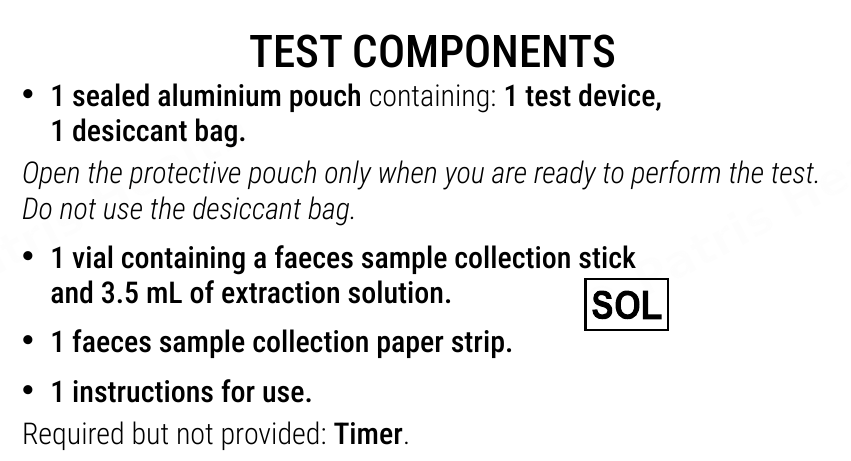
What is in the box
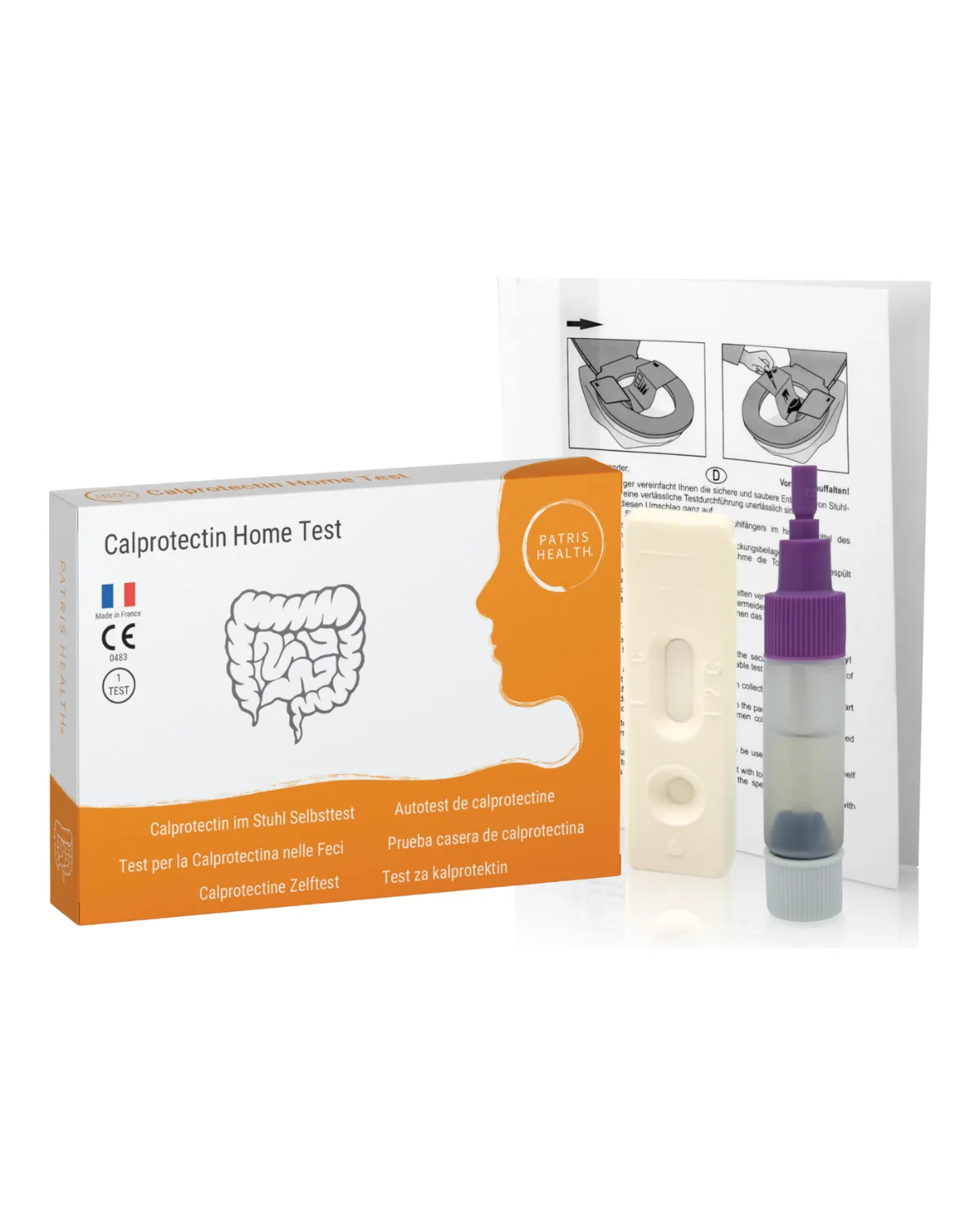
- 1 × test device in a sealed foil pouch
- 1 × collection vial with sampling stick and 3.5 mL of extraction solution
- 1 × stool collection paper strip
- 1 × instructions for use in seven languages
- 1 × desiccant bag discard it, do not use it
Everything you need is in the box except a timer. Keep the foil pouch sealed until you test.
How it works
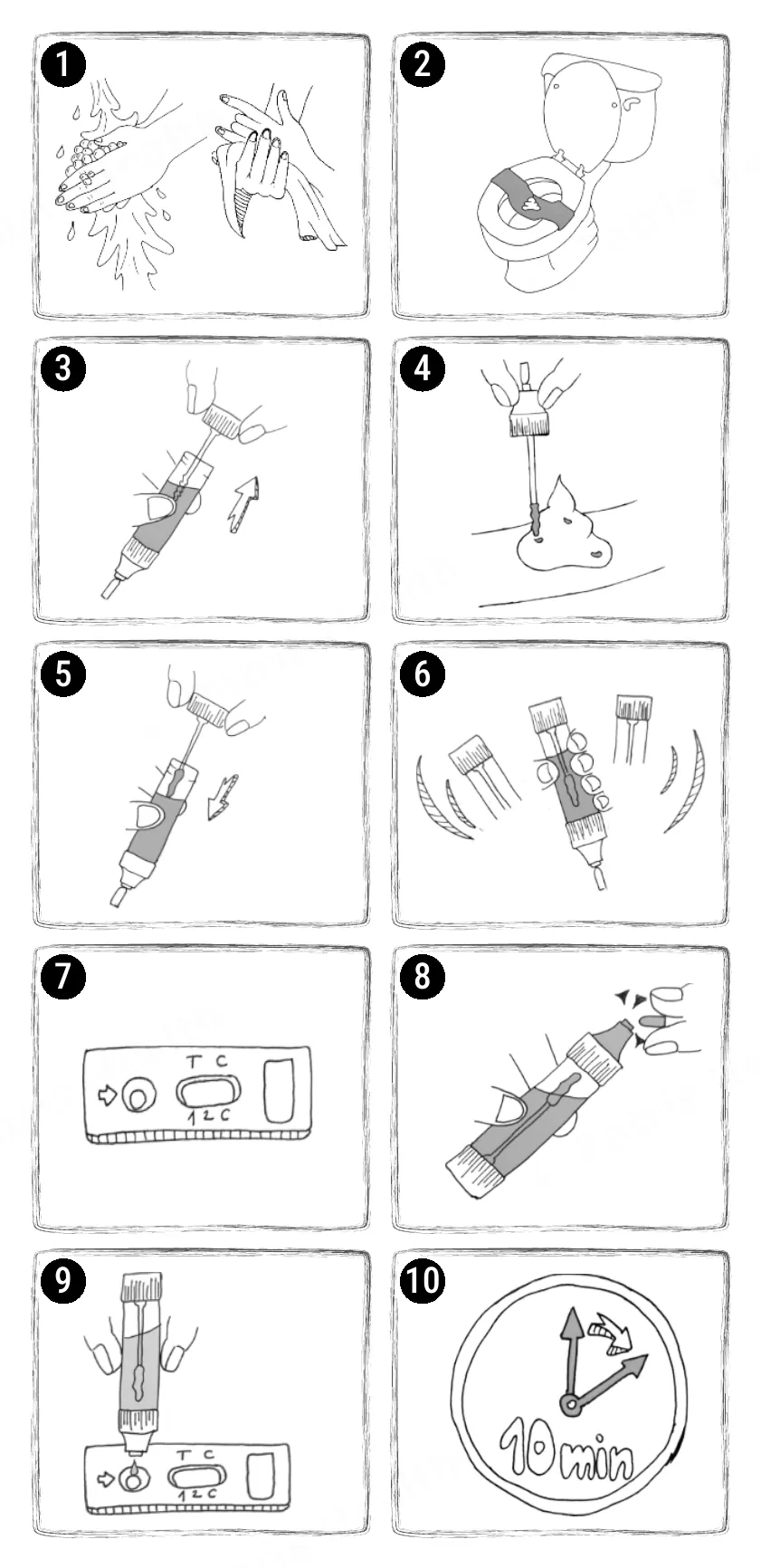
Four steps, about fifteen minutes

01
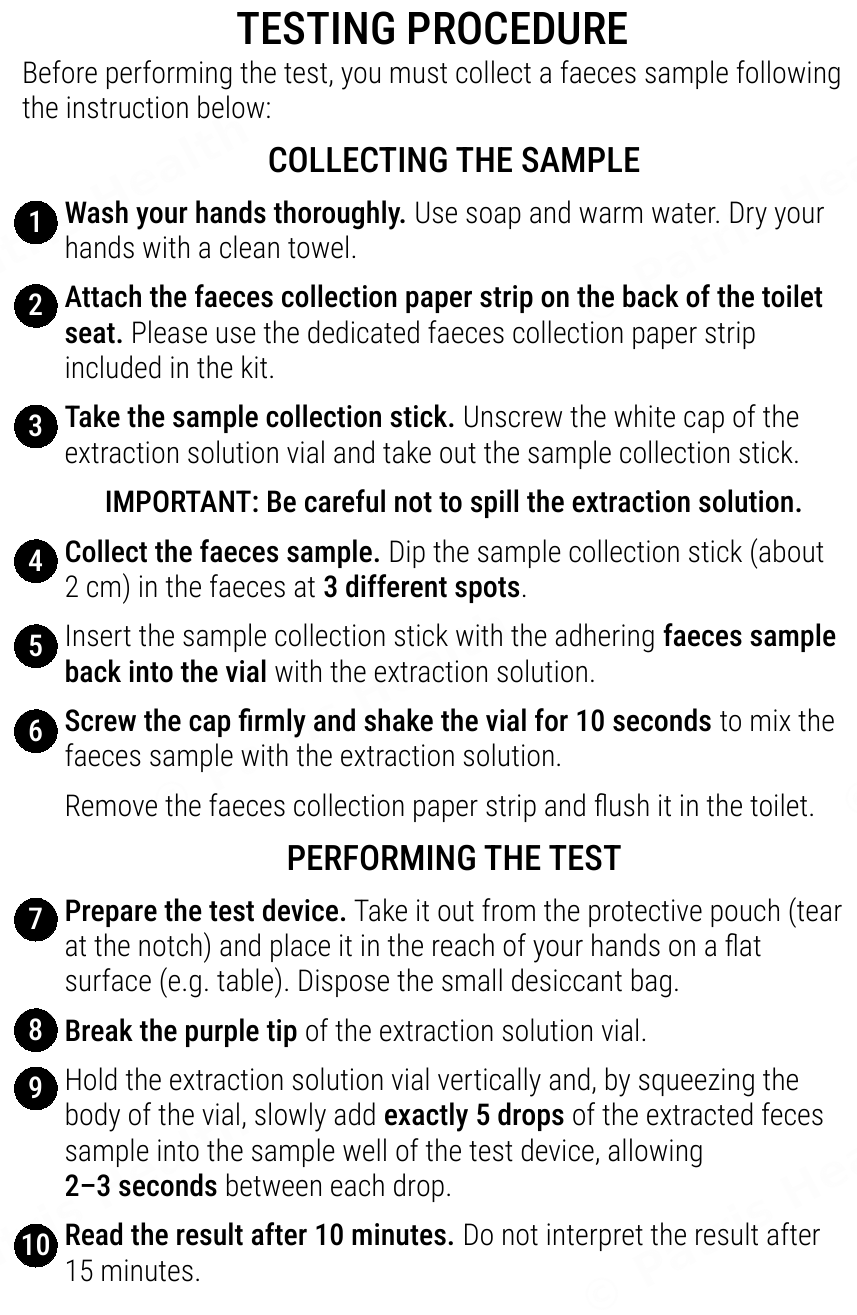
Collect a small stool sample
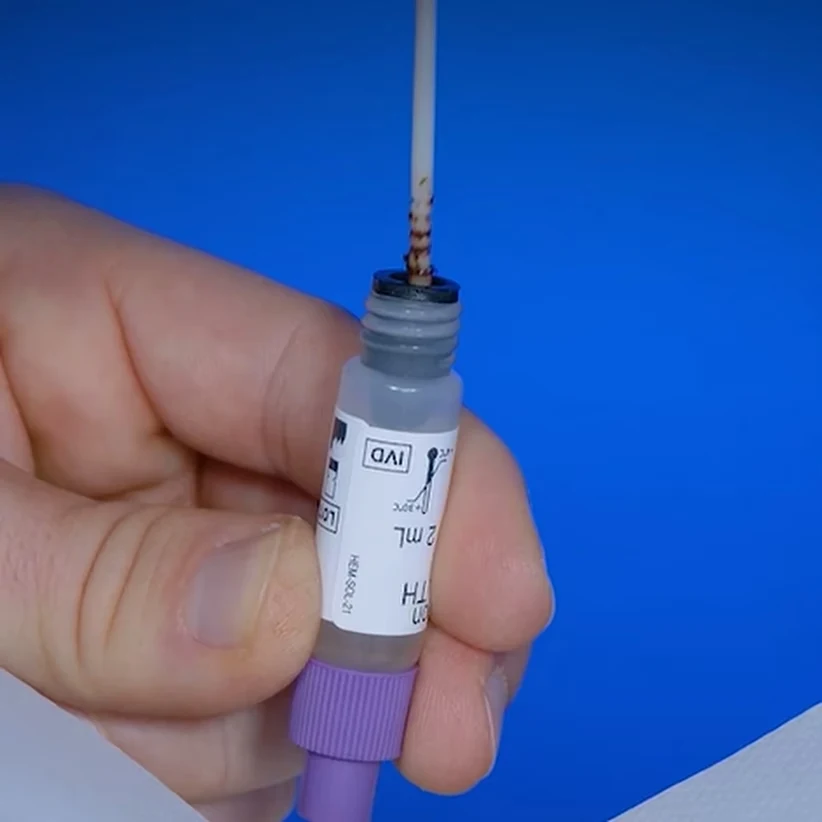
Fix the paper strip across the back of the toilet seat. Unscrew the cap of the vial without spilling the extraction solution, and dip the stick about 2 cm into the stool at three different spots.
02
Back into the vial, then shake
Put the stick back into the vial, close the cap firmly and shake for 10 seconds so that the sample mixes with the extraction solution.
03
Exactly five drops
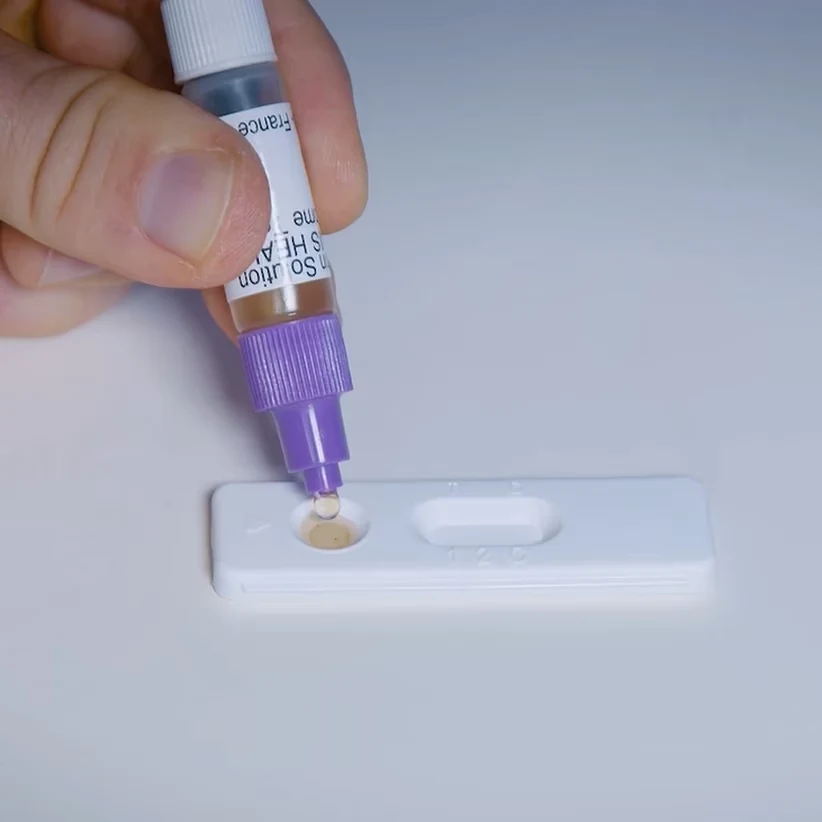
Very important: break off the purple tip, hold the vial upright and squeeze gently to add exactly five drops into the sample well, 2–3 seconds apart.
04
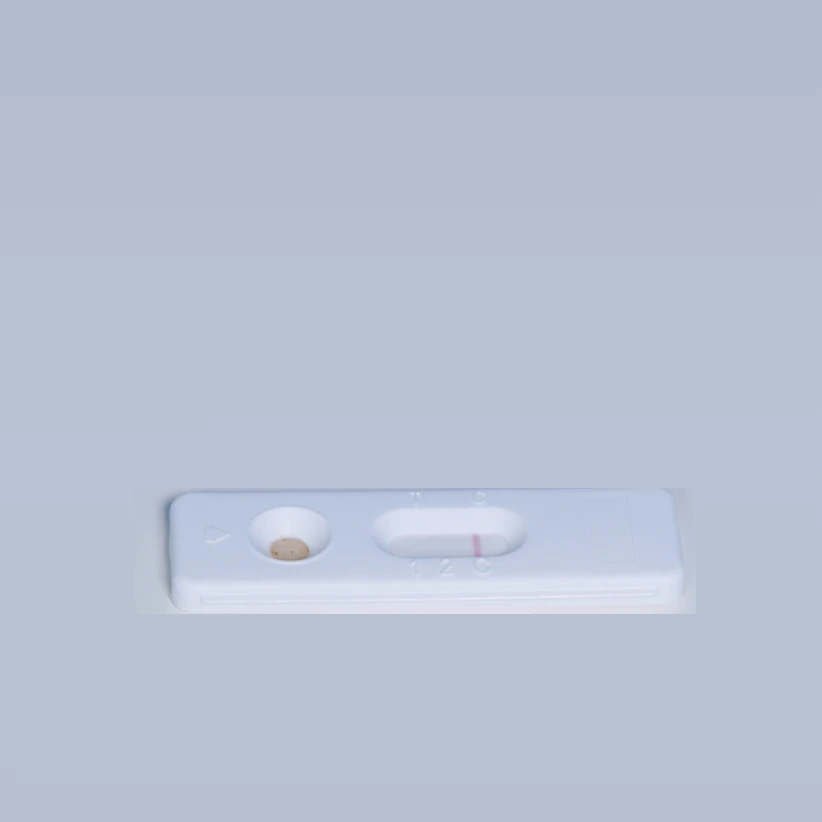
Read the result after 10 minutes
Not after 15. Set a timer.
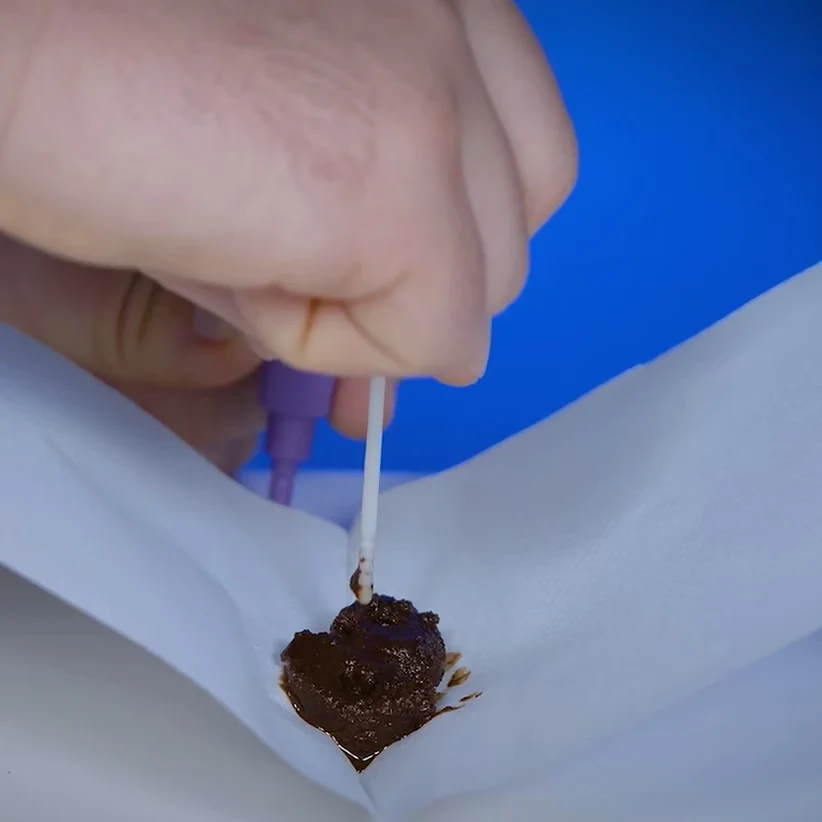
Instructions for useWatch the video demonstration
On the clock: the ten minutes, step by step
- Sample
Stick into the stool at three spots, back into the vial.
- Shake
Ten seconds, then break off the purple tip.
- Five drops
Exactly five, 2–3 seconds apart.
- Read
Read the result now, in good light.
- Stop
Do not interpret the result after 15 minutes.
Your result
How to read your calprotectin test result
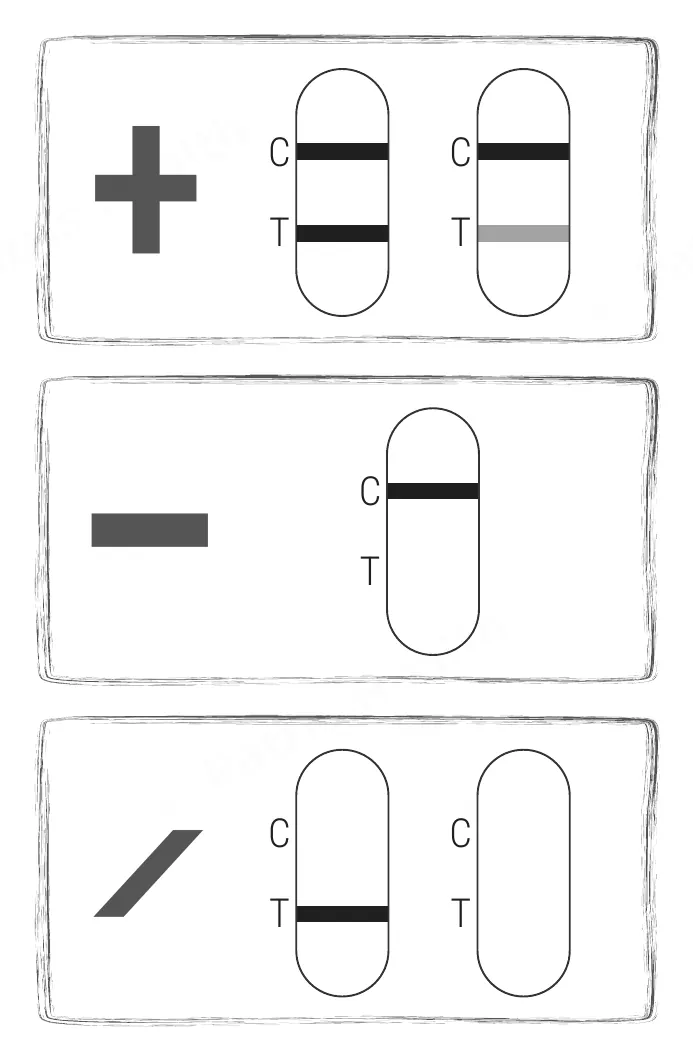
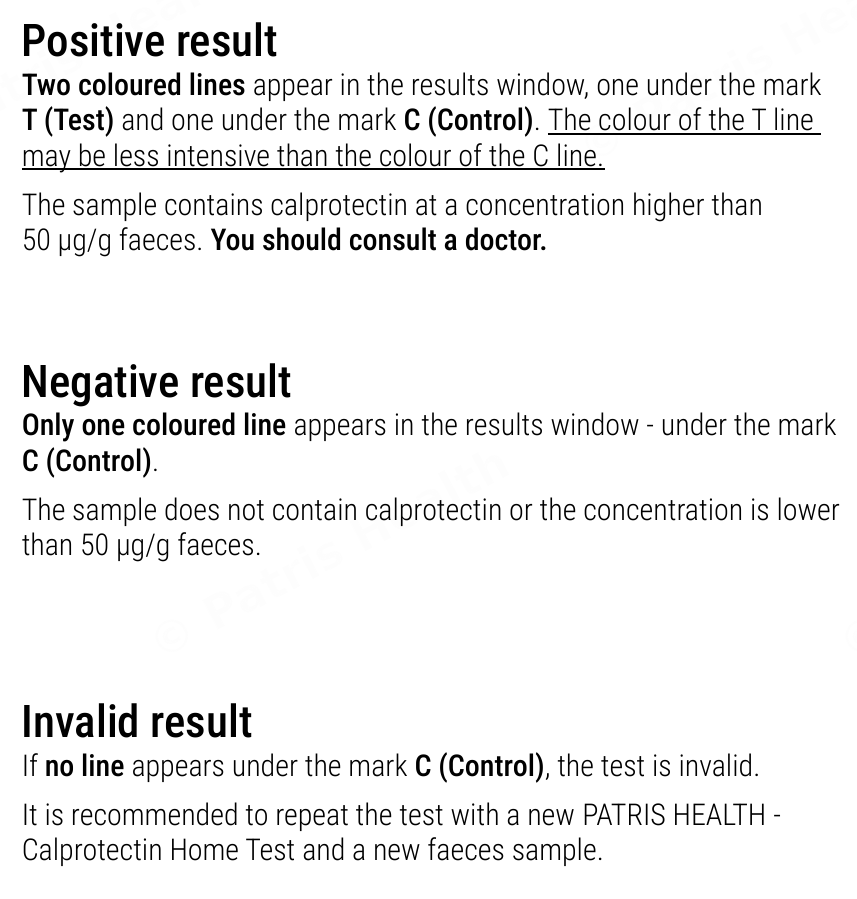
Two lines means your calprotectin is raised. One line means it is not. A faint second line still counts as a line. The pictures below show each result.
Raised positive
Both C and T lines are visible. Calprotectin is above 50 µg/g. See your doctor.
Normal negative
Only the C line is visible. Calprotectin is below 50 µg/g, or none was found.
Invalid repeat
No C line. The result cannot be read; repeat with a new test and a new sample.
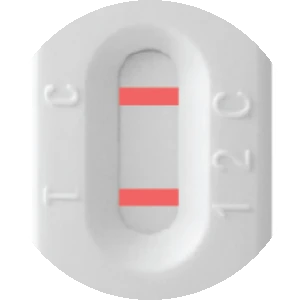
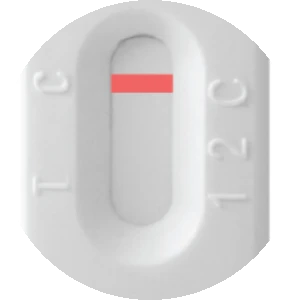
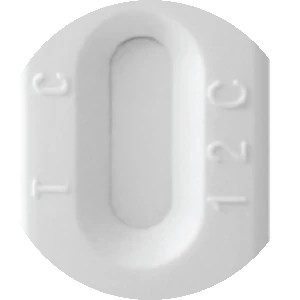
A faint T line still counts as a line — the intensity of the colour does not matter, only that the line is complete. Read at 10 minutes; do not interpret the result after 15. The pictures are for illustration purposes; the actual lines may differ in intensity.
Next step
What to do with your result
If your calprotectin is raised
See your doctor and show the result. They will decide whether further examination is needed. A raised calprotectin is a sign of inflammation, not a diagnosis.
If it is normal but the complaints stay
Inflammation in the gut is unlikely. If the symptoms continue, see your doctor.
The technology
What happens inside the test device
All of it happens on a paper strip inside the test device, in ten minutes.
- The sample moves
The drops of extract travel along the strip by capillary action. No pump, no power.
- Antibodies find calprotectin
The strip carries antibodies tagged with red gold particles. As the sample passes, they bind to the calprotectin in it.
- The T line
A second antibody fixed at T catches those complexes. Above 50 µg/g, enough gold gathers to show a red line. Below that, none.
- The C line
The excess reagent is caught at C whatever the sample holds. The C line only means that the test was performed well. No C line, no result.
It gives one answer — above or below the threshold — not a number.
Quality
Made in France, checked batch by batch
30+
years of diagnostic expertise — rapid tests made in France since 1991
- ISO 13485The international quality-management standard for organisations that design, manufacture and service medical devices
- Every batch checkedDefined checks completed before a batch is released
- Monitored after releasePerformance tracked for as long as the batch is on the market
Notified body 0483ISO 13485Made in FranceCE-marked IVD
The Patris Health promise. No valid result? Write to us and we replace the test or refund the purchase price. It applies whenever the test was performed as the instructions describe, and we do not argue about it.
Specification
Technical data for the calprotectin test
| Intended use | Qualitative immunochromatographic screening test for calprotectin in faeces, for self-testing by lay users |
|---|---|
| Analyte | Faecal calprotectin |
| Method | Lateral flow immunoassay |
| Cut-off | 50 µg/g of faeces |
| Sample | Stool, one sample taken at three spots |
| Time to result | Read at 10 minutes; do not interpret after 15 minutes |
| Agreement | 95.4 % overall agreement with a reference method (95 % CI 90.38–98.18 %) |
| Storage | 4 to 30 °C, do not freeze |
| Expiry date | Indicated on the label and the foil pouch |
| Device type | CE-marked in-vitro diagnostic medical device (IVD) for self-testing |
| Certificates | CE 0483 · ISO 13485 |
Questions
Asked before ordering
How accurate is a calprotectin test at home compared with the laboratory?+
In the evaluation study, the test agreed with the laboratory reference method in 95.4 % of cases (95 % CI 90.38–98.18 %). The difference is what you get back: the laboratory reports a calprotectin value, this test tells you whether you are above or below 50 µg/g. For a first answer that is enough; the next steps are for your doctor to decide. As with any screening test, false positive or false negative results are possible.
Is collecting the sample unpleasant?+
Less than people expect. A paper strip attached to the back of the toilet seat catches the stool, the collection stick takes a very small amount, and the strip is flushed away afterwards. Nothing has to be sent anywhere.
Can I test when I have diarrhoea?+
Not with a liquid stool. In that case, see your doctor before testing.
Which medicines affect the result?+
Regular aspirin, anti-inflammatory painkillers (NSAIDs) and proton pump inhibitors can lead to false positive results, as can being over 60. Tell your doctor about them when you show the result; do not stop a prescribed medicine in order to test.
I had a colonoscopy recently. When can I test?+
Wait several days after a colonoscopy or a bowel cleansing before using the test.
Why did I get an invalid result?+
Usually because the sample was not collected as described, because the wrong number of drops went into the well, or because the test device got wet before use. Repeat with a new test and a new sample: dip the stick at three spots, shake for 10 seconds, then add exactly five drops. Write to us and we replace the test.
How do I dispose of the test?+
All components can go in household waste. The paper strip is flushed down the toilet.
Sources
Mayo Clinic. (n.d.-a). Calprotectin fecal test. Retrieved October 4, 2026, from https://www.mayoclinic.org/tests-procedures/calprotectin-fecal-test/about/pac-20604704
Mayo Clinic. (n.d.-b). Inflammatory bowel disease (IBD): Symptoms and causes. Retrieved October 4, 2026, from https://www.mayoclinic.org/diseases-conditions/inflammatory-bowel-disease/symptoms-causes/syc-20353315
National Library of Medicine. (2024, January 9). Calprotectin stool test. MedlinePlus. https://medlineplus.gov/lab-tests/calprotectin-stool-test/
Pathirana, W. P. N. G. W., Chubb, S. A. P., Gillett, M. J., & Vasikaran, S. D. (2018). Faecal calprotectin. The Clinical Biochemist Reviews, 39(3), 77–90. https://pmc.ncbi.nlm.nih.gov/articles/PMC6370282/
Last reviewed 2 October 2026
Instructions for use
Patris Health Calprotectin Home Test
Detection of calprotectin in feces. CE-marked in-vitro diagnostic medical device for self-testing.
This is the English part of the multi-language instructions for use. The printed instructions in the box carry the same text in seven languages: English, German, French, Italian, Spanish, Dutch and Slovenian. If the version printed on the instructions in your box differs from this one, follow the instructions in your box.
Precautions and test components
Read this before you start: safety, storage and what is in the kit.
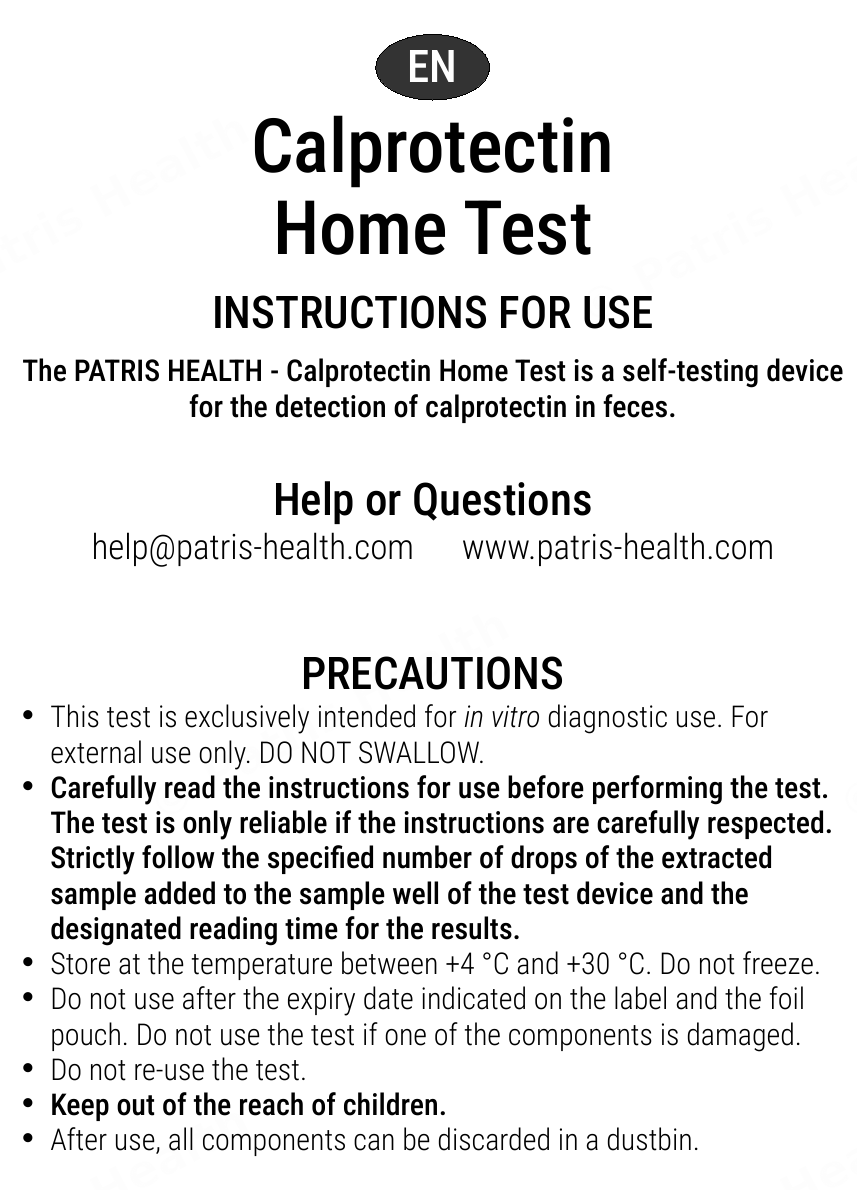
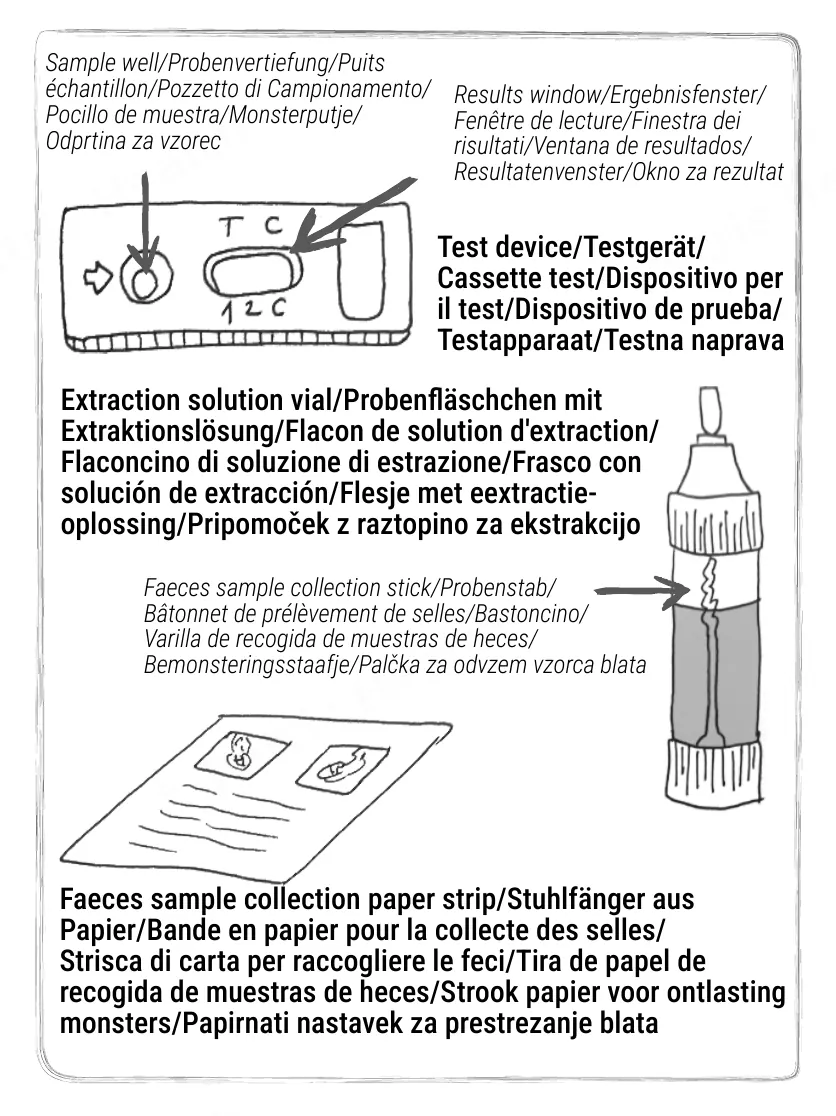
Testing procedure
Step by step, with a picture for each step.
Interpretation of the results
How to read your result, with pictures.

About the test
Background, questions and answers, accuracy.
Questions about the test: help@patris-health.com
Instructions for use CALPRV02, January 2025 · © Patris Health. Copying and reproduction are not permitted.