


Who it is for
Is this stool blood test right for you?
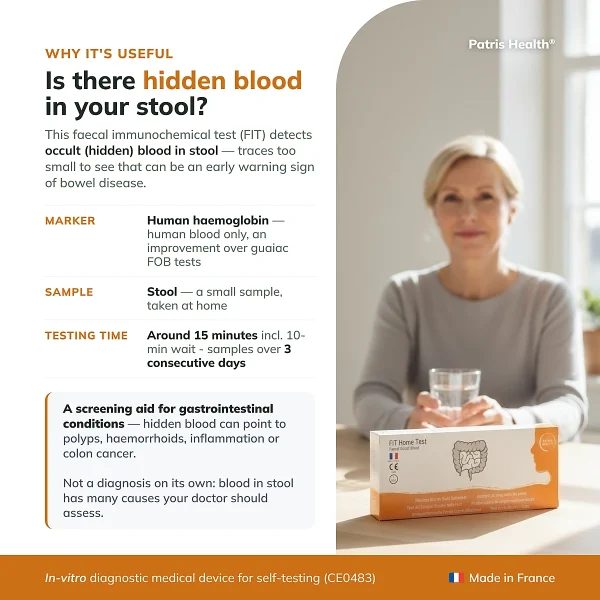
Ulcers, polyps, colitis and bowel cancer can all bleed into the gut in amounts too small to see. A FIT test at home (faecal immunochemical test) finds that hidden blood. Polyps often bleed only now and then, which is why this test collects a sample on three days in a row. It is used by:
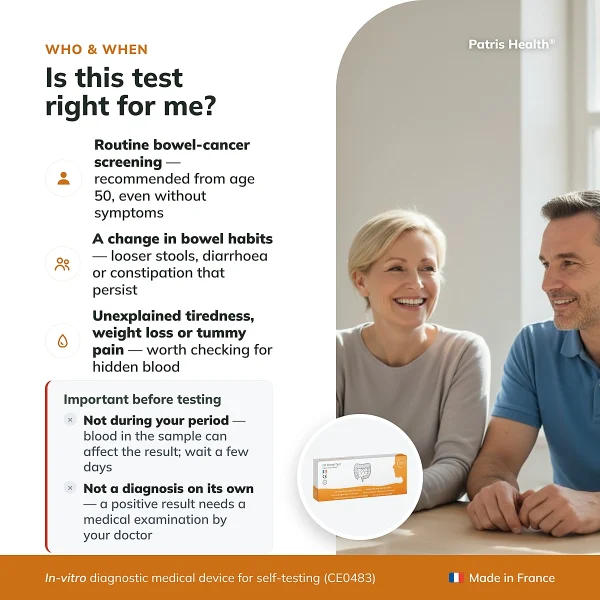
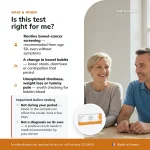
- Everyone from the age of 50, once a year
- People with bowel cancer in the family
- Anyone who wants to check at home, at any time of day
- From 50A yearly check is recommended
- Bowel cancer in the familyA reason to test regularly
- No symptomsEarly changes usually cause none
- At homeNo appointment, nothing to post
What it measures
What this FIT stool test tells you, and what it does not
It tells you
- Whether there is blood in your stool that you cannot see, above 10 ng/mL of haemoglobin
- From samples taken on three consecutive days, so that bleeding which comes and goes is not missed
- In ten minutes once the samples are collected, at home
It does not tell you
- Where the blood comes from. Ulcers, haemorrhoids, polyps and cancer can all cause it
- Whether you have cancer. Blood in the stool alone is not enough for that diagnosis
- Anything reliable during a period, or with bleeding haemorrhoids or cuts: other blood can give a false positive
- Anything reliable on anticoagulant treatment, which can also give a false positive
Contents
What is in the box
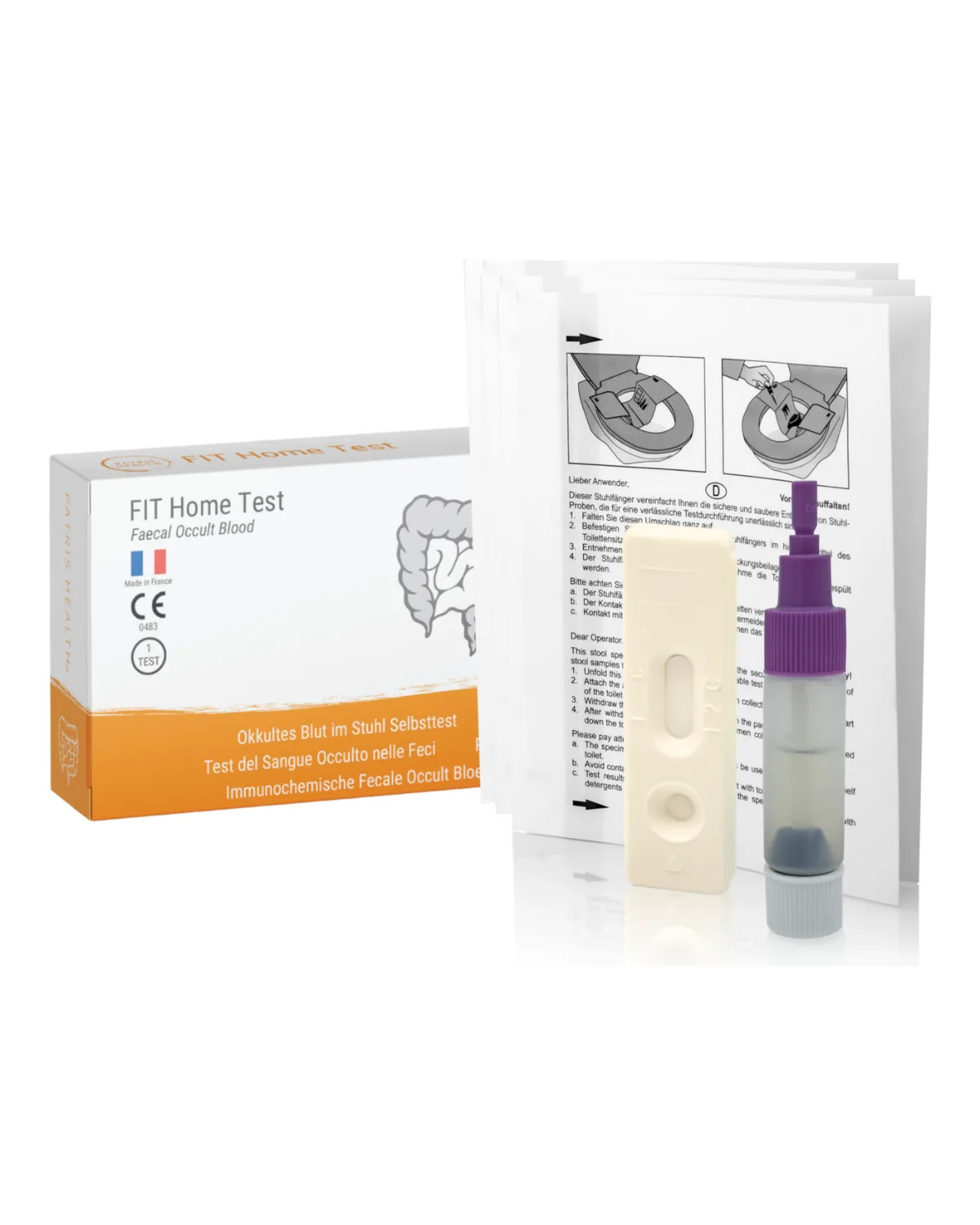
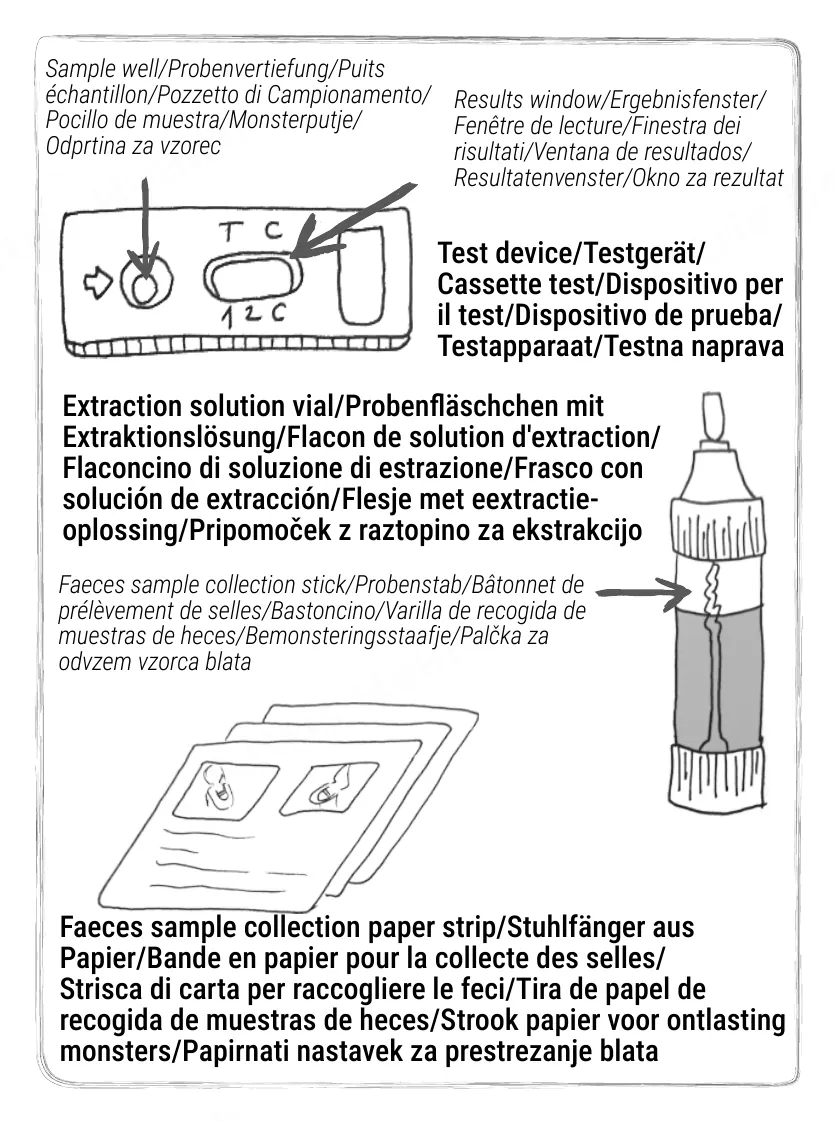
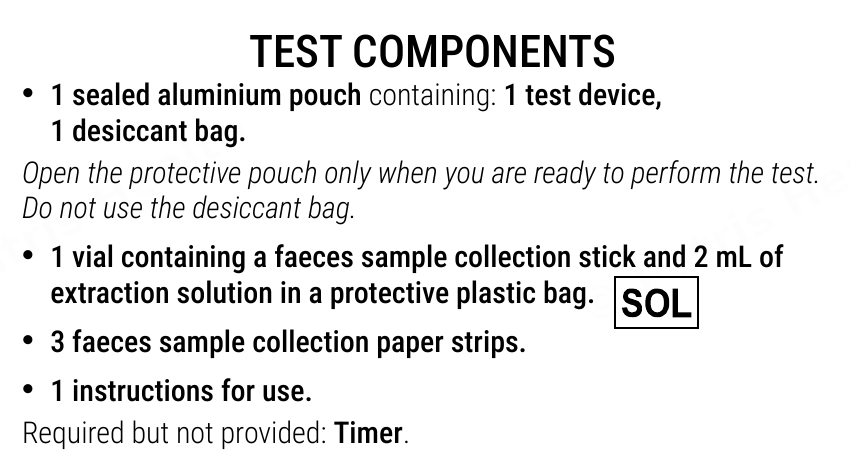
- 1 × test device in a sealed foil pouch
- 1 × collection vial with sampling stick and 2 mL of extraction solution, in a protective bag
- 3 × stool collection paper strips one for each day
- 1 × instructions for use in seven languages
- 1 × desiccant bag discard it, do not use it
Everything you need is in the box except a timer and a place in the fridge. Keep the foil pouch sealed until day three.
How it works
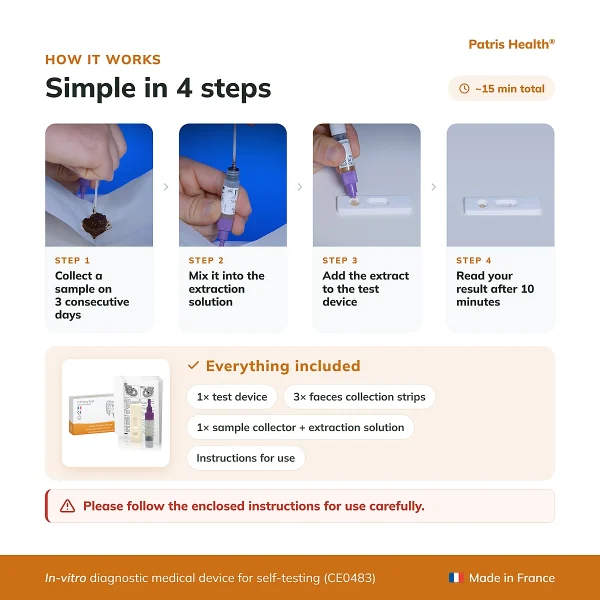
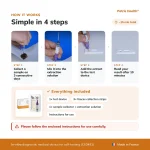
Three days of sampling, then fifteen minutes

01
Collect a sample on three days in a row
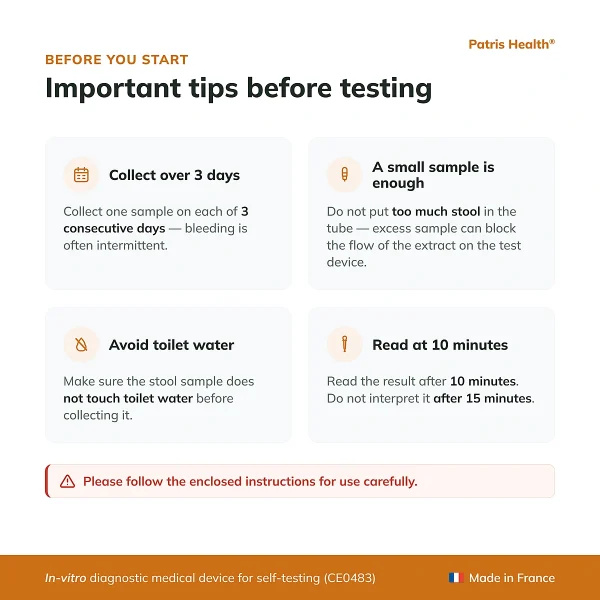
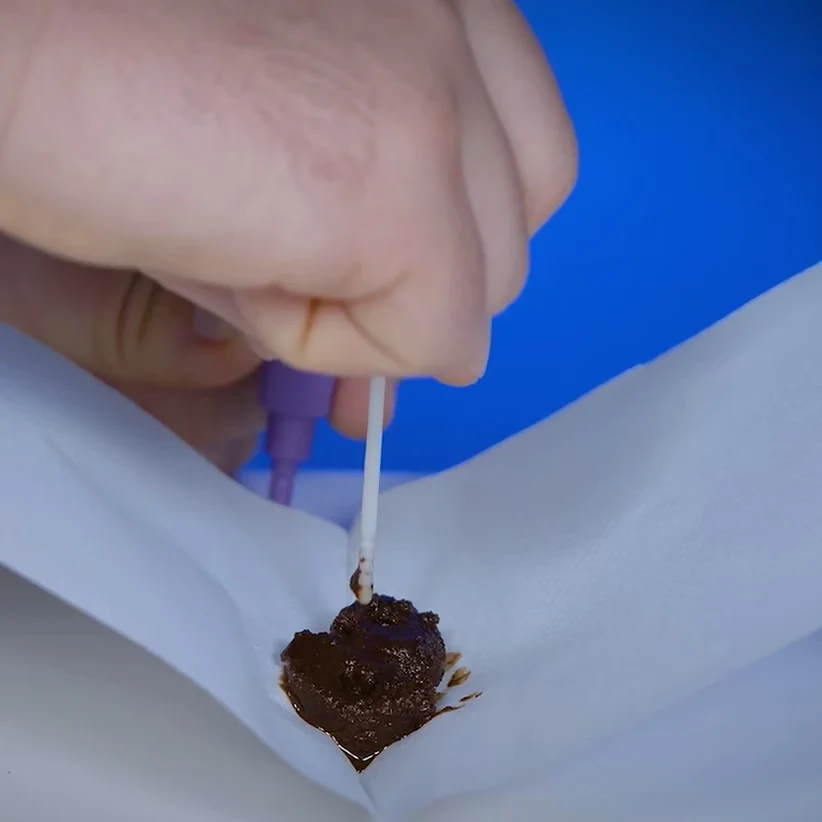
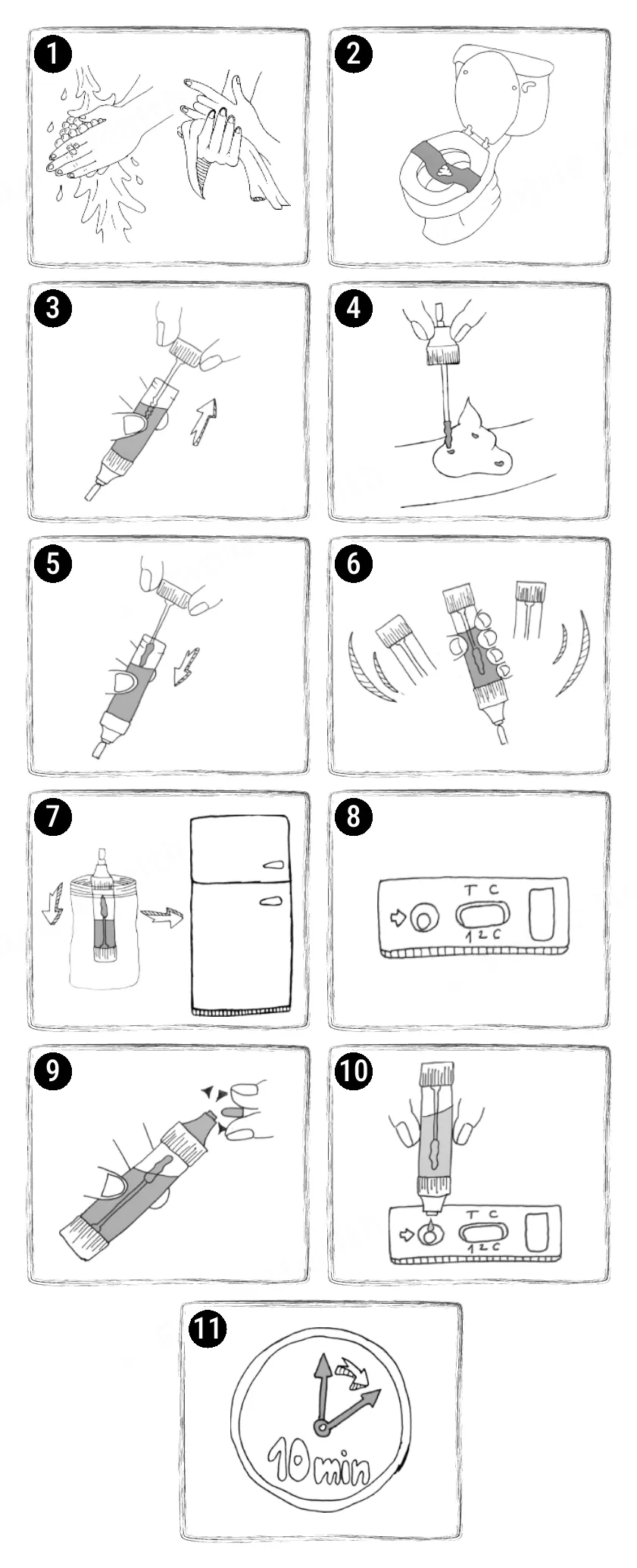
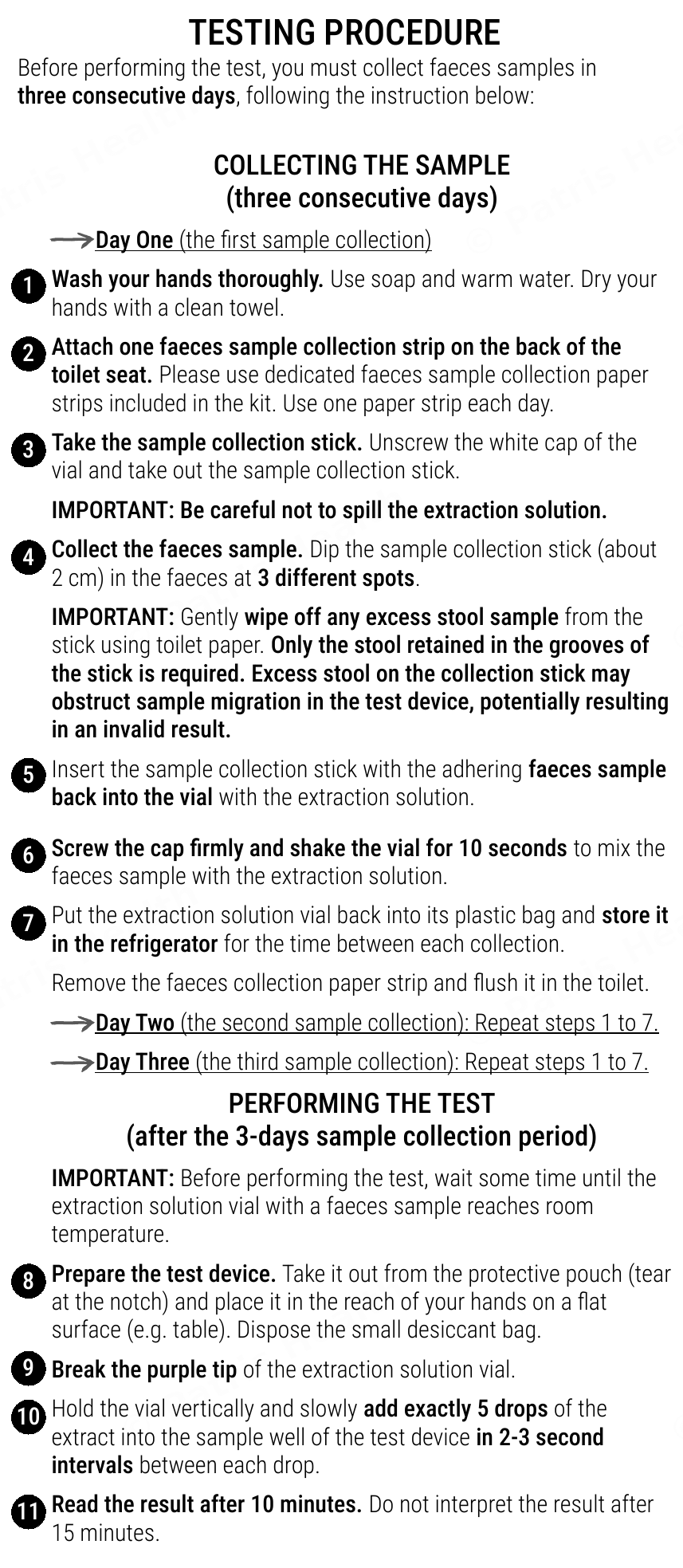
Very important: dip the stick about 2 cm into the stool at three spots, then wipe off the excess with toilet paper — only what stays in the grooves is needed. Too much stool blocks the test. Same stick, same vial, each day.
02
Back into the vial, shake, into the fridge
Put the stick back into the vial, close the cap firmly and shake for 10 seconds. Store the vial in its bag in the refrigerator until the next sample.
03
After day three: exactly five drops
Very important: let the vial reach room temperature first. Break off the purple tip, hold the vial upright and add exactly five drops into the sample well, 2–3 seconds apart.
04
Read the result after 10 minutes
Not after 15. Set a timer.
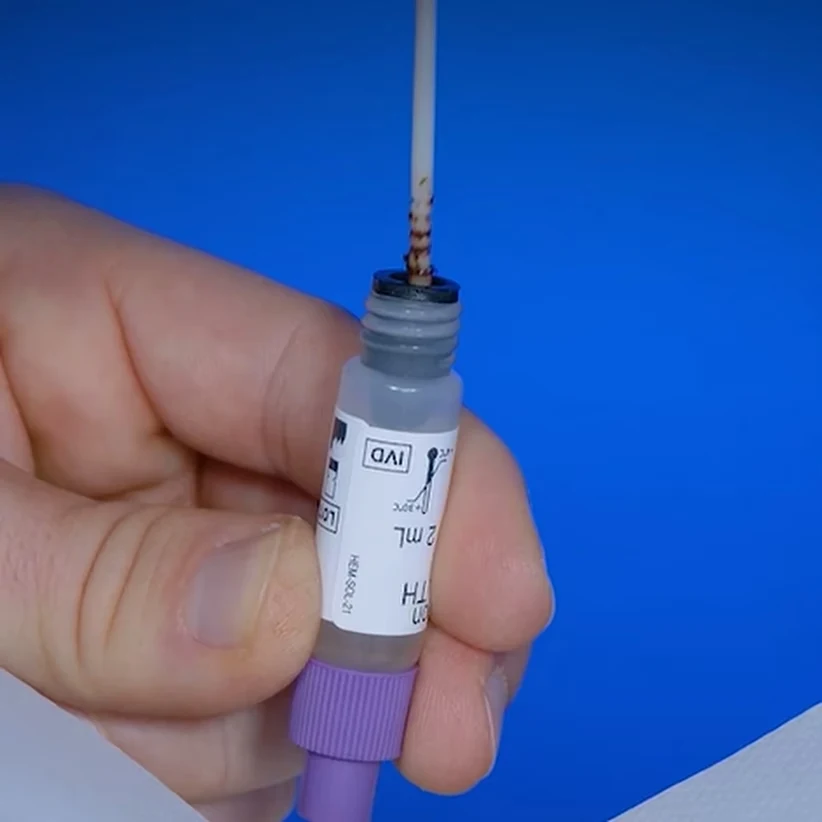
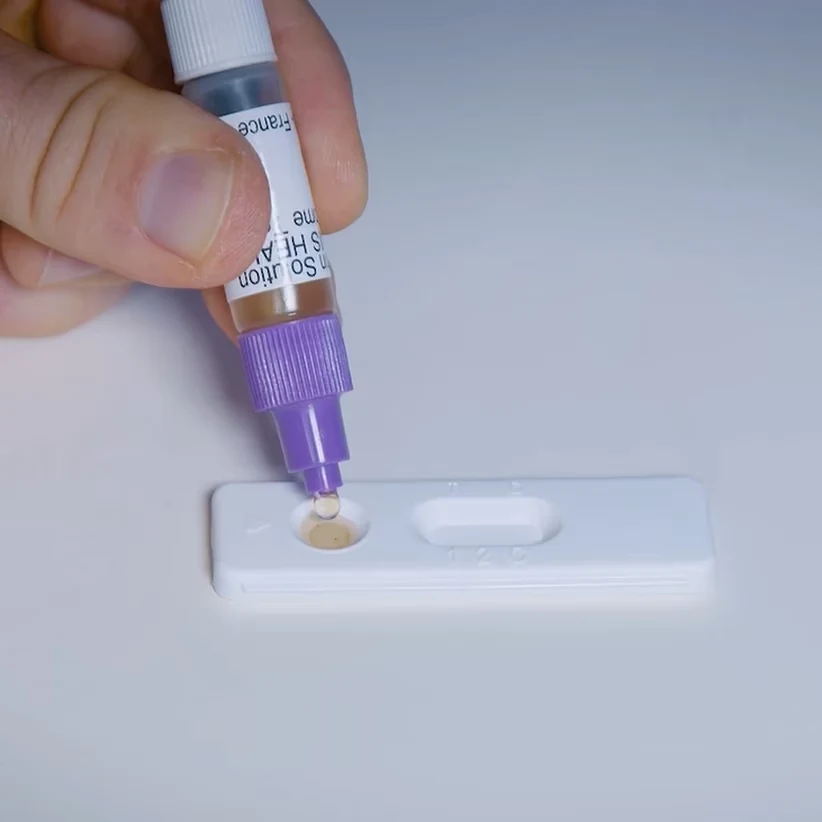
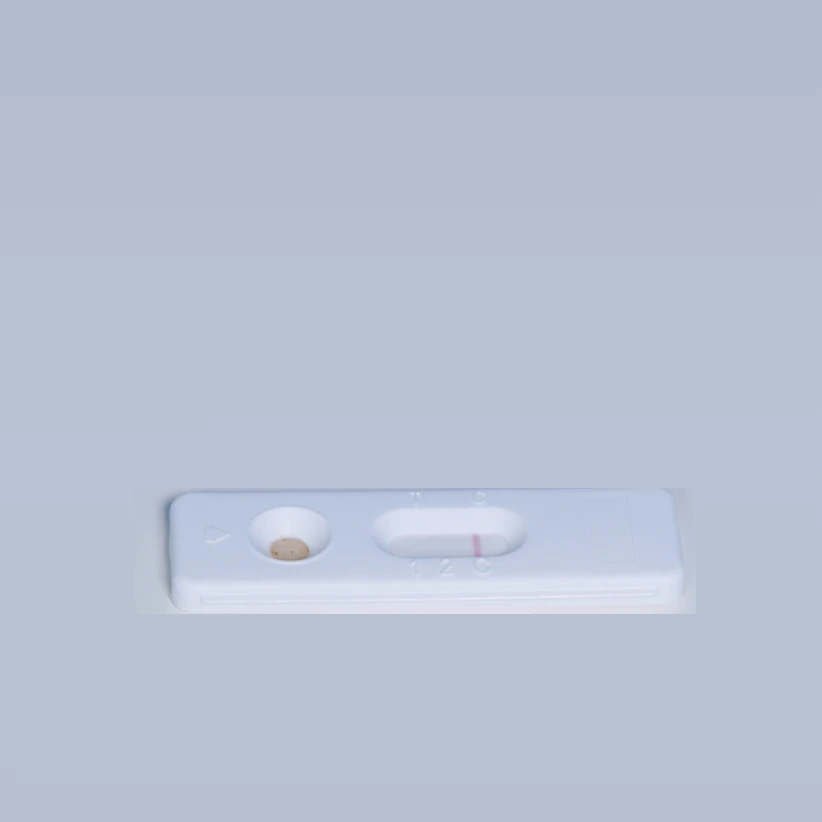
Instructions for useWatch the video demonstration
The three days, step by step
- First sample
Stick at three spots, wipe the excess, shake, into the fridge.
- Second sample
The same again, into the same vial.
- Third sample
The same again. Then let the vial warm to room temperature.
- Five drops
Break the purple tip. Exactly five drops, 2–3 seconds apart.
- Read
Read now. Do not interpret the result after 15 minutes.
Why three days
Why three days, not just one?
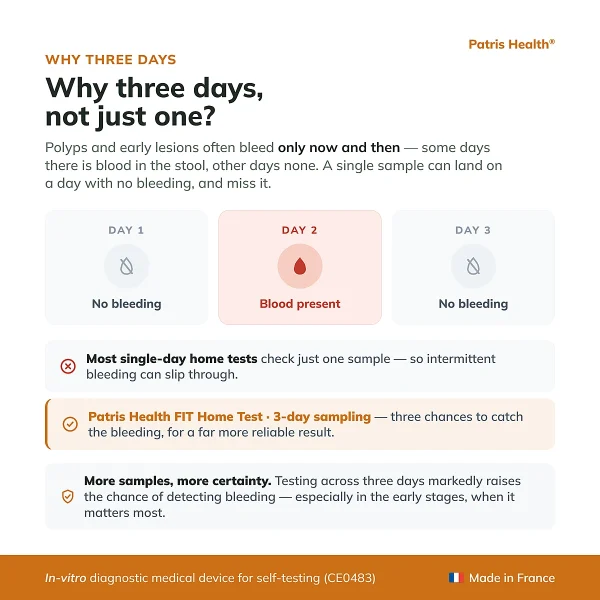
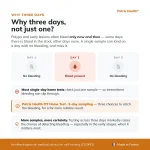
Polyps and early lesions often bleed only now and then — on some days there is blood in the stool, on other days none. A single sample can fall on a day with no bleeding and miss it.
Day 1
No bleeding
Day 2
Blood present
Day 3
No bleeding
Most single-day home tests check just one sample — so intermittent bleeding can be missed.
Patris Health FIT Home Test · 3-day sampling — three chances to catch the bleeding, collected in one vial and read in one test, for a more reliable result.
More samples, more certainty. Testing across three days raises the probability of detecting bleeding — especially in the early stages, when it matters most.
Blood in the stool alone does not diagnose any condition. A positive result is a reason to see your doctor, who decides on further examination.
Your result
How to read your stool blood test result
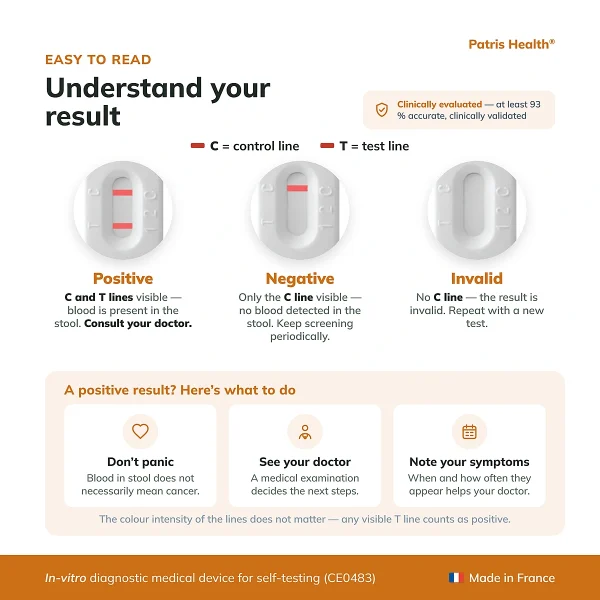
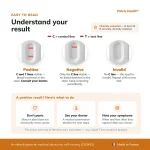
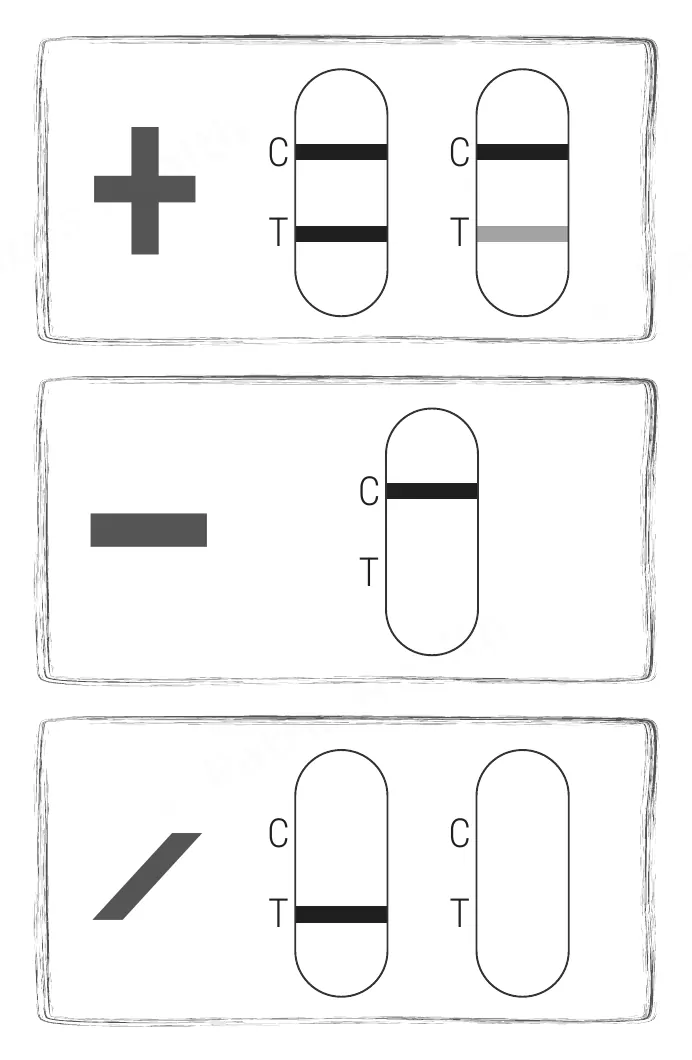
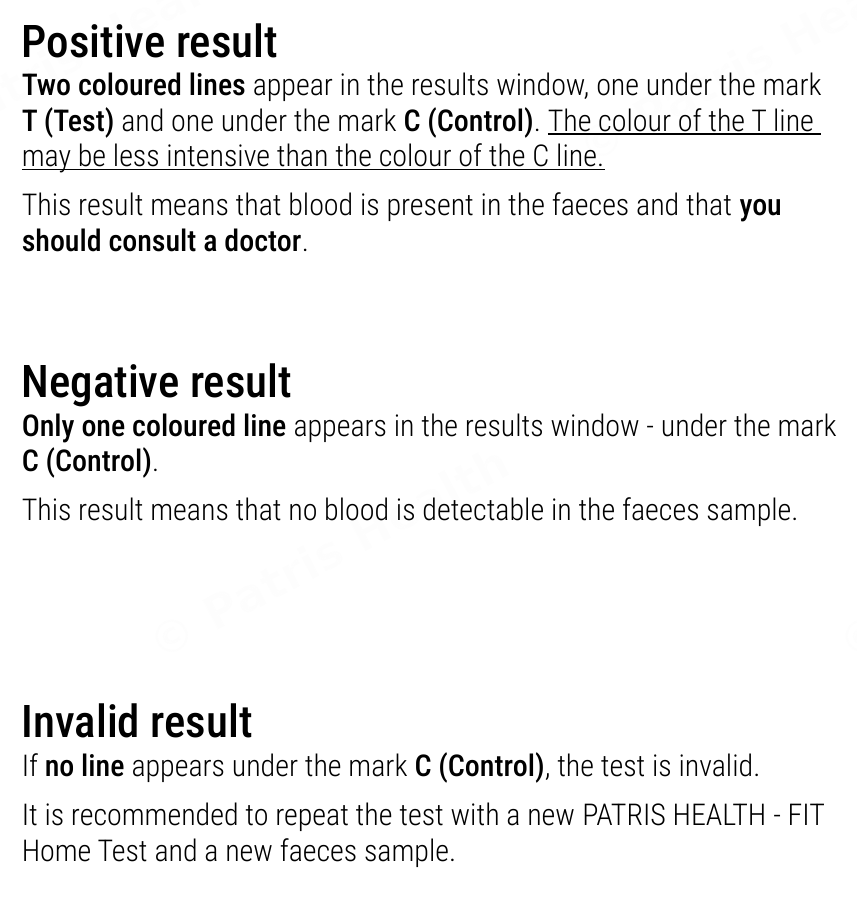
Two lines means blood was found in the stool. One line means it was not. A faint second line still counts as a line. The pictures below show each result.
Blood found positive
Both C and T lines are visible. There is blood in the stool. See your doctor.
None detected negative
Only the C line is visible. No blood was detected in the samples.
Invalid repeat
No C line. The result cannot be read; repeat with a new test and a new sample.
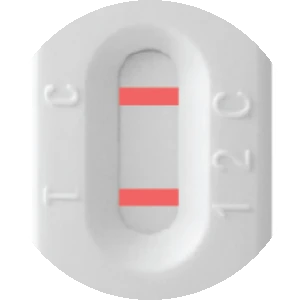
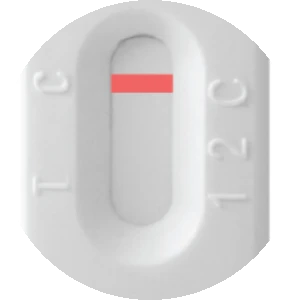
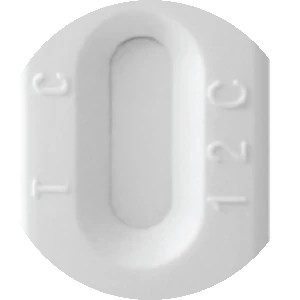
A faint T line still counts as a line — the intensity of the colour does not matter, only that the line is complete. Read at 10 minutes; do not interpret the result after 15. The pictures are for illustration purposes; the actual lines may differ in intensity.
Next step
What to do with your result
If blood was found
See your doctor and show the result. Blood in the stool has many causes, and your doctor will decide what to examine. Do not delay.
If none was detected
No hidden blood was found in these samples. From the age of 50, or with bowel cancer in the family, repeat the test every year.
The technology
What happens inside the test device
All of it happens on a paper strip inside the test device, in ten minutes.
- The sample moves
The drops of extract travel along the strip by capillary action. No pump, no power.
- Antibodies find haemoglobin
The strip carries a pair of antibodies that recognise human haemoglobin, the red pigment of blood.
- The T line
When haemoglobin is above 10 ng/mL, a coloured line appears at T. Below that, none.
- The C line
The excess reagent is caught at C whatever the sample holds. The C line only means that the test was performed well. No C line, no result.
This test has been used by professionals for more than 10 years. It gives one answer — blood detected or not detected.
Quality
Made in France, checked batch by batch
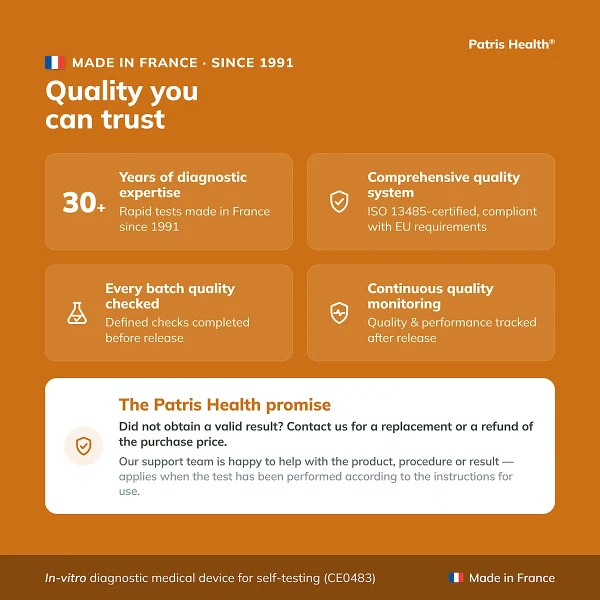
30+
years of diagnostic expertise — rapid tests made in France since 1991
- ISO 13485The international quality-management standard for organisations that design, manufacture and service medical devices
- Every batch checkedDefined checks completed before a batch is released
- Monitored after releasePerformance tracked for as long as the batch is on the market
Notified body 0483ISO 13485Made in FranceCE-marked IVD
The Patris Health promise. No valid result? Write to us and we replace the test or refund the purchase price. It applies whenever the test was performed as the instructions describe, and we do not argue about it.
Specification
Technical data for the stool blood test
| Intended use | Qualitative immunochromatographic screening test for occult blood in stool, for self-testing by lay users |
|---|---|
| Analyte | Human haemoglobin |
| Method | Lateral flow immunoassay |
| Cut-off | 10 ng/mL of haemoglobin |
| Sample | Stool, collected on three consecutive days into one vial |
| Time to result | Read at 10 minutes; do not interpret after 15 minutes |
| Agreement | 93 % overall agreement with reference methods (95 % CI 86.78–97.17 %) |
| Storage | 4 to 30 °C, do not freeze |
| Expiry date | Indicated on the label and the foil pouch |
| Device type | CE-marked in-vitro diagnostic medical device (IVD) for self-testing |
| Certificates | CE 0483 · ISO 13485 |
Questions
Asked before ordering
How accurate is a stool blood test at home compared with the laboratory?+
In the evaluation studies, the test agreed with reference methods in 93 % of cases (95 % CI 86.78–97.17 %). It is a faecal immunochemical test, a method professionals have used for more than ten years; you read it yourself, as blood found or not found. As with any screening test, false positive or false negative results are possible.
Why do I have to collect on three days?+
Polyps and other lesions often bleed only from time to time. One sample can miss a bleed; three consecutive days make it more likely to be caught.
Is collecting the sample unpleasant?+
Less than people expect. A paper strip attached to the back of the toilet seat catches the stool, the collection stick takes a very small amount, and the strip is flushed away afterwards. Nothing has to be sent anywhere.
Can I test during my period?+
No. Menstrual blood gives a false positive result. Wait until your period is over.
I take blood thinners. Can I use the test?+
Anticoagulant treatment can lead to false positive results. Tell your doctor about it when you show the result; do not stop a prescribed medicine in order to test.
Does a positive result mean cancer?+
No. It means blood was found, which also happens with haemorrhoids, ulcers, polyps and inflammation. It does mean you should see your doctor.
Why did I get an invalid result?+
Usually because too much stool was on the stick, which blocks the strip, or because the wrong number of drops went into the well. Take only what stays in the grooves of the stick, and add exactly five drops.
How do I dispose of the test?+
All components can go in household waste. The paper strip is flushed down the toilet.
Sources
Goede, S. L., van Roon, A. H. C., Reijerink, J. C. I. Y., van Vuuren, A. J., Lansdorp-Vogelaar, I., Habbema, J. D. F., Kuipers, E. J., van Leerdam, M. E., & van Ballegooijen, M. (2013). Cost-effectiveness of one versus two sample faecal immunochemical testing for colorectal cancer screening. Gut, 62(5), 727–734. https://doi.org/10.1136/gutjnl-2011-301917
National Cancer Institute. (2024, October 29). Screening tests to detect colorectal cancer and polyps. https://www.cancer.gov/types/colorectal/screening-fact-sheet
National Health Service. (2023, July 28). Bowel polyps. https://www.nhs.uk/conditions/bowel-polyps/
National Library of Medicine. (2024, November 25). Fecal occult blood test (FOBT). MedlinePlus. https://medlineplus.gov/lab-tests/fecal-occult-blood-test-fobt/
Last reviewed 2 October 2026
Instructions for use
Patris Health FIT Home Test
Detection of occult blood in stool. CE-marked in-vitro diagnostic medical device for self-testing.
This is the English part of the multi-language instructions for use. The printed instructions in the box carry the same text in seven languages: English, German, French, Italian, Spanish, Dutch and Slovenian. If the version printed on the instructions in your box differs from this one, follow the instructions in your box.
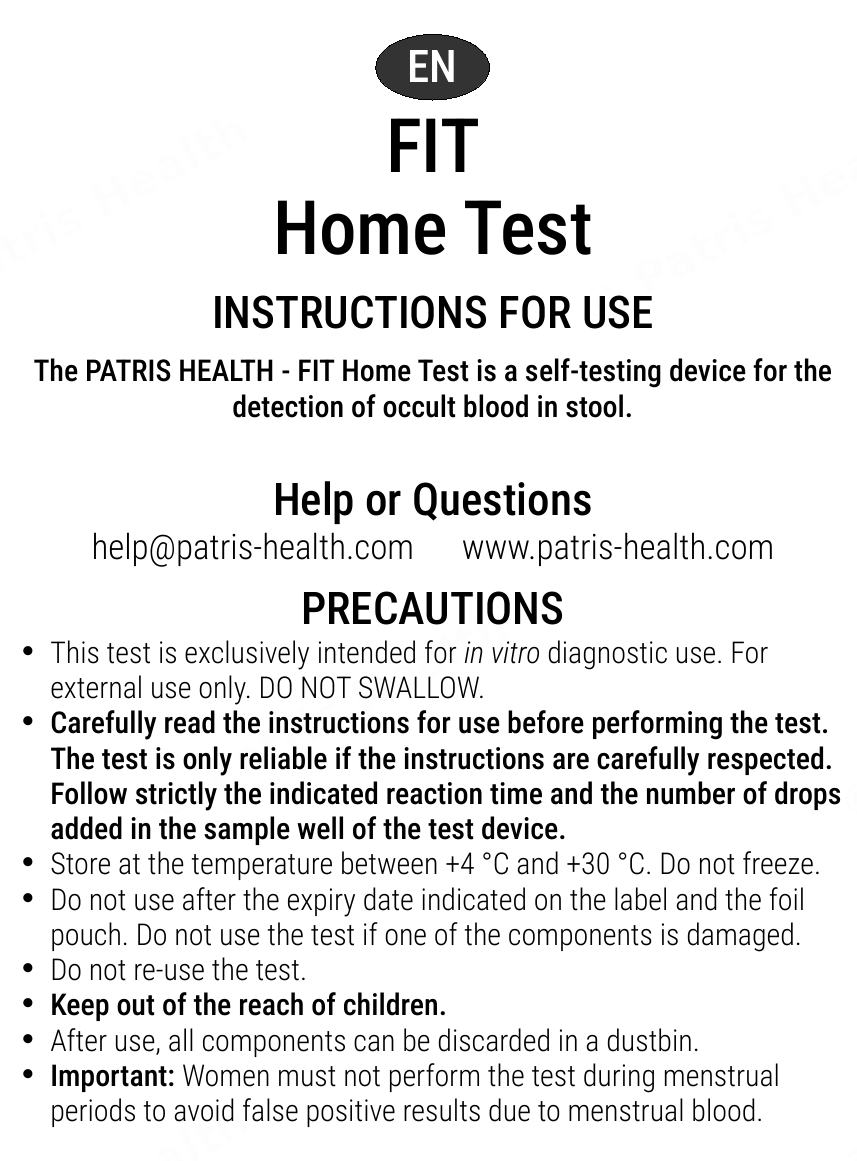
Precautions and test components
Read this before you start: safety, storage and what is in the kit.
Testing procedure
Step by step, with a picture for each step.
Interpretation of the results
How to read your result, with pictures.

About the test
Background, questions and answers, accuracy.
Questions about the test: help@patris-health.com
Instructions for use FITV02, January 2025 · © Patris Health. Copying and reproduction are not permitted.