





Who it is for
Is this kidney test right for you?
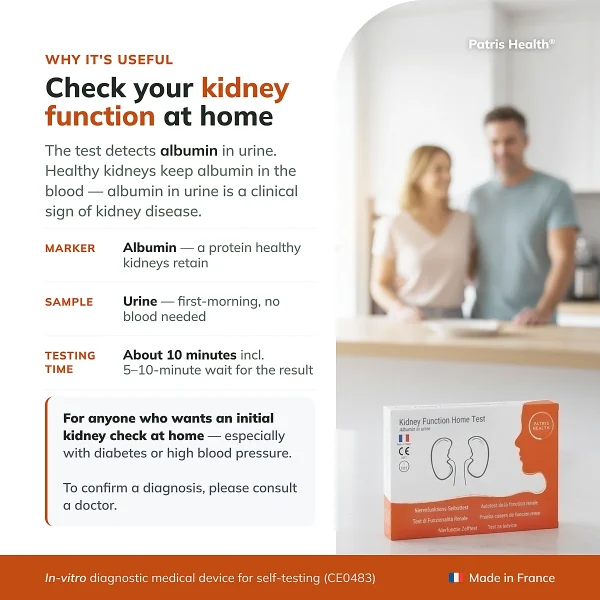
Healthy kidneys filter the blood and hold back large proteins such as albumin. When the filter starts to leak, albumin appears in the urine. This kidney test at home checks for it in ten minutes. It is used by people who:
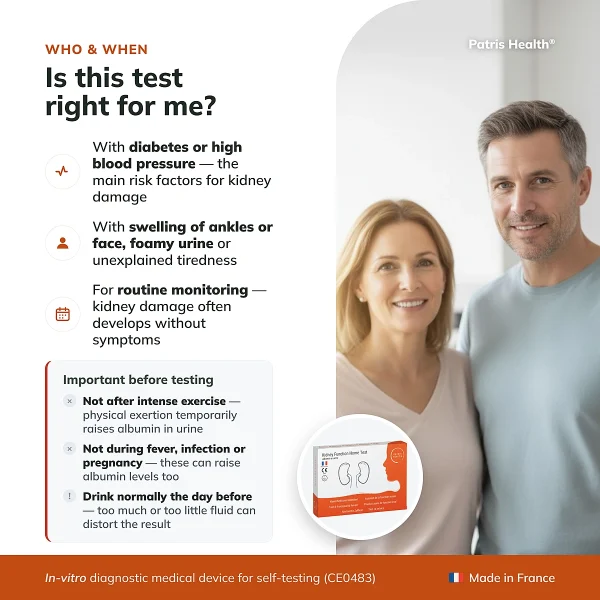
- Have diabetes
- Have high blood pressure
- Have raised blood sugar or blood fats
- Want to check their kidneys from time to time
Why check from time to time. Diabetes, high blood pressure and raised blood sugar or blood fats all promote the loss of albumin in the urine.
- DiabetesA history of diabetes promotes albumin loss
- High blood pressureHypertension promotes albumin loss
- Raised triglyceridesBlood fats promote albumin loss
- A regular checkFollow the result over time
What it measures
What this kidney function test tells you, and what it does not
It tells you
- Which of three ranges your urine albumin is in: below 10, 10 to 20, or above 20 mg/L
- Above 20 mg/L (WHO reference) is a sign that the kidney filter is letting protein through
- From first-morning urine, in ten minutes, at home
It does not tell you
- Why albumin is in the urine. That needs a doctor
- A diagnosis from one result. A positive can be temporary, so the test is repeated a few days later first
- Anything reliable after intense exercise, with a fever or a severe infection, or in pregnancy: all of these raise urine albumin
- Anything reliable if you drank far more or far less than usual the day before
Contents
What is in the box
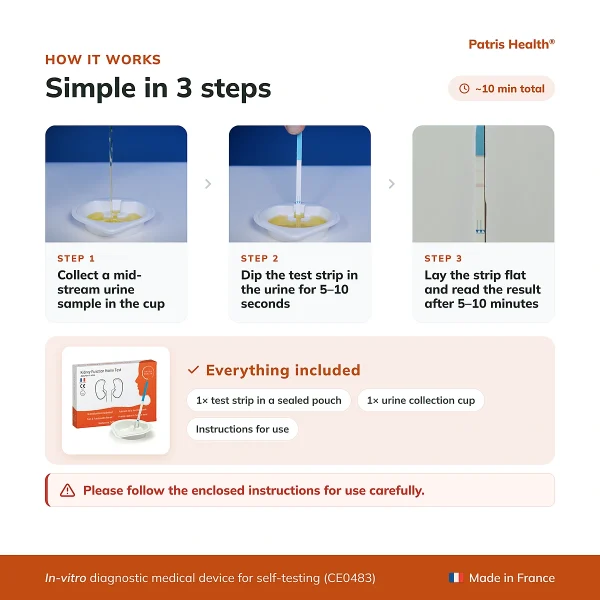
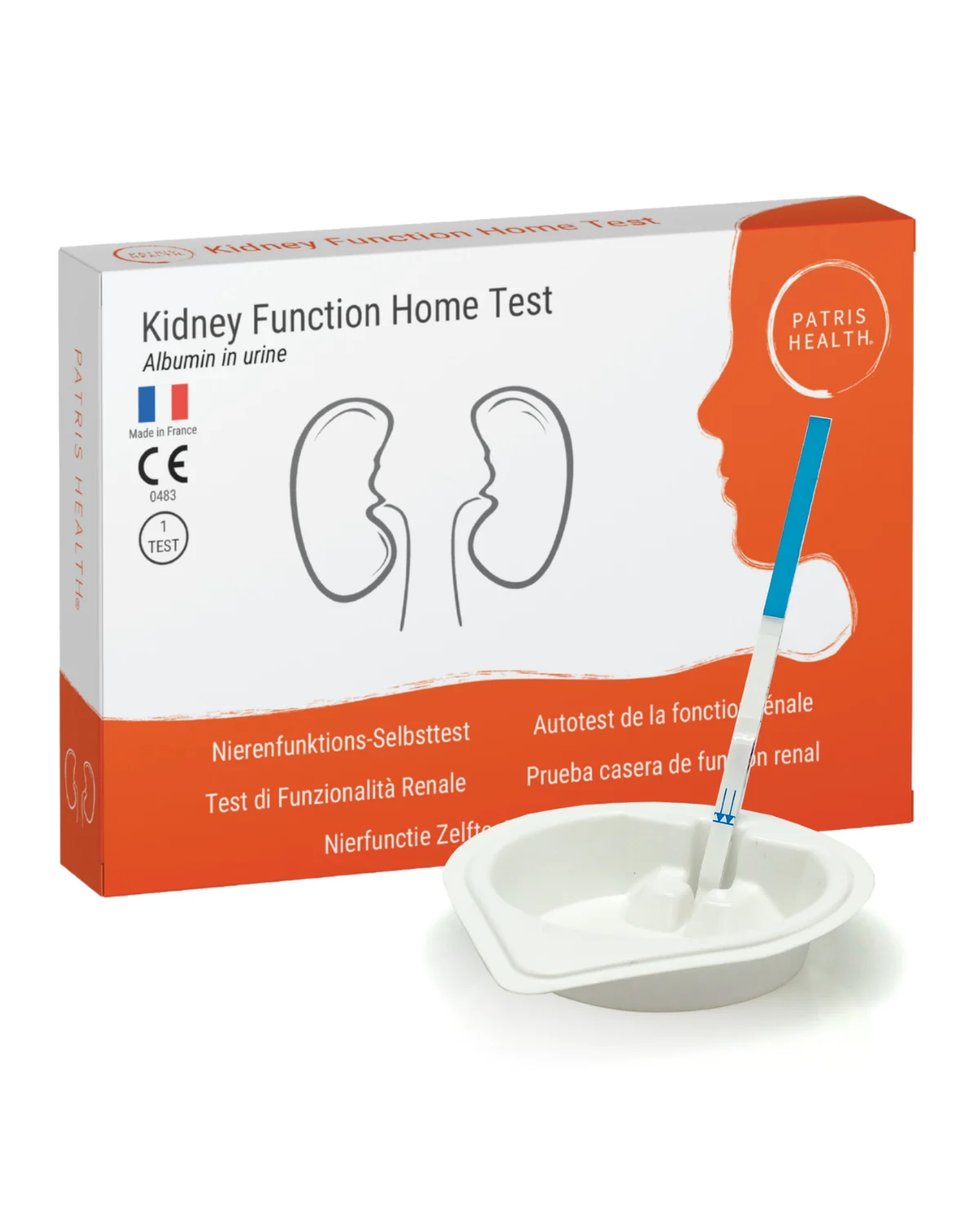
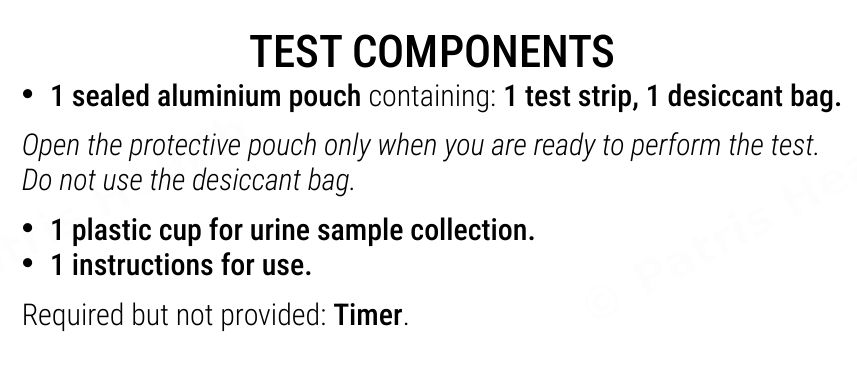
- 1 × test strip in a sealed foil pouch
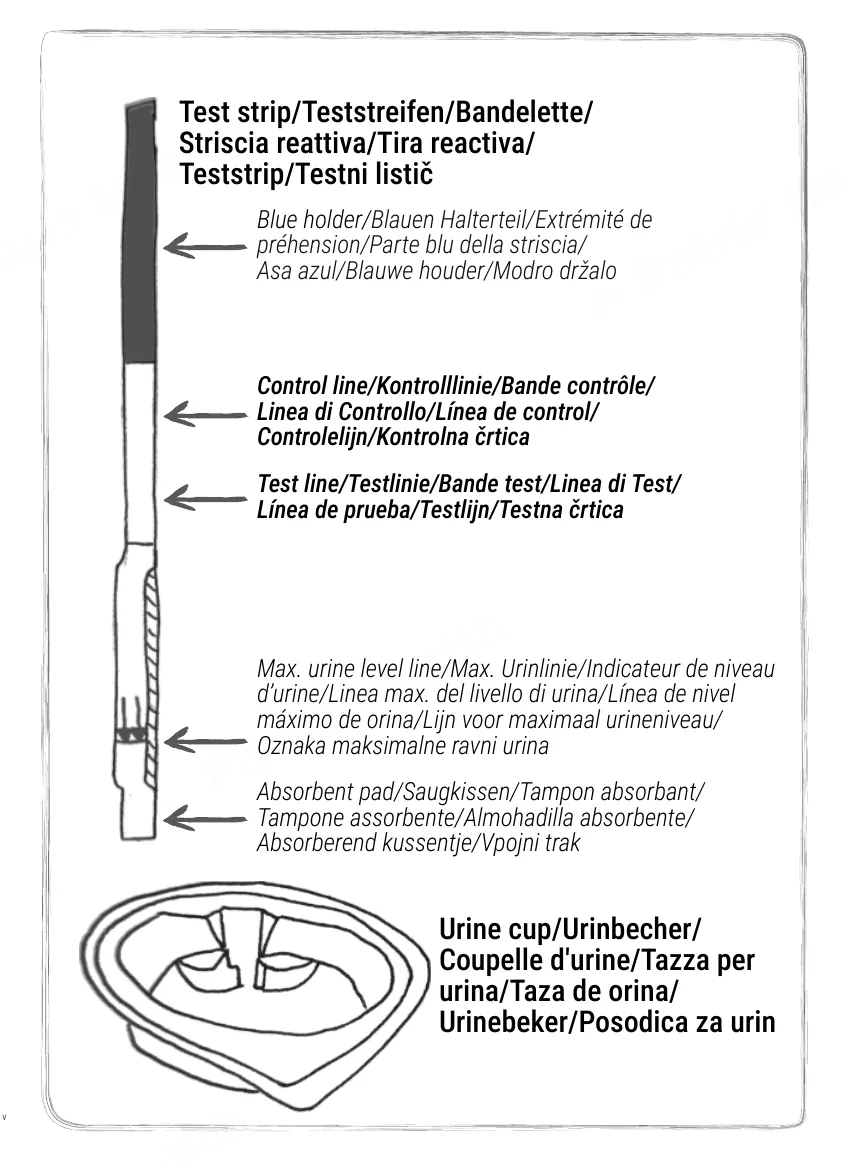
- 1 × urine cup with a notch that holds the test strip
- 1 × instructions for use in seven languages
- 1 × desiccant bag discard it, do not use it
Everything you need is in the box except a timer. Keep the foil pouch sealed until you test. No finger prick, no blood.
How it works
Three steps, about ten minutes

01
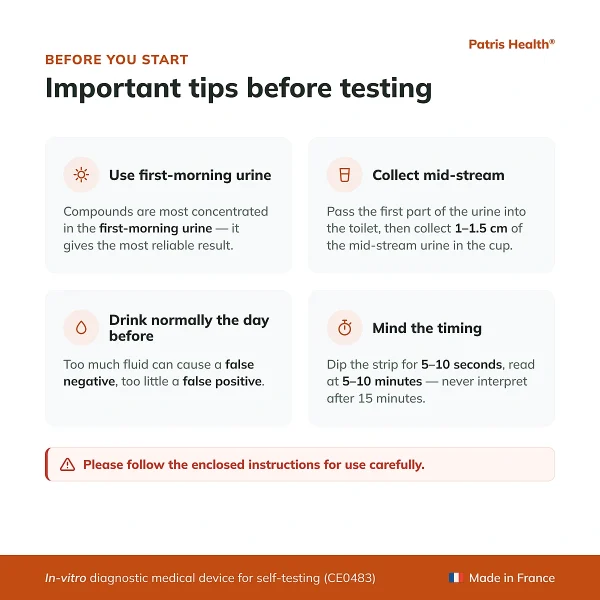
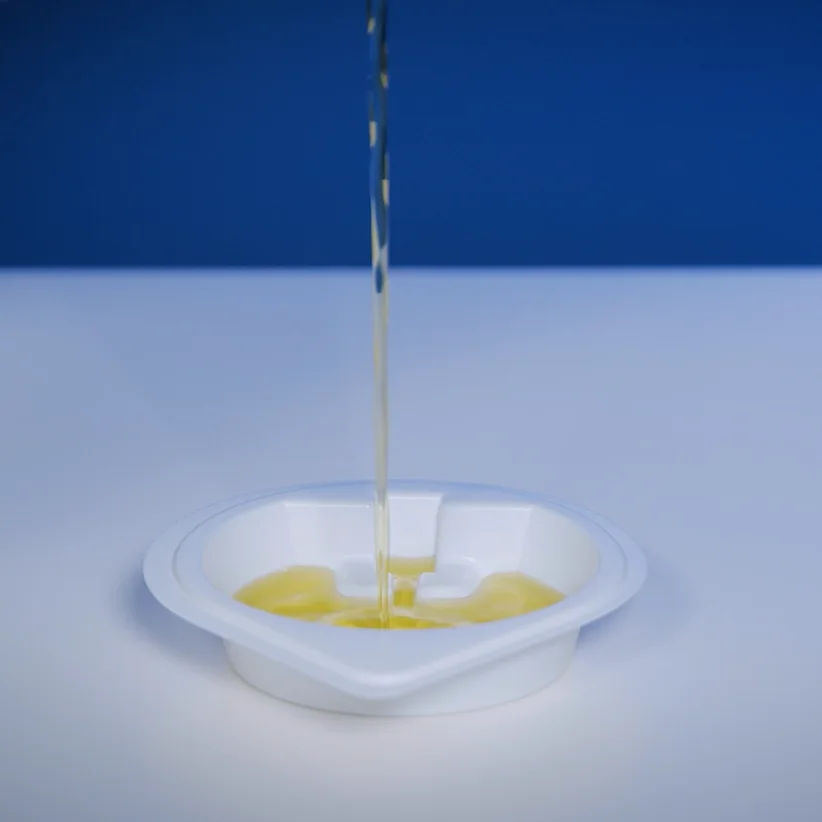
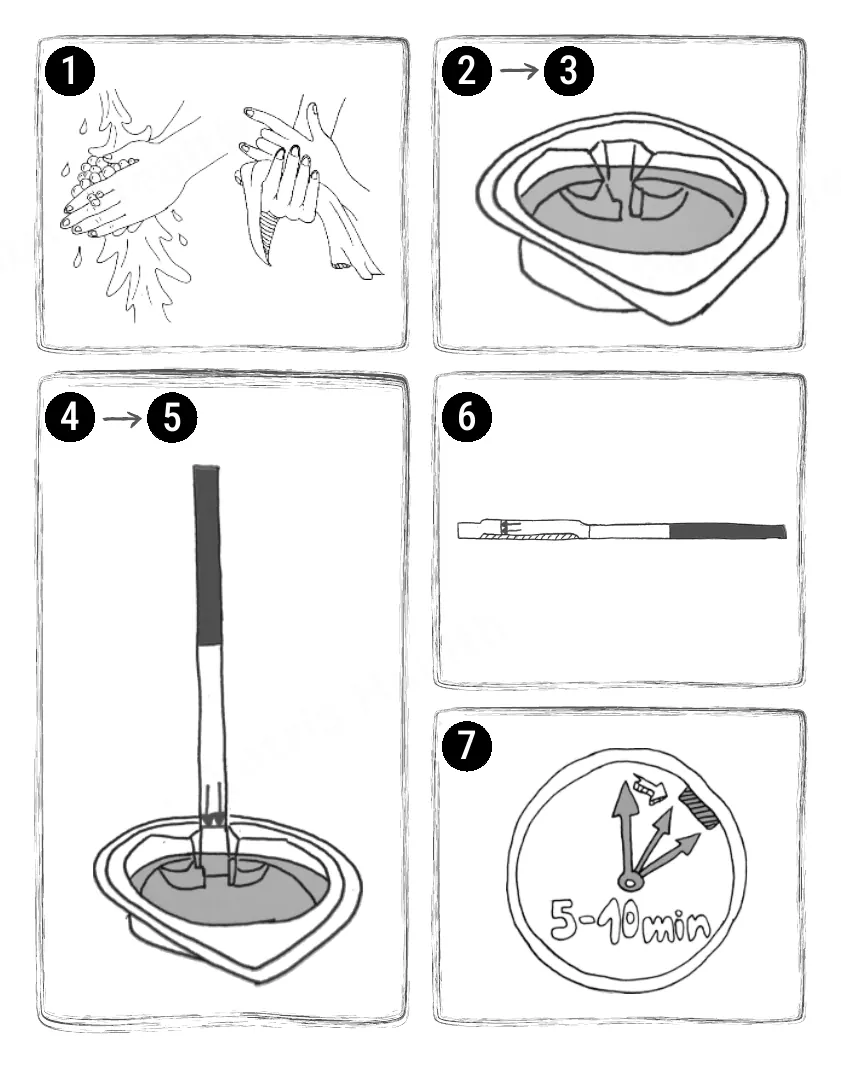
Collect first-morning urine in the cup
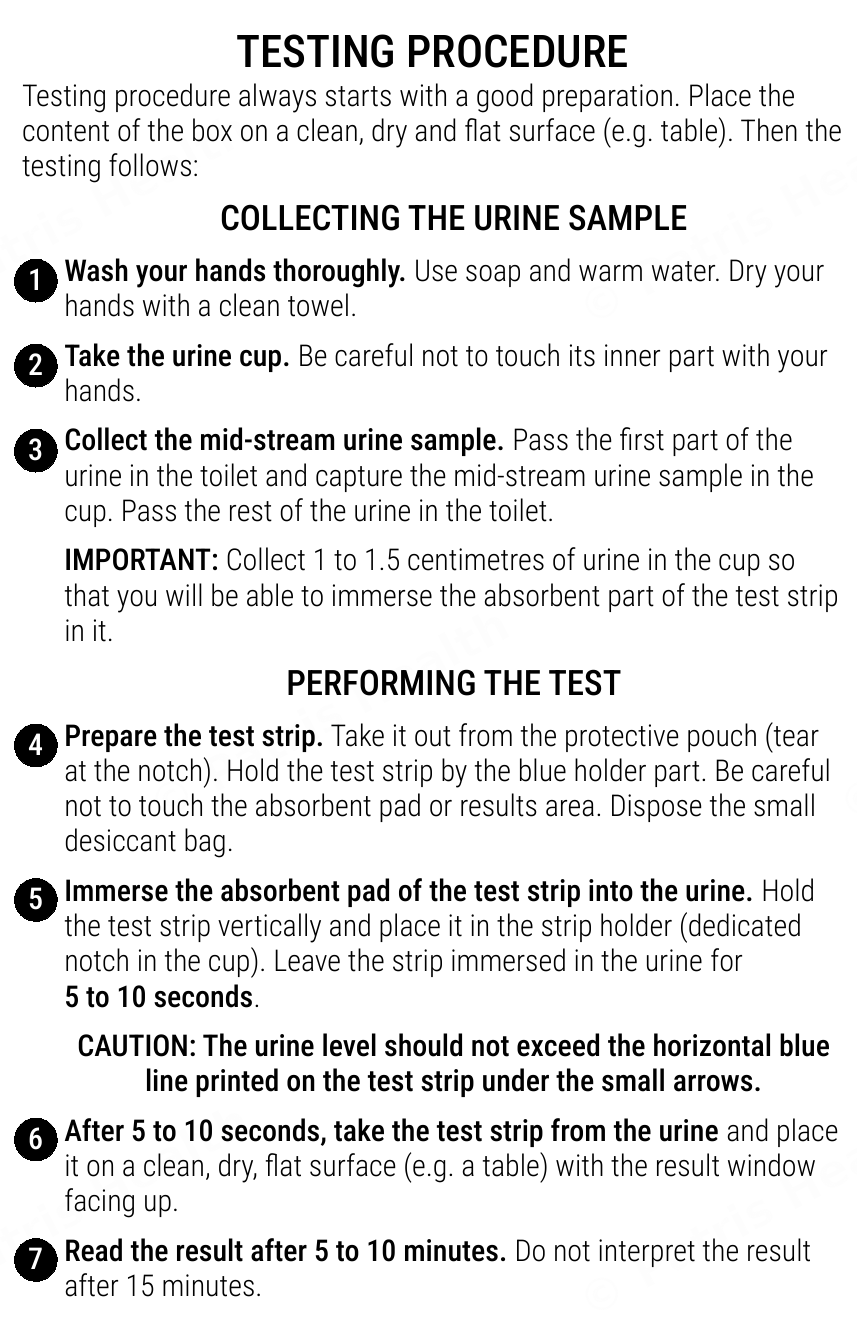
Pass the first part into the toilet, catch the middle part in the cup, and pass the rest into the toilet. You need 1 to 1.5 cm in the cup.
02
Dip the test strip for 5 to 10 seconds
Very important: hold the test strip by the blue holder part and do not touch the absorbent pad or the results area. The urine must not rise above the blue line under the arrows. Stand the test strip in the notch of the cup.
03
Lay it flat and read after 5 to 10 minutes
Not after 15. Set a timer.
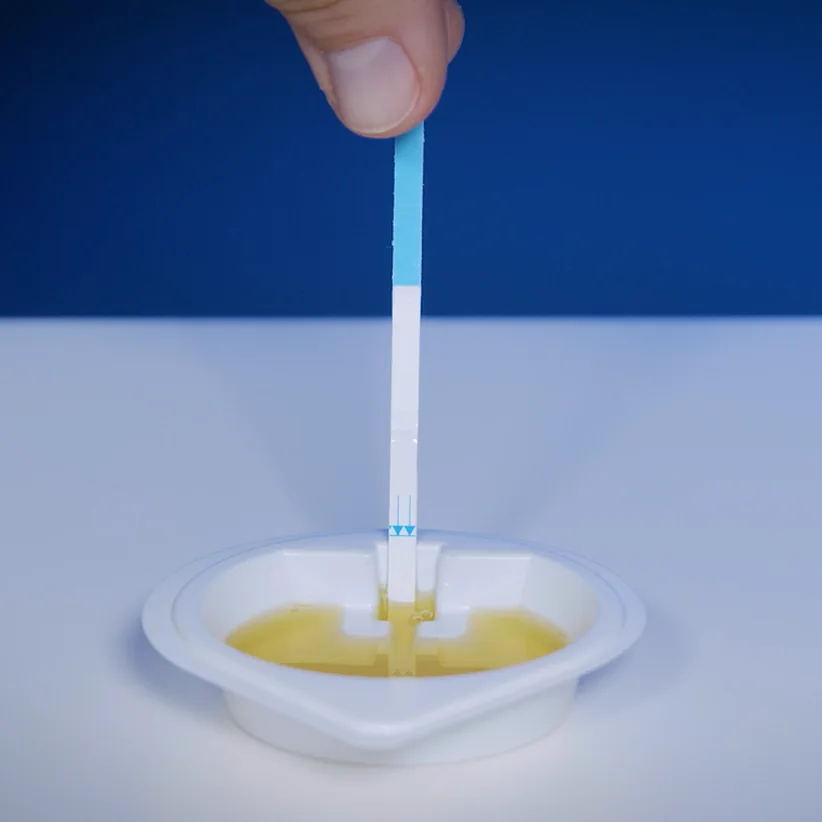
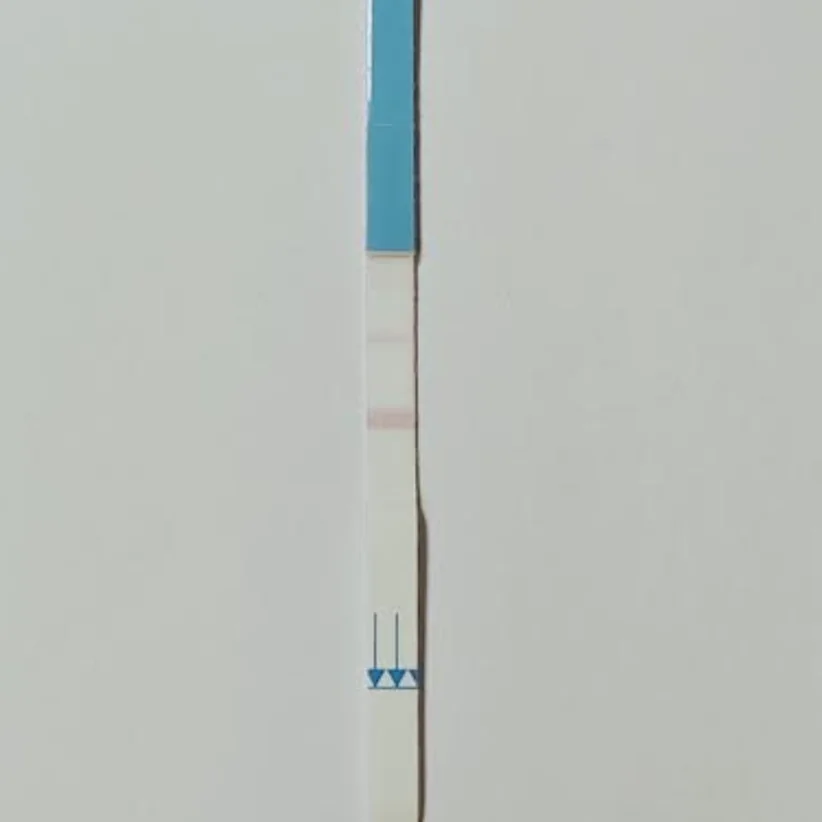
Instructions for useWatch the video demonstration
On the clock: the ten minutes, step by step
- Urine
First-morning, mid-stream, 1 to 1.5 cm in the cup.
- Dip
Strip in the urine, not above the blue line.
- Lay flat
After 5 to 10 seconds, take it out. Result window facing up.
- Read
Read between 5 and 10 minutes, in good light.
- Stop
Do not interpret the result after 15 minutes.
Your result
How to read your kidney test result
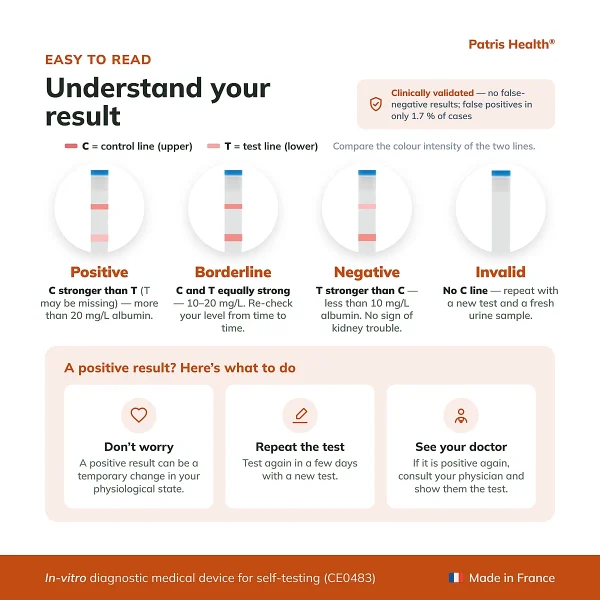
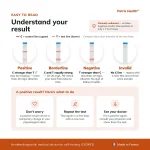
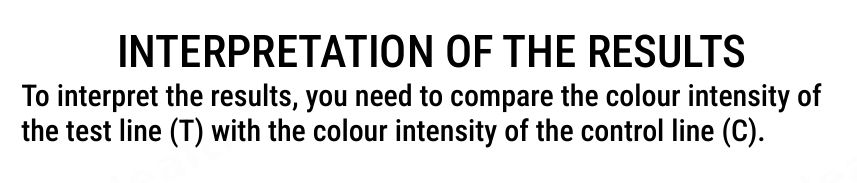
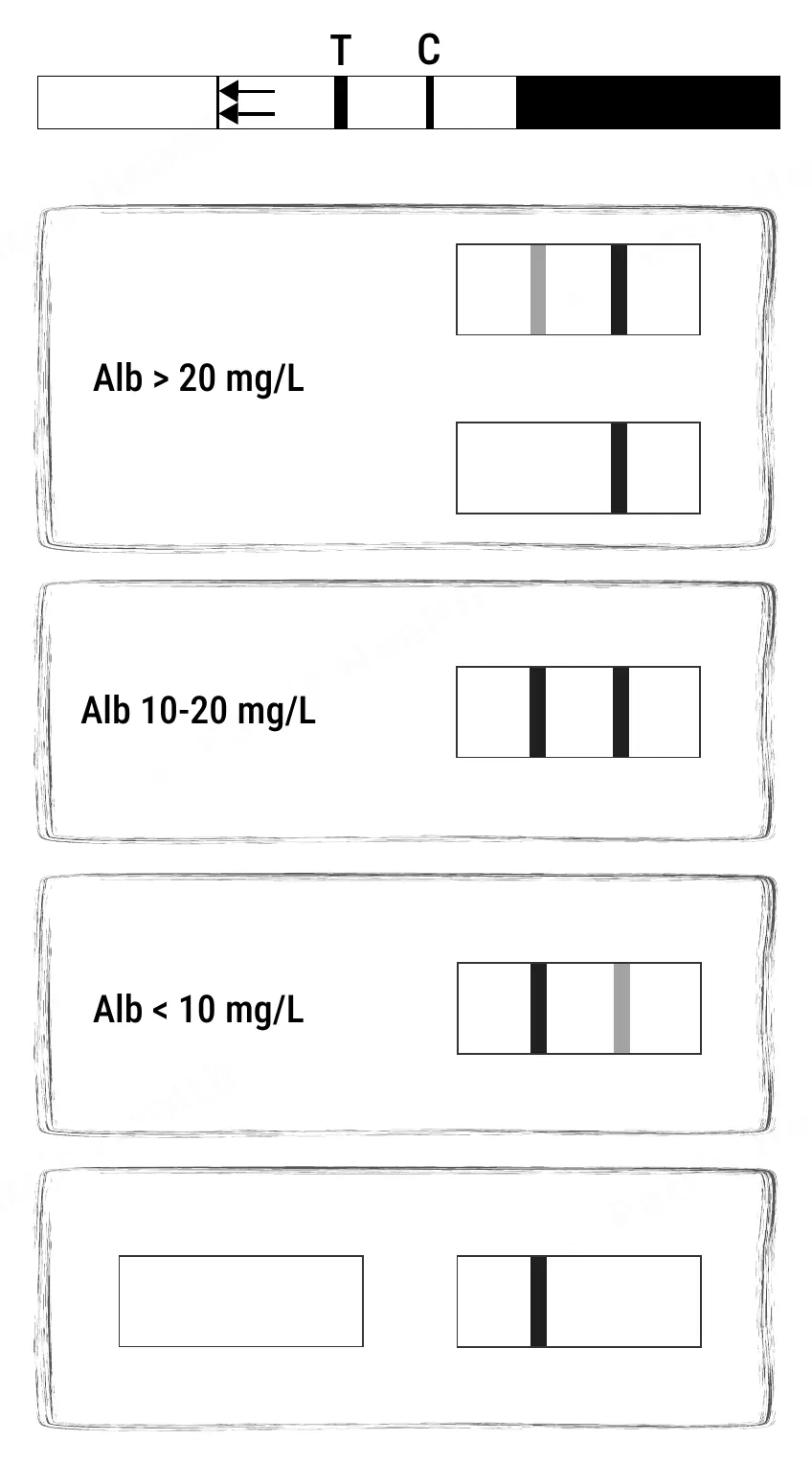
This test is read by comparing the colour of two lines. A test line (T) that is paler than the control line (C) is the positive result. That is the opposite of what most people expect, so look at the pictures before you read your test strip.
C = control line, the upper line, nearer the blue holder partT = test line, the lower line
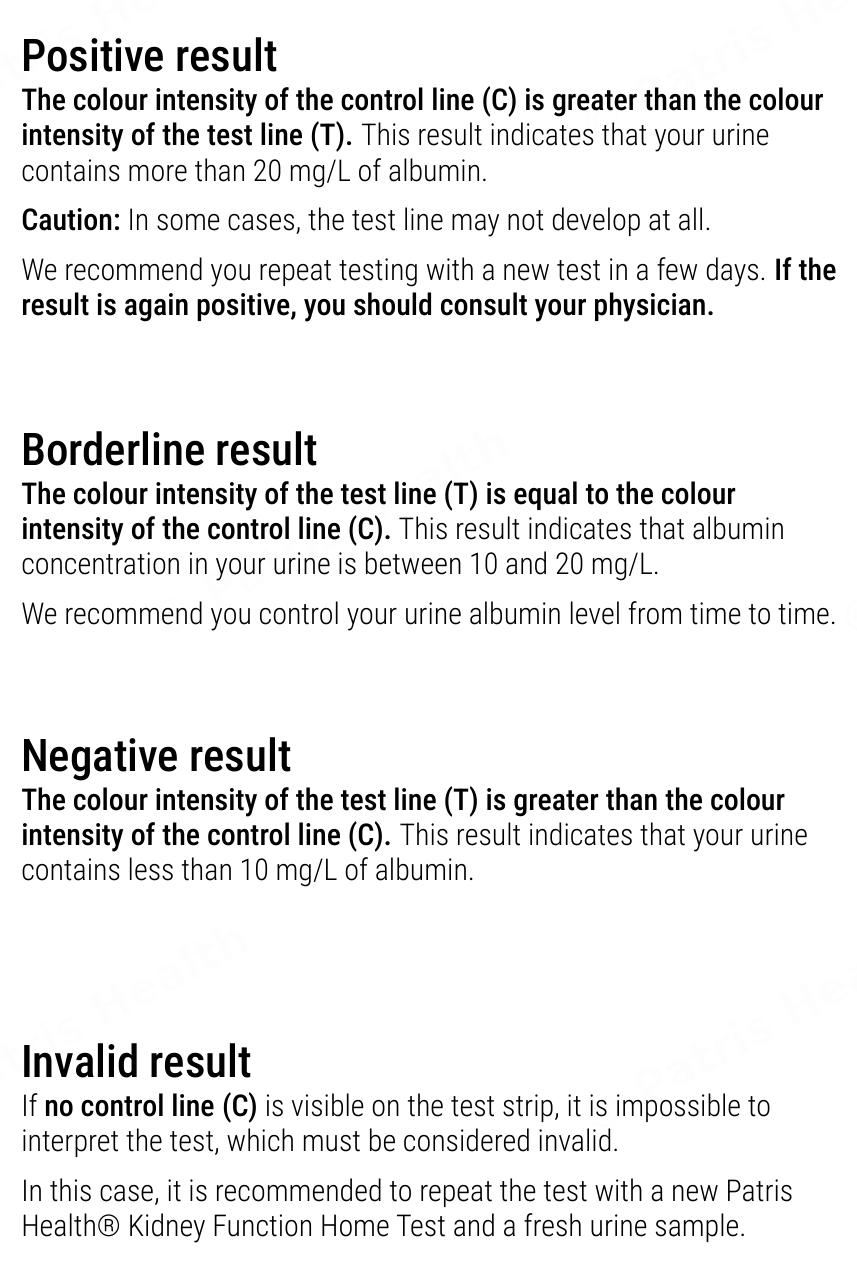
Above 20 mg/L positive
The C line is stronger than the T line; the T line may not appear at all. Repeat with a new test in a few days. If it is positive again, see your doctor.
10 to 20 mg/L borderline
The T line is as strong as the C line. Check your urine albumin again from time to time.
Below 10 mg/L negative
The T line is stronger than the C line. Albumin is in the normal range.
Invalid repeat
No C line. The result cannot be read; repeat with a new test and fresh urine.
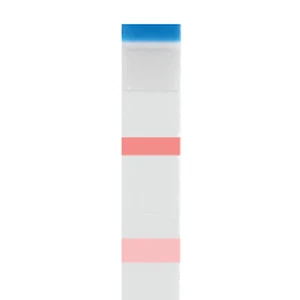
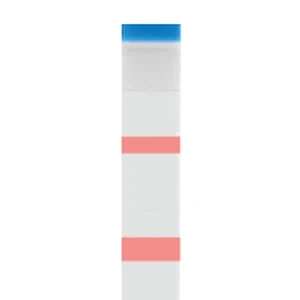
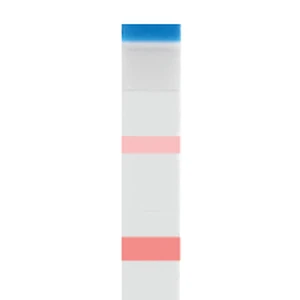
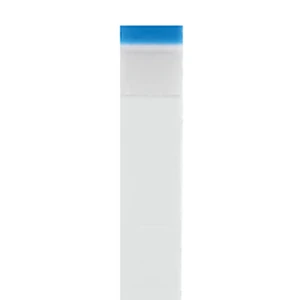
Here the strength of the colour is the result. Read between 5 and 10 minutes; do not interpret the test strip after 15. The pictures are for illustration purposes; the actual lines may differ in intensity.
Next step
What to do with your result
If the result is positive
A raised albumin can be temporary. Repeat the test a few days later with a new test. If it is positive again, see your doctor and take the test and these instructions with you.
If the result is borderline or negative
Borderline needs no action beyond checking again from time to time. A negative result means albumin is in the normal range today; with diabetes or high blood pressure, a regular check stays worthwhile.
The technology
What happens on the test strip
All of it happens on a paper test strip, in ten minutes.
- The urine moves
The urine rises along the test strip from the pad by capillary action. No pump, no power.
- Albumin meets the reagent
The test strip carries a coloured reagent that reacts with the albumin in the urine as it passes.
- The T line
The more albumin the urine holds, the paler the T line becomes. That is why a faint T line means a high level.
- The C line
The C line forms whatever the sample holds, and serves as the colour to compare against. No C line, no result.
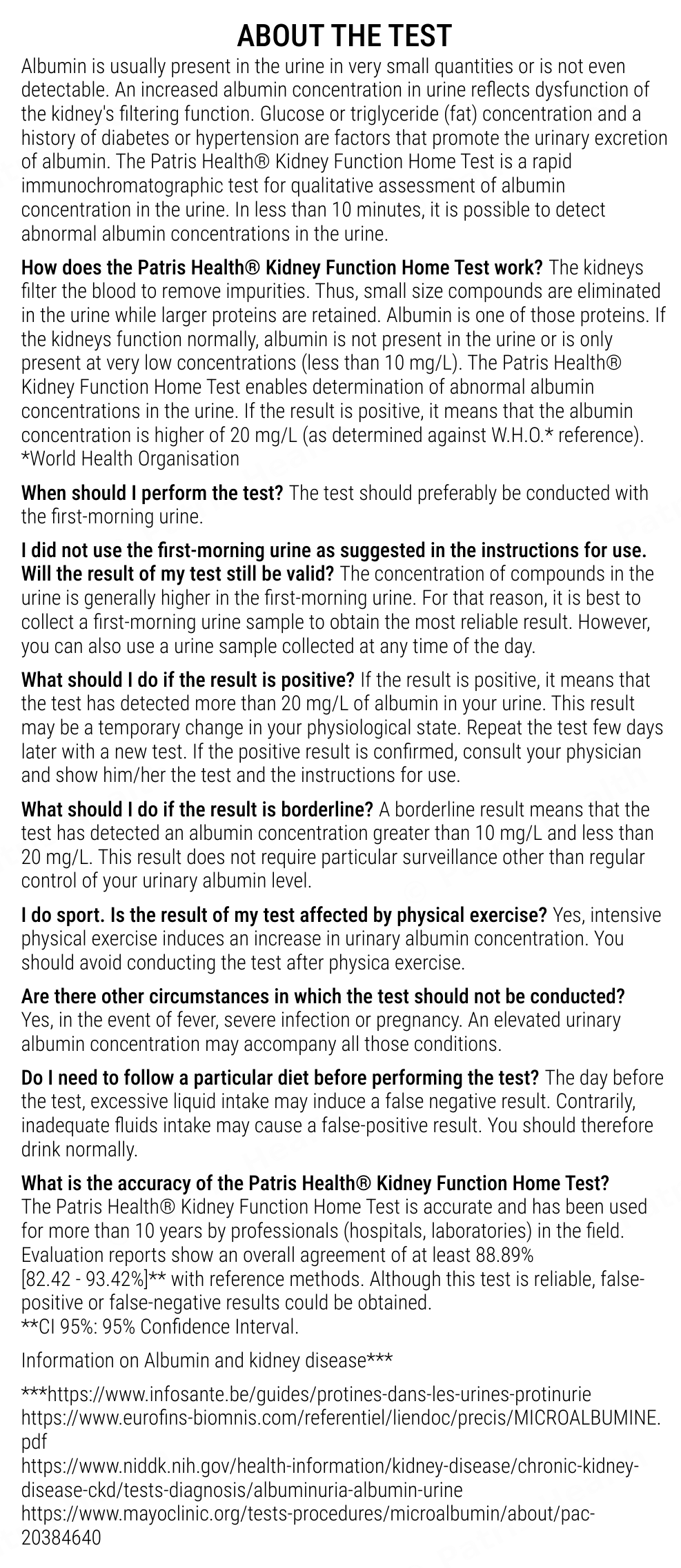
This test has been used by professionals in hospitals and laboratories for more than 10 years. It places the result in one of three ranges, set against the WHO reference.
Quality
Made in France, checked batch by batch
30+
years of diagnostic expertise — rapid tests made in France since 1991
- ISO 13485The international quality-management standard for organisations that design, manufacture and service medical devices
- Every batch checkedDefined checks completed before a batch is released
- Monitored after releasePerformance tracked for as long as the batch is on the market
Notified body 0483ISO 13485Made in FranceCE-marked IVD
The Patris Health promise. No valid result? Write to us and we replace the test or refund the purchase price. It applies whenever the test was performed as the instructions describe, and we do not argue about it.
Specification
Technical data for the kidney test
| Intended use | Qualitative immunochromatographic screening test for albumin in urine, for self-testing by lay users |
|---|---|
| Analyte | Albumin |
| Method | Lateral flow immunoassay |
| Ranges | Below 10 mg/L negative · 10 to 20 mg/L borderline · above 20 mg/L positive (WHO reference) |
| Sample | Urine, preferably first-morning, mid-stream |
| Time to result | Read at 5 to 10 minutes; do not interpret after 15 minutes |
| Agreement | No false-negative results and false-positive results in 1.7 % of cases in the evaluation study; 88.89 % overall agreement across the three ranges (95 % CI 82.42–93.42 %) |
| Storage | 4 to 30 °C, do not freeze |
| Expiry date | Indicated on the label and the foil pouch |
| Device type | CE-marked in-vitro diagnostic medical device (IVD) for self-testing |
| Certificates | CE 0483 · ISO 13485 |
Questions
Asked before ordering
How accurate is a kidney test at home compared with the laboratory?+
In the evaluation study the test gave no false-negative results, and a false-positive result in 1.7 % of cases. Across all three ranges — negative, borderline and positive — it matched the reference method in 88.89 % of cases (95 % CI 82.42–93.42 %). The laboratory reports an albumin number; this test places you in a range. As with any screening test, false positive or false negative results are possible.
Do I have to use first-morning urine?+
It is the best sample, because urine is most concentrated in the morning. A sample from any time of day can be used, but first-morning urine gives the most reliable result.
I exercise a lot. Does that affect the result?+
Yes. Intense exercise raises urine albumin. Do not test after physical exercise.
When should I not test?+
With a fever, during a severe infection, or in pregnancy. All of these can raise urine albumin without a kidney problem.
Should I drink more or less before the test?+
Neither. Drinking far more than usual the day before can give a false negative result, and drinking too little a false positive. Drink normally.
The test line is very faint. What does that mean?+
On this test a faint or missing T line is the positive result, as long as the C line is there. Compare your test strip with the pictures on this page.
How do I dispose of the test?+
All components can go in household waste.
Sources
National Health Service. (2023, March 22). Chronic kidney disease: Diagnosis. https://www.nhs.uk/conditions/kidney-disease/diagnosis/
National Institute of Diabetes and Digestive and Kidney Diseases. (2016a, October). Albuminuria: Albumin in the urine. https://www.niddk.nih.gov/health-information/kidney-disease/chronic-kidney-disease-ckd/tests-diagnosis/albuminuria-albumin-urine
National Institute of Diabetes and Digestive and Kidney Diseases. (2016b, October). Chronic kidney disease tests & diagnosis. https://www.niddk.nih.gov/health-information/kidney-disease/chronic-kidney-disease-ckd/tests-diagnosis
National Institute of Diabetes and Digestive and Kidney Diseases. (2017, February). Diabetic kidney disease. https://www.niddk.nih.gov/health-information/diabetes/overview/preventing-problems/diabetic-kidney-disease
Last reviewed 2 October 2026
Instructions for use
Patris Health Kidney Function Home Test
Detection of albumin in urine. CE-marked in-vitro diagnostic medical device for self-testing.
This is the English part of the multi-language instructions for use. The printed instructions in the box carry the same text in seven languages: English, German, French, Italian, Spanish, Dutch and Slovenian. If the version printed on the instructions in your box differs from this one, follow the instructions in your box.
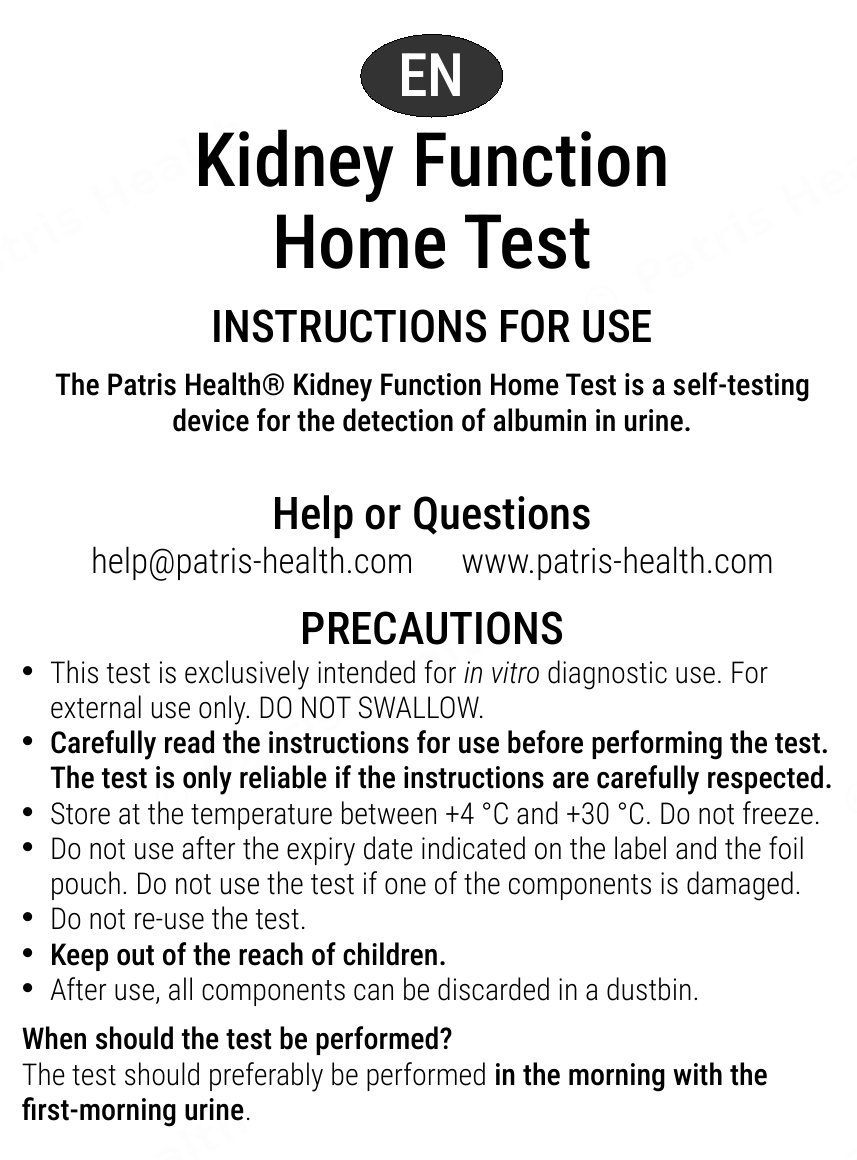
Precautions and test components
Read this before you start: safety, storage and what is in the kit.
Testing procedure
Step by step, with a picture for each step.
Interpretation of the results
How to read your result, with pictures.
About the test
Background, questions and answers, accuracy.
Questions about the test: help@patris-health.com
Instructions for use ALBUV01, January 2024 · © Patris Health. Copying and reproduction are not permitted.