





Who it is for
Is this thyroid test right for you?
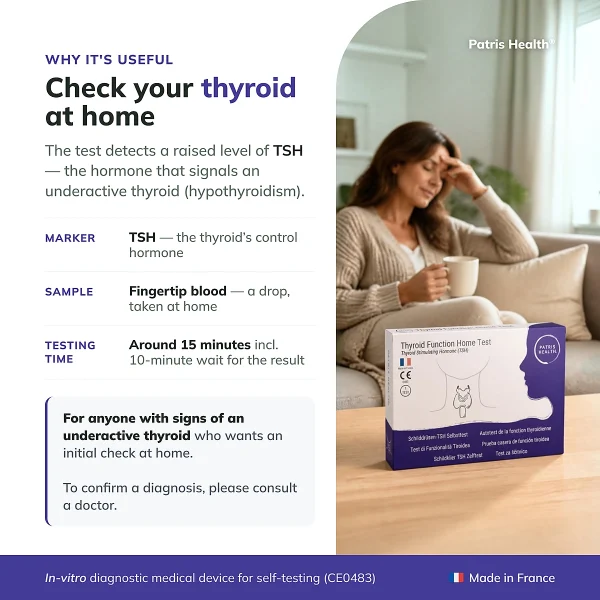
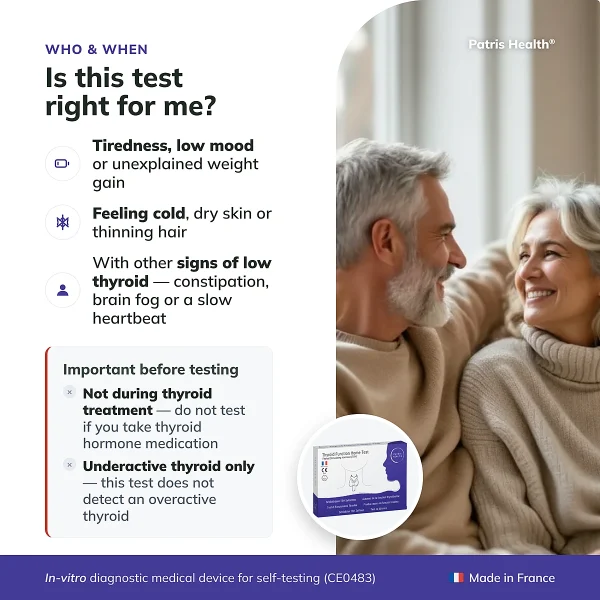
An underactive thyroid comes on slowly, and every one of its signs has an everyday explanation. A thyroid test you do at home gives you a first answer in ten minutes. Thyroid disorders are among the most common medical conditions in the world, and women are affected far more often than men. People use this test when they notice several of these at once:
- Tiredness and lethargy that rest does not fix
- Weight gain without a change in eating
- Feeling cold when others are comfortable
- Dry skin, brittle hair, constipation
- Forgetfulness, low mood
- Irregular periods
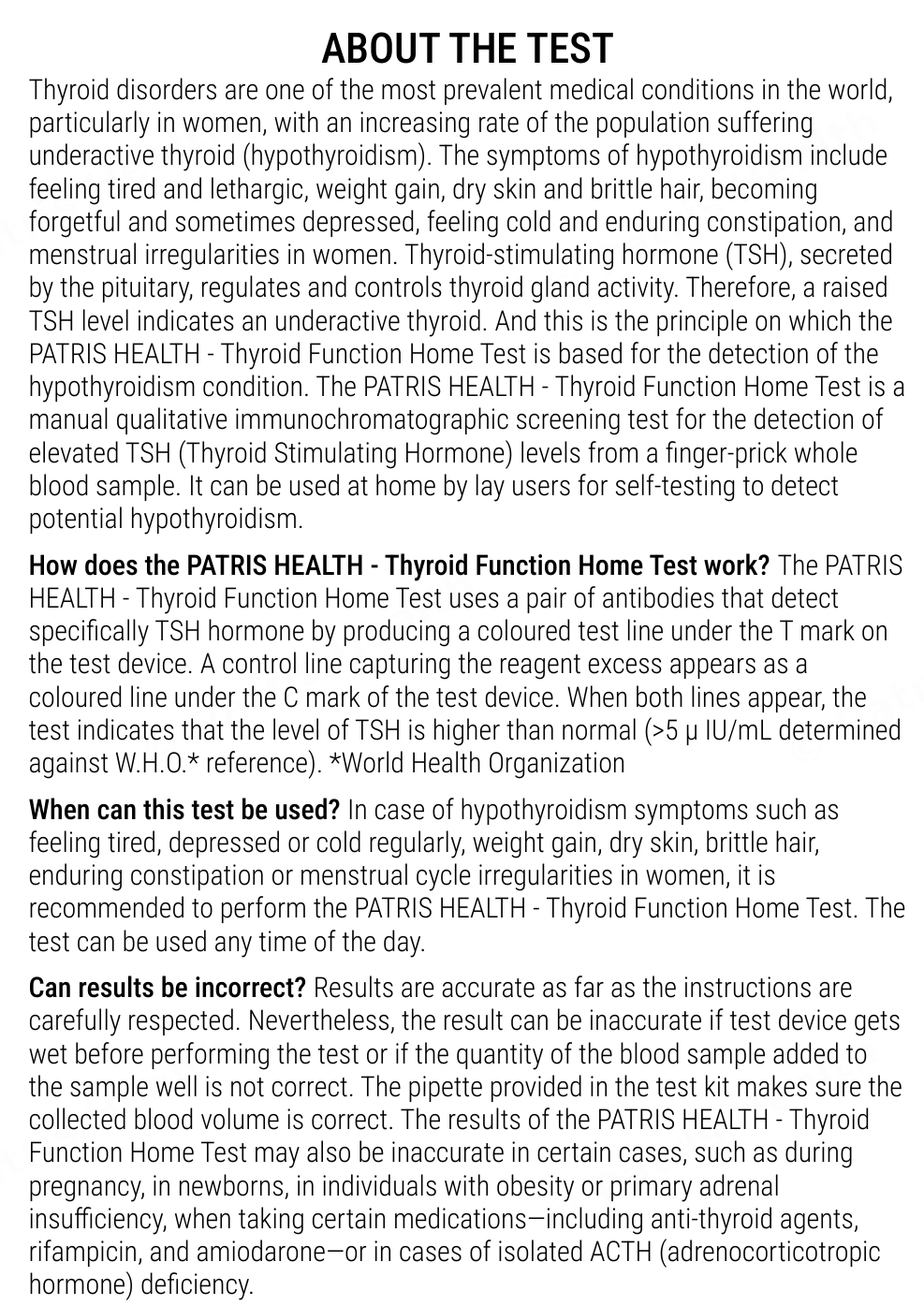
Why these symptoms belong together. The thyroid sets the pace of the whole body. When it slows down, the pituitary gland raises TSH to push it — and that raised TSH is what this test detects.
- WomenThyroid disorders are far more common in women
- Family historyA family history of thyroid disease raises the risk
- After pregnancyThe thyroid can slow down in the months after a birth
- Tired despite normal ironWhen a ferritin test came back normal, the thyroid is the next question

What it measures
What this TSH test tells you, and what it does not
It tells you
- Whether the TSH in your blood is above 5 µIU/mL, determined against the WHO reference
- From a fingertip blood sample, in ten minutes, at home, at any time of day
- A raised TSH is the first laboratory sign of an underactive thyroid (hypothyroidism) — it is the same marker a doctor orders first
It does not tell you
- The exact TSH number. It answers above or below one threshold
- Whether your thyroid is overactive. A low TSH does not show on this test
- Why the thyroid is slow. That needs a doctor
- Anything reliable while you take thyroid hormone, during pregnancy (TSH usually runs lower early on), in newborns, with obesity or primary adrenal insufficiency, with isolated ACTH deficiency, or on certain medicines, including anti-thyroid drugs, rifampicin and amiodarone
Contents
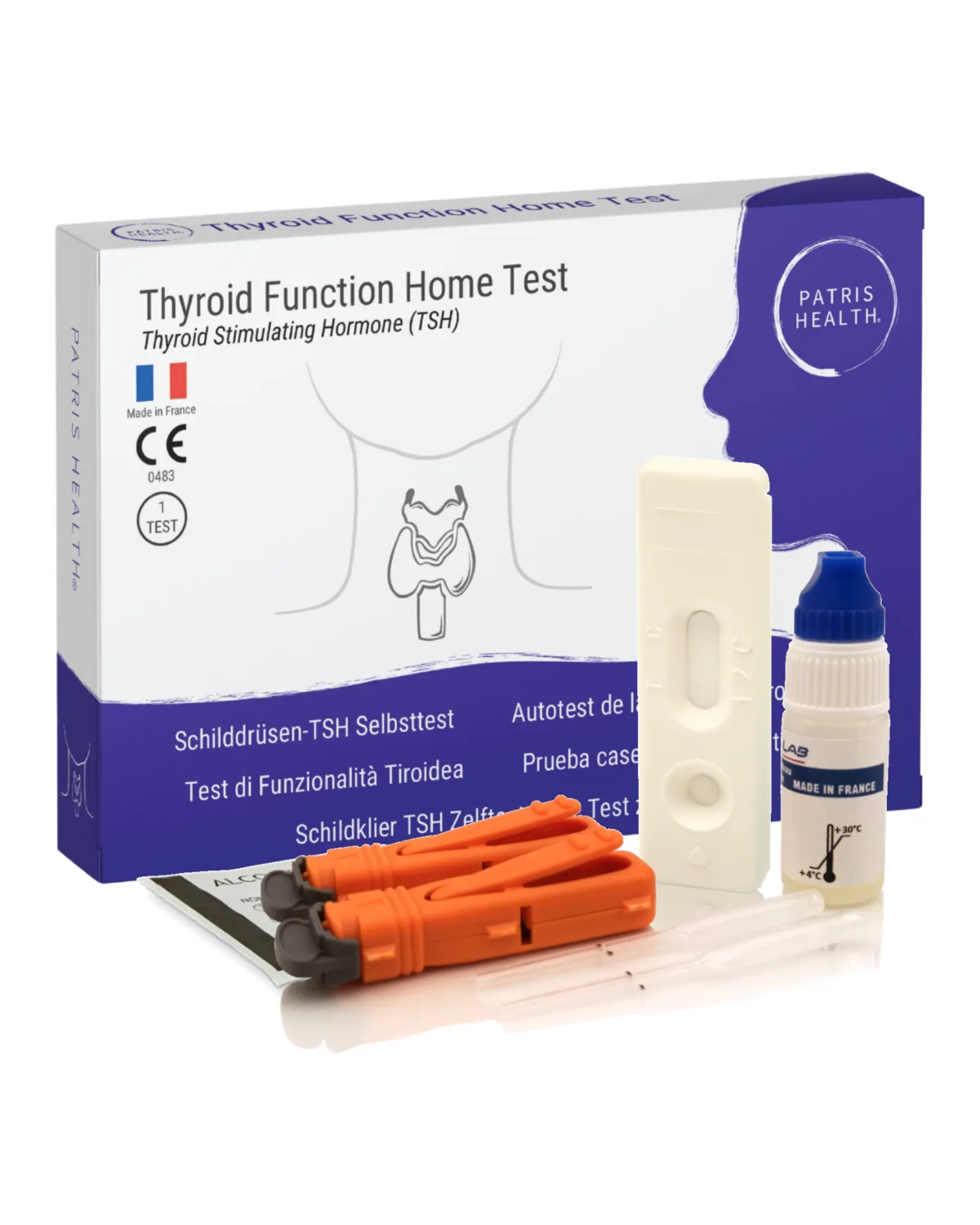
What is in the box
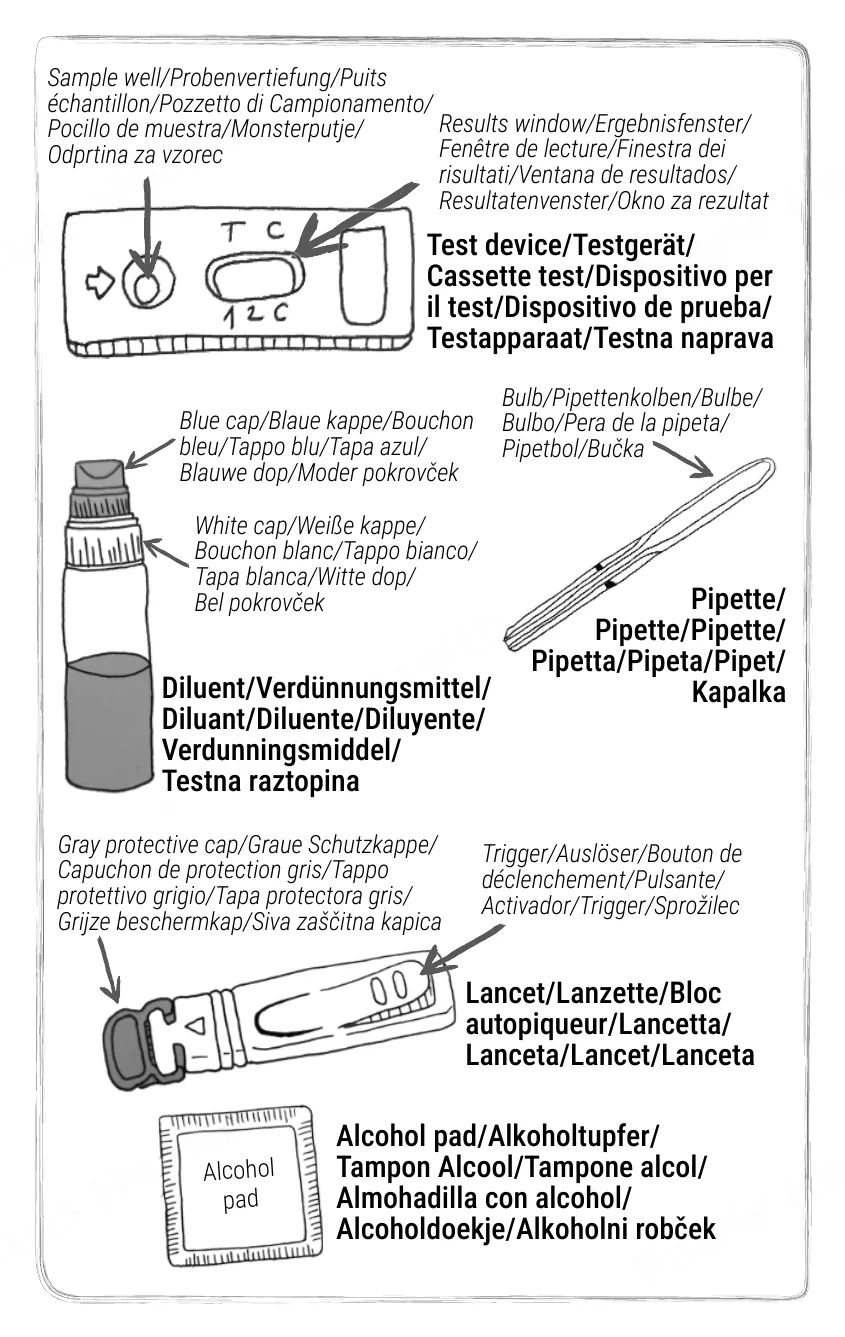
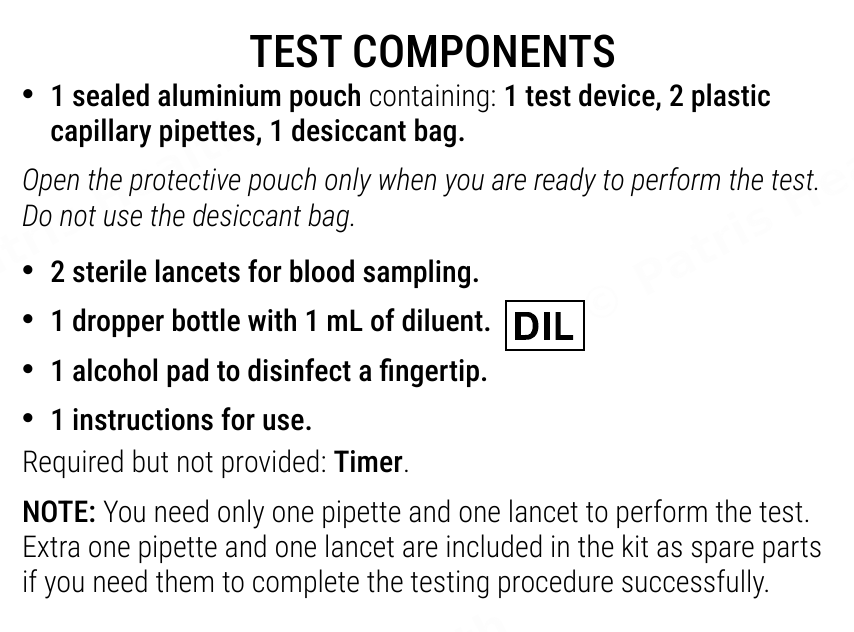
- 1 × test device in a sealed foil pouch
- 1 × dropper bottle of diluent 1 mL
- 2 × plastic capillary pipettes one is a spare
- 2 × sterile lancets one is a spare
- 1 × alcohol pad
- 1 × instructions for use in seven languages
- 1 × desiccant bag discard it, do not use it
Everything you need is in the box except a timer. Keep the foil pouch sealed until you test.
How it works
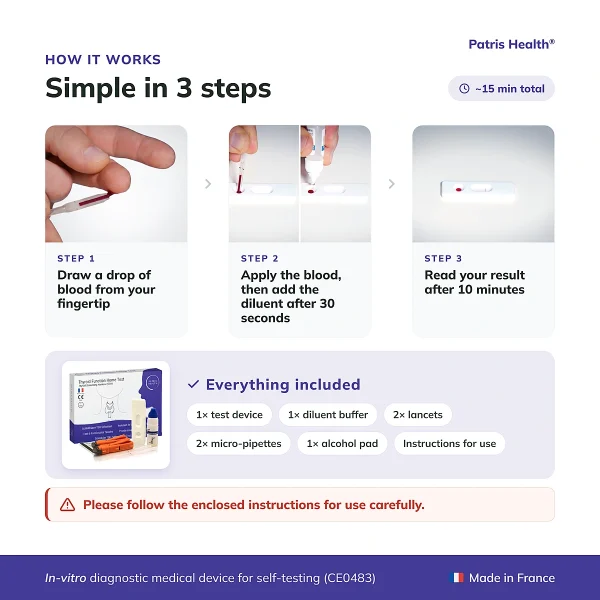
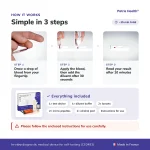
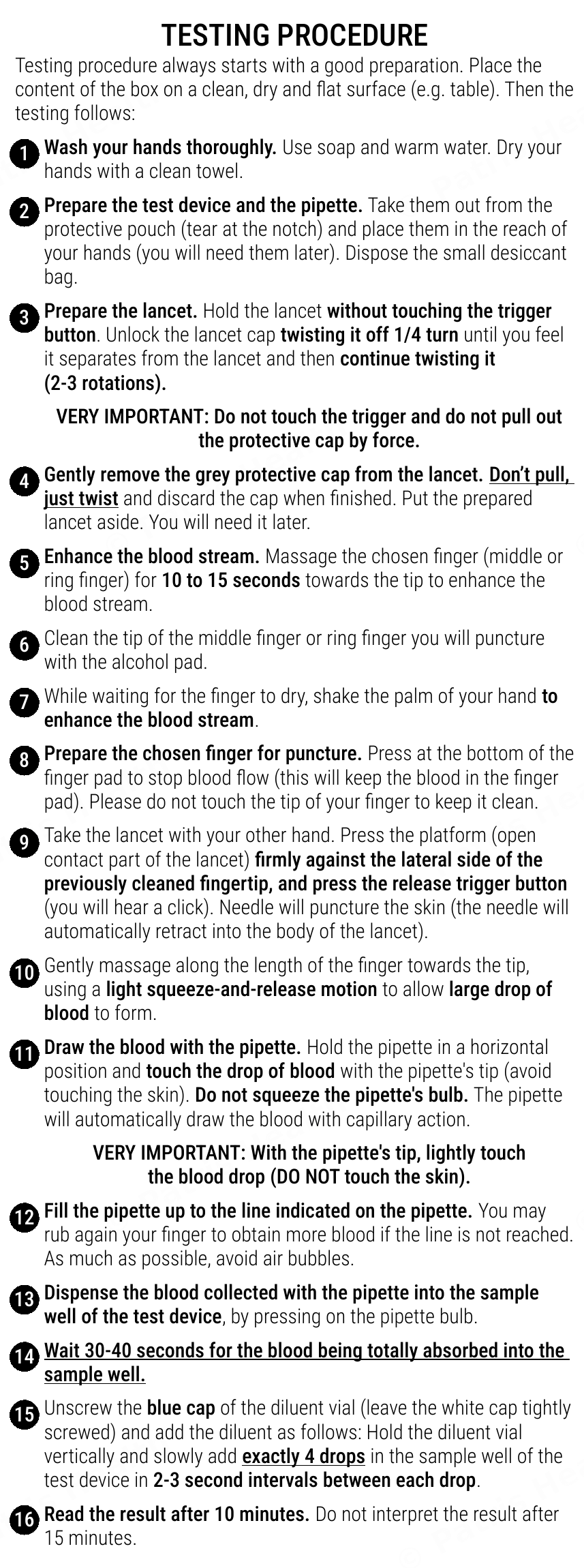
Five steps, about fifteen minutes

01
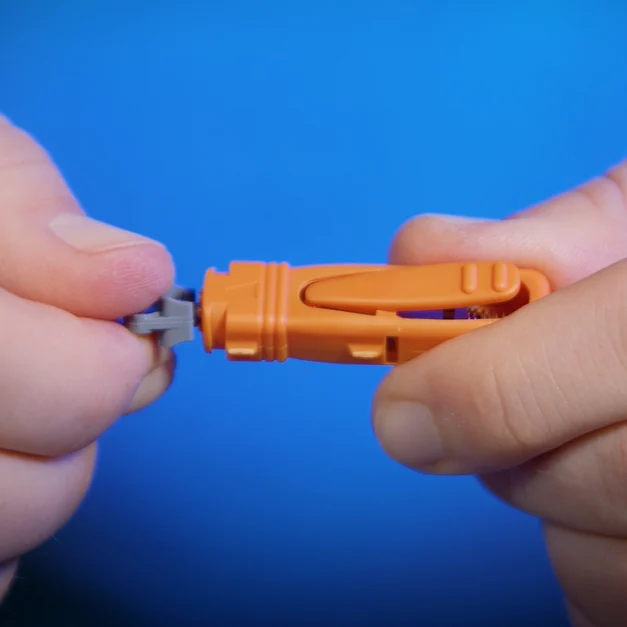
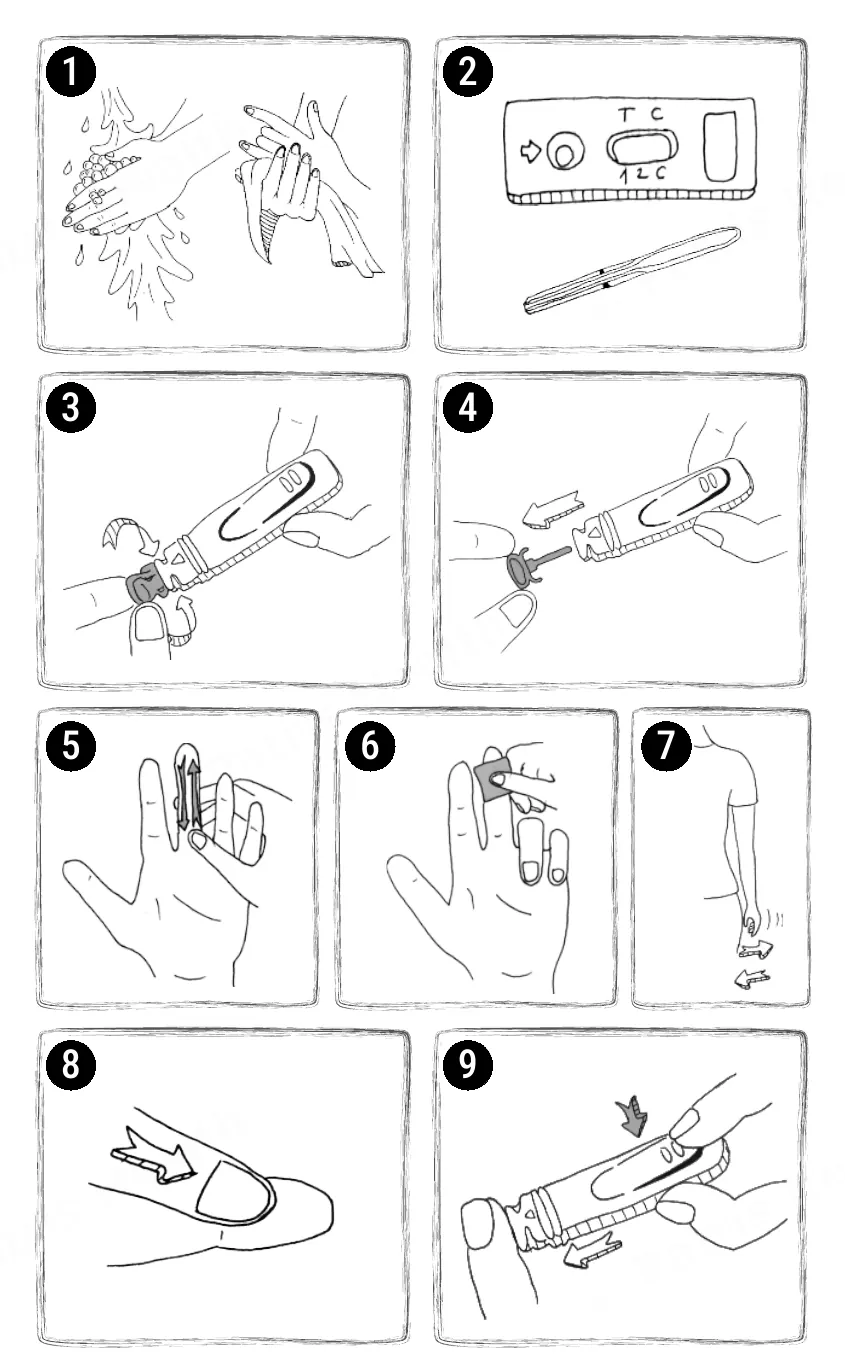
Prepare the lancet
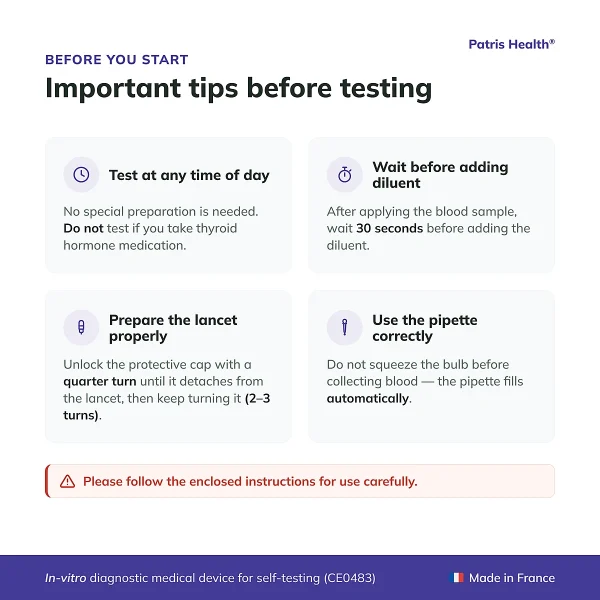
Very important: do not touch the trigger. Twist the grey protective cap off, never pull it. Keep turning until it comes away.

02
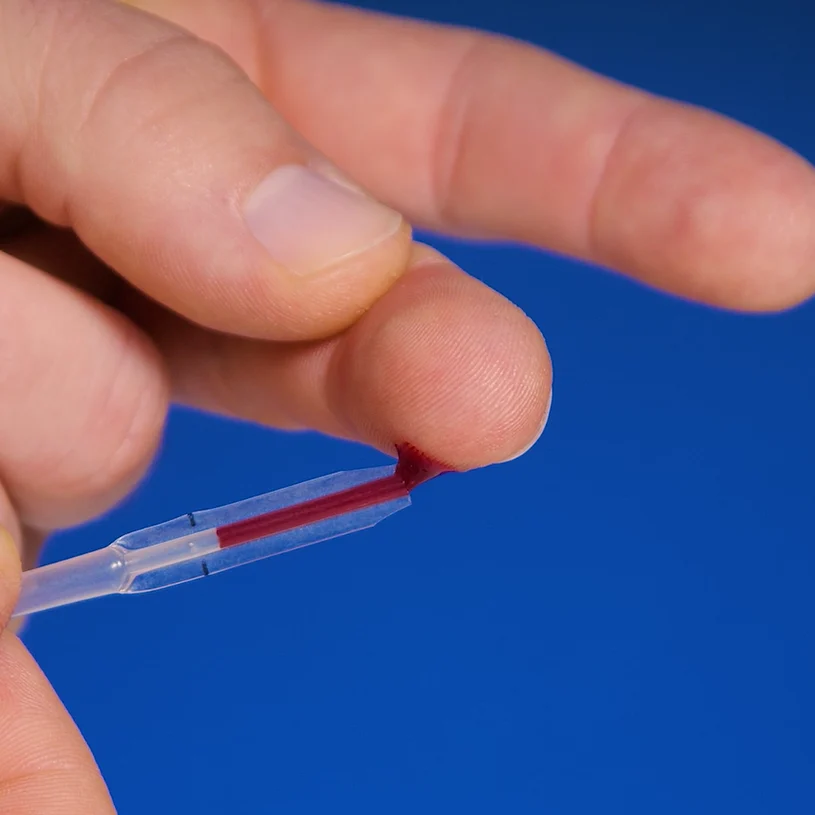
Take a blood sample from your fingertip
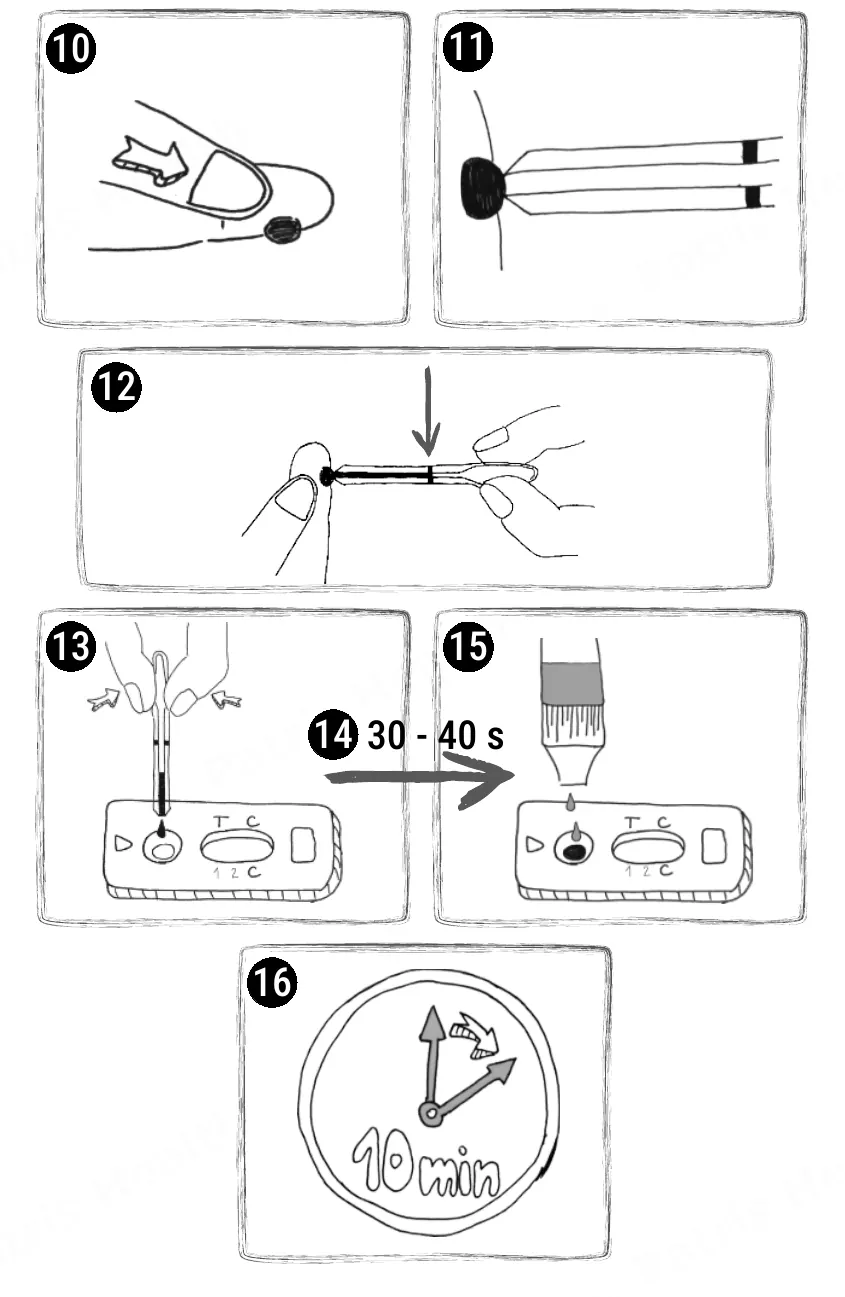
Very important: use the pipette correctly — lightly touch the drop of blood with the pipette’s tip, not the skin, do not squeeze the bulb, fill to the line.

03
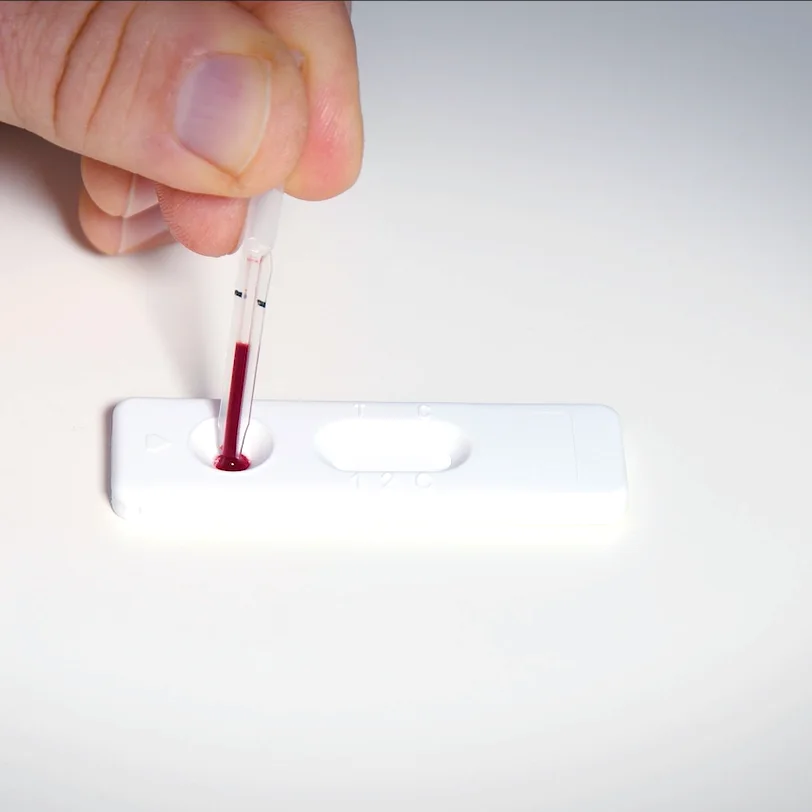
Put the blood into the sample well
Press the pipette bulb to release the blood into the sample well. Then wait 30 to 40 seconds until it is absorbed.

04
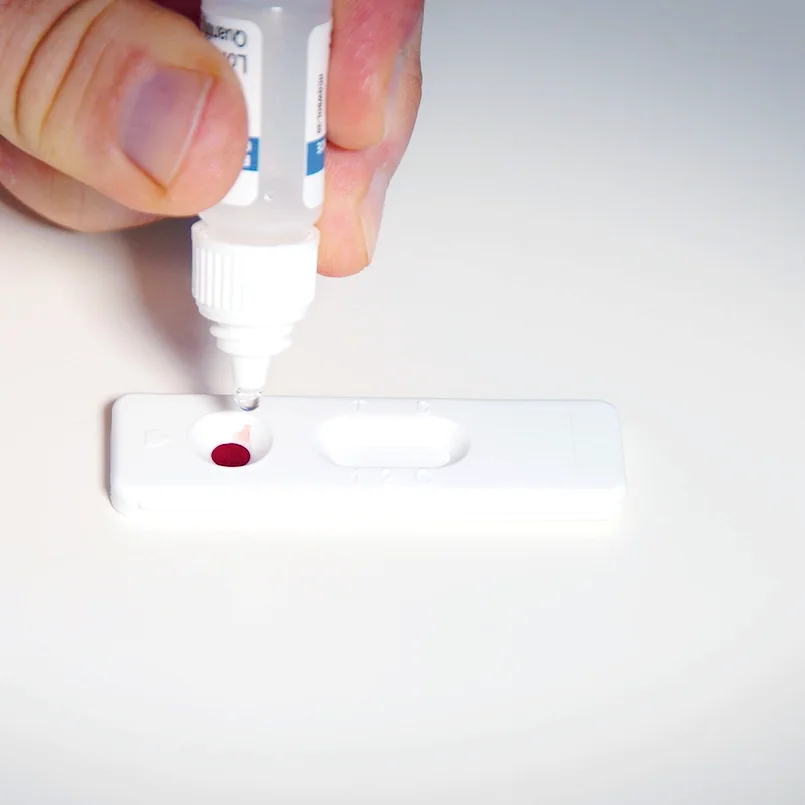
Add exactly 4 drops of diluent
Very important: add the diluent only after the 30 to 40 seconds. Hold the vial upright and add exactly four drops, 2–3 seconds apart.

05
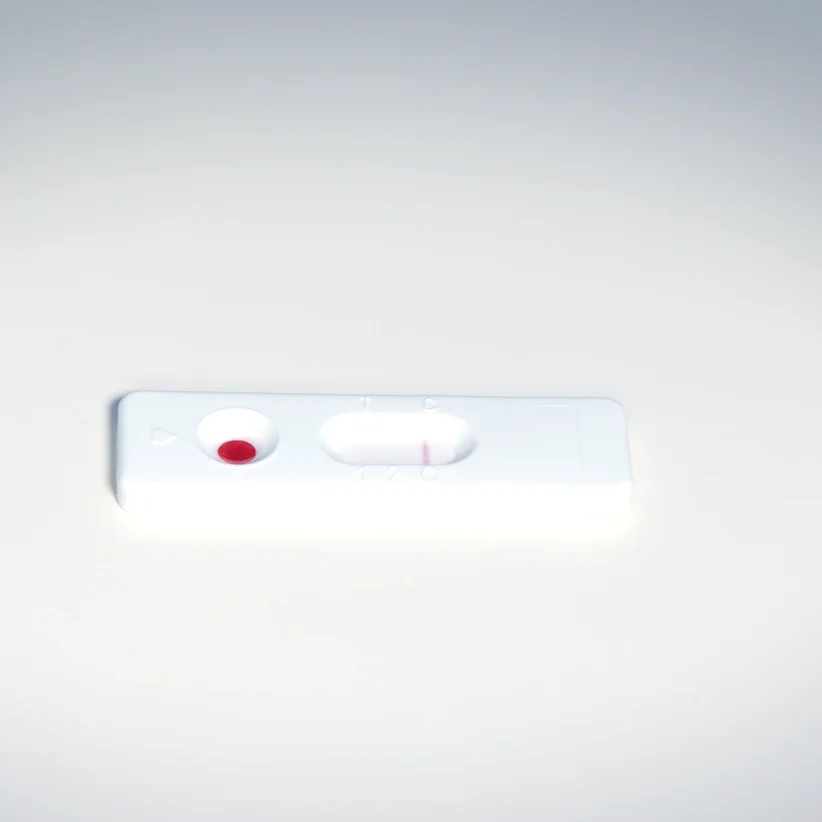
Read the result after 10 minutes
Not after 15. Set a timer.
Instructions for useWatch the video demonstration
On the clock: the ten minutes, step by step
- Drop in
Blood from the pipette into the sample well.
- Wait, then diluent
Not before 30–40 seconds. Then exactly four drops, 2–3 seconds apart.
- Colour moves
Lines begin to form. Not readable yet.
- Read
Read the result now, in good light.
- Stop
Do not interpret the result after 15 minutes.
Your result
How to read your thyroid test result
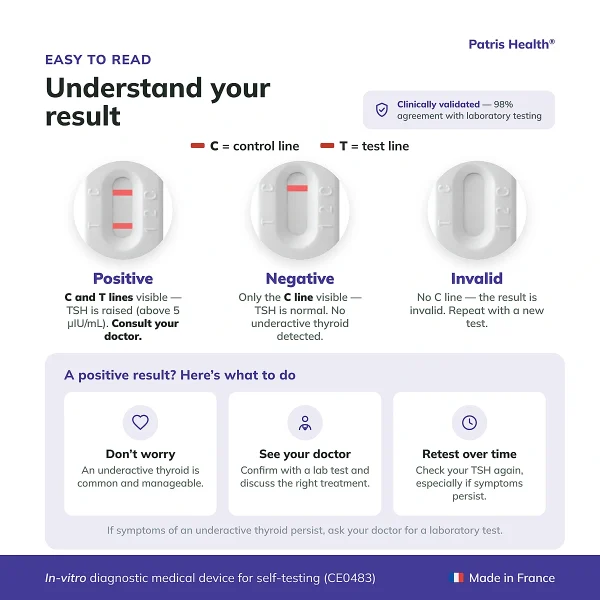
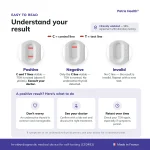
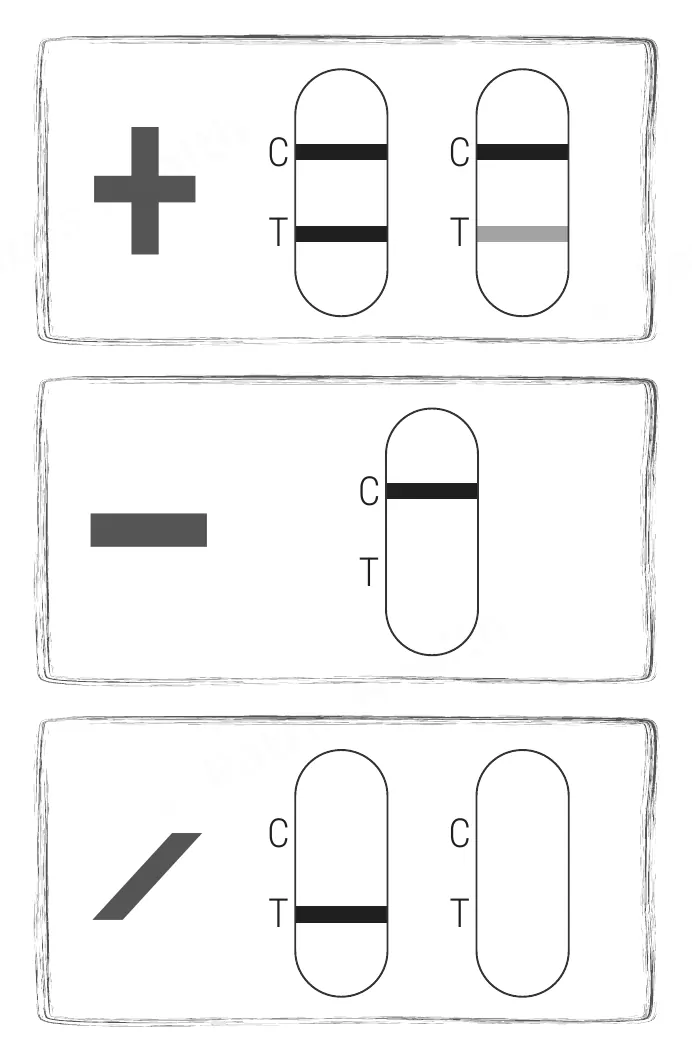
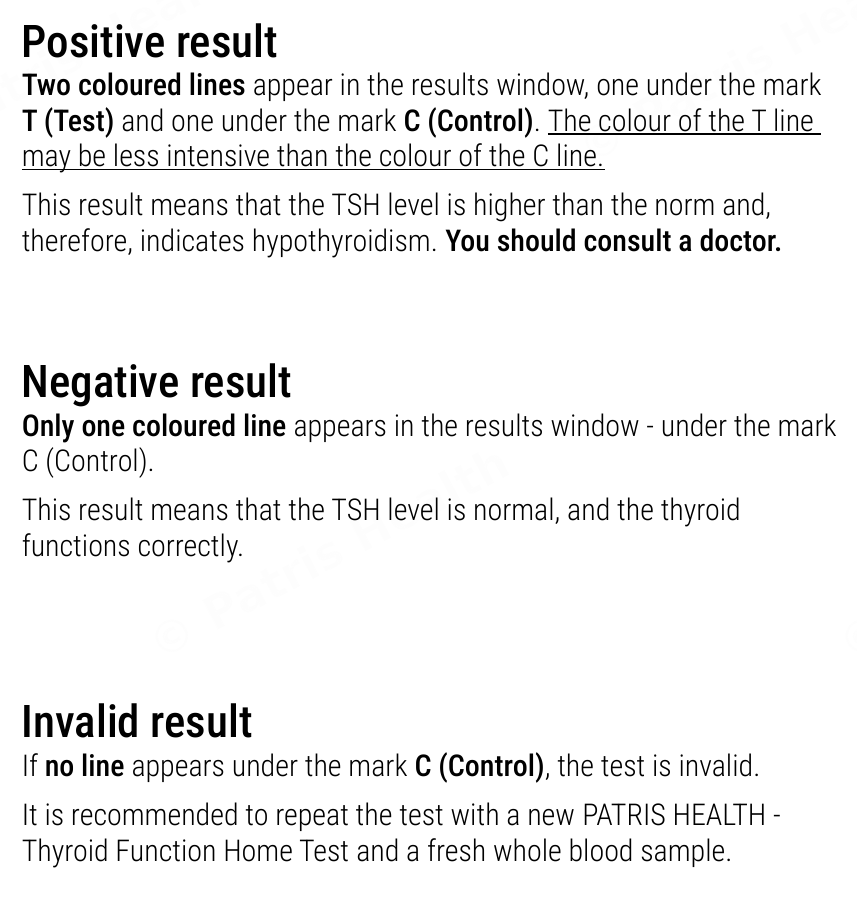
Two lines means your TSH is raised. One line means it is in the normal range. A faint second line still counts as a line. The pictures below show each result.
TSH raised positive
Both C and T lines are visible. TSH is above 5 µIU/mL, which points to an underactive thyroid. See your doctor.
Normal negative
Only the C line is visible. TSH is below 5 µIU/mL; no sign of an underactive thyroid.
Invalid repeat
No C line. The result cannot be read. This happens most often when the diluent is added before the blood has been absorbed. Repeat with a new test and a fresh blood sample, and wait the full 30 to 40 seconds before you add the diluent.
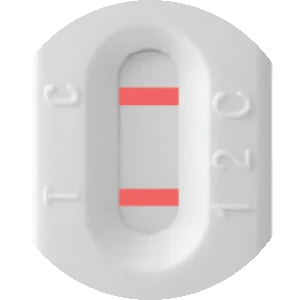
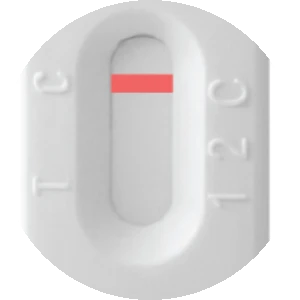
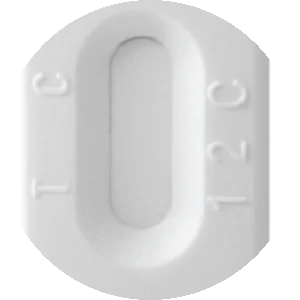
A faint T line still counts as a line — the colour and intensity of the lines do not matter, only that they are homogeneous and complete. Read at 10 minutes; do not interpret the result after 15. The pictures are for illustration purposes; the actual lines may differ in intensity.
Next step
What to do with your result
If your TSH is raised
Book an appointment and tell your doctor you used a TSH self-test that read above 5 µIU/mL. They will usually confirm it with a laboratory TSH and free T4. Do not start or change any medicine based on this result alone — a slow thyroid is treatable, but the dose has to be set from laboratory numbers.
If your TSH is normal but you still feel tired
A normal TSH makes an underactive thyroid unlikely as the cause. It does not rule out low iron, infection or a vitamin deficiency. If the tiredness continues, see your doctor and show them the result.
The technology
What happens inside the test device
All of it happens on a paper strip inside the test device, in ten minutes.
- The sample moves
The drop of blood and the diluent travel along the strip by capillary action. No pump, no power.
- Antibodies find TSH
The strip carries antibodies tagged with a coloured reagent. As the sample passes, they bind to the thyroid-stimulating hormone in it.
- The T line
A second antibody fixed at T catches those complexes. At 5 µIU/mL or more, a coloured line appears. Below that, none.
- The C line
The C line captures the excess reagent whatever the sample holds. The C line only means that the test was performed well. No C line, no result.
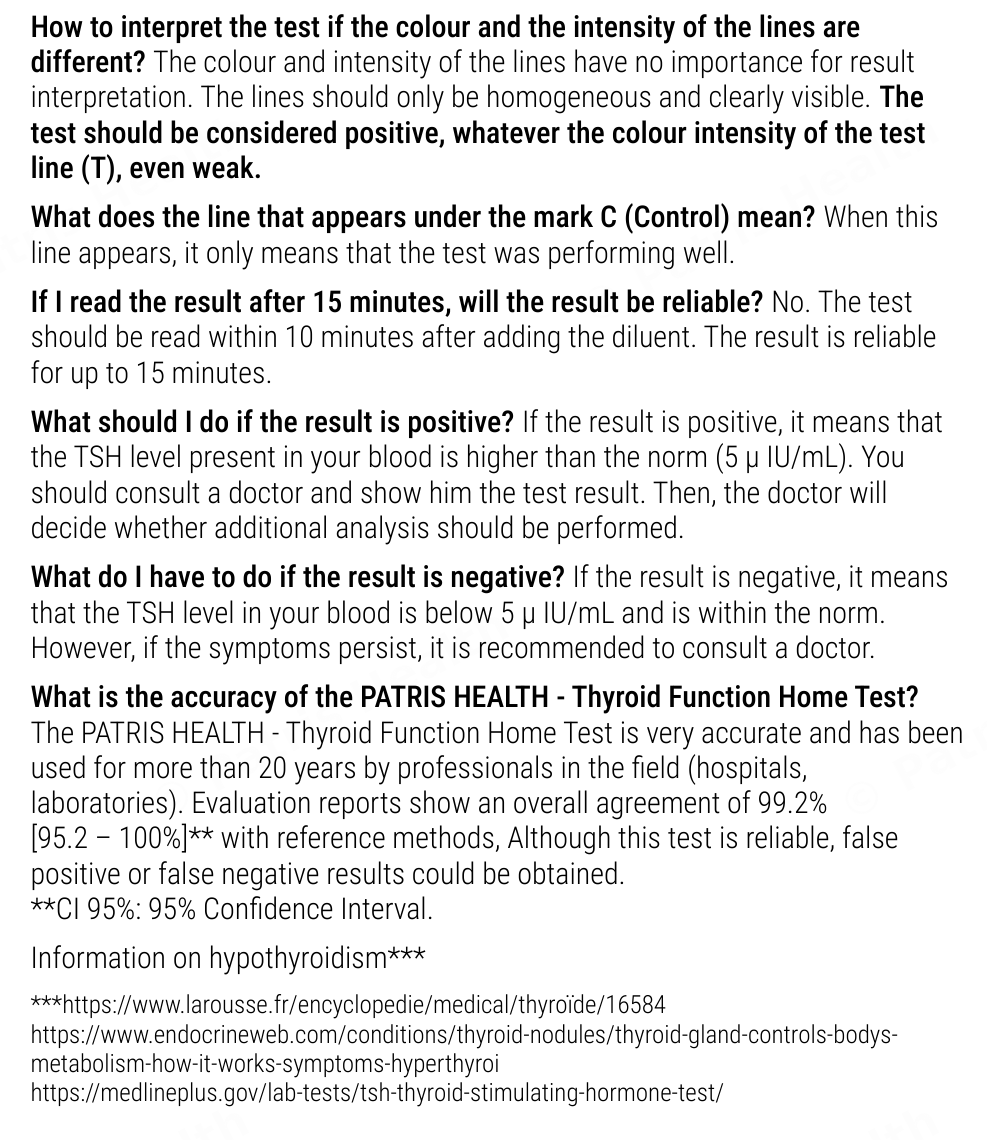
This test has been used by professionals in hospitals and laboratories for more than 20 years. It gives one answer — above or below the threshold — not a number.
Quality
Made in France, checked batch by batch
30+
years of diagnostic expertise — rapid tests made in France since 1991
- ISO 13485The international quality-management standard for organisations that design, manufacture and service medical devices
- Every batch checkedDefined checks completed before a batch is released
- Monitored after releasePerformance tracked for as long as the batch is on the market
Notified body 0483ISO 13485Made in FranceCE-marked IVD
The Patris Health promise. No valid result? Write to us and we replace the test or refund the purchase price. It applies whenever the test was performed as the instructions describe, and we do not argue about it.
Specification
Technical data for the thyroid test
| Intended use | Qualitative immunochromatographic screening test for elevated thyroid-stimulating hormone (TSH) in capillary whole blood, for self-testing by lay users |
|---|---|
| Analyte | Thyroid-stimulating hormone (TSH) |
| Method | Lateral flow immunoassay |
| Cut-off | 5 µIU/mL (determined against the WHO reference) |
| Sample | Capillary whole blood from a fingertip, pipette filled to the line |
| Time to result | Read at 10 minutes; do not interpret after 15 minutes |
| Agreement | 99.2 % overall agreement with reference methods (95 % CI 95.2–100 %) |
| Storage | 4 to 30 °C, do not freeze |
| Expiry date | Indicated on the label and the foil pouch |
| Device type | CE-marked in-vitro diagnostic medical device (IVD) for self-testing |
| Certificates | CE 0483 · ISO 13485 |
Questions
Asked before ordering
How accurate is a thyroid test at home compared with the laboratory?+
In the evaluation studies, the test agreed with laboratory reference methods in 99.2 % of cases (95 % CI 95.2–100 %). The difference is what you get back: the laboratory reports a number, this test tells you whether you are above or below 5 µIU/mL. For a first answer that is enough; the number comes from your doctor afterwards. As with any rapid test, a false positive or false negative result can occur.
Does the finger prick hurt?+
It is a brief prick. Wash your hands with warm water first, massage the finger towards the tip for 10 to 15 seconds, and prick the side of the fingertip. The needle retracts into the lancet straight away.
I take levothyroxine. Can I use this test to check my dose?+
No. The test is not for anyone on thyroid hormone treatment, because the medicine moves TSH and the result cannot be interpreted. Dose checks belong to the laboratory test your doctor orders.
I am pregnant. Is the result reliable?+
Early in pregnancy TSH is naturally lower, so the test can miss a raised level. Pregnancy thyroid checks should be done through your doctor or midwife.
Can children use it?+
Not for children under two. For an older child, ask your doctor first whether a TSH check makes sense.
What if I cannot get enough blood?+
Massage the finger gently from its base towards the tip, with a light squeeze-and-release motion, until a large drop forms. Then fill the pipette to the line. Every kit has a spare lancet and pipette for a second attempt.
The lancet did nothing when I pressed it+
A lancet works only once. If the grey protective cap was pulled off by force instead of twisted, the lancet may already have been triggered. Take the spare lancet, give the cap a quarter turn, keep turning until it comes away, then press the lancet firmly against the side of the fingertip and press the trigger button.
Why did I get an invalid result?+
The most common causes are an incorrect amount of blood, adding the diluent before the blood was absorbed, or a test device that was exposed to moisture before use. A test device can be used only once, so repeat with a new test: fill the pipette to the line, wait 30 to 40 seconds, then add four drops. Write to us and we replace the test.
How do I dispose of the lancet?+
The needle retracts into the lancet body after use, so all components can go in household waste. If your pharmacy collects sharps separately, use that; it is the tidier option.
Sources
Mayo Clinic. (2026, September 10). Hypothyroidism (underactive thyroid): Symptoms and causes. https://www.mayoclinic.org/diseases-conditions/hypothyroidism/symptoms-causes/syc-20350284
National Institute of Diabetes and Digestive and Kidney Diseases. (2017, December). Thyroid disease & pregnancy. National Institutes of Health. https://www.niddk.nih.gov/health-information/endocrine-diseases/pregnancy-thyroid-disease
National Institute of Diabetes and Digestive and Kidney Diseases. (2021, March). Hypothyroidism (underactive thyroid). National Institutes of Health. https://www.niddk.nih.gov/health-information/endocrine-diseases/hypothyroidism
National Library of Medicine. (2024, October 30). TSH (thyroid-stimulating hormone) test. MedlinePlus. https://medlineplus.gov/lab-tests/tsh-thyroid-stimulating-hormone-test/
Taylor, P. N., Albrecht, D., Scholz, A., Gutierrez-Buey, G., Lazarus, J. H., Dayan, C. M., & Okosieme, O. E. (2018). Global epidemiology of hyperthyroidism and hypothyroidism. Nature Reviews Endocrinology, 14(5), 301–316. https://doi.org/10.1038/nrendo.2018.18
Last reviewed 2 October 2026
Instructions for use
Patris Health Thyroid Function Home Test
Detection of thyroid stimulating hormone (TSH) in whole blood. CE-marked in-vitro diagnostic medical device for self-testing.
This is the English part of the multi-language instructions for use. The printed instructions in the box carry the same text in seven languages: English, German, French, Italian, Spanish, Dutch and Slovenian. If the version printed on the instructions in your box differs from this one, follow the instructions in your box.
Precautions and test components
Read this before you start: safety, storage and what is in the kit.
Testing procedure
Step by step, with a picture for each step.
Interpretation of the results
How to read your result, with pictures.

About the test
Background, questions and answers, accuracy.
Questions about the test: help@patris-health.com
Instructions for use TSHV02, February 2025 · © Patris Health. Copying and reproduction are not permitted.