





Who it is for
Is this PSA test right for you?
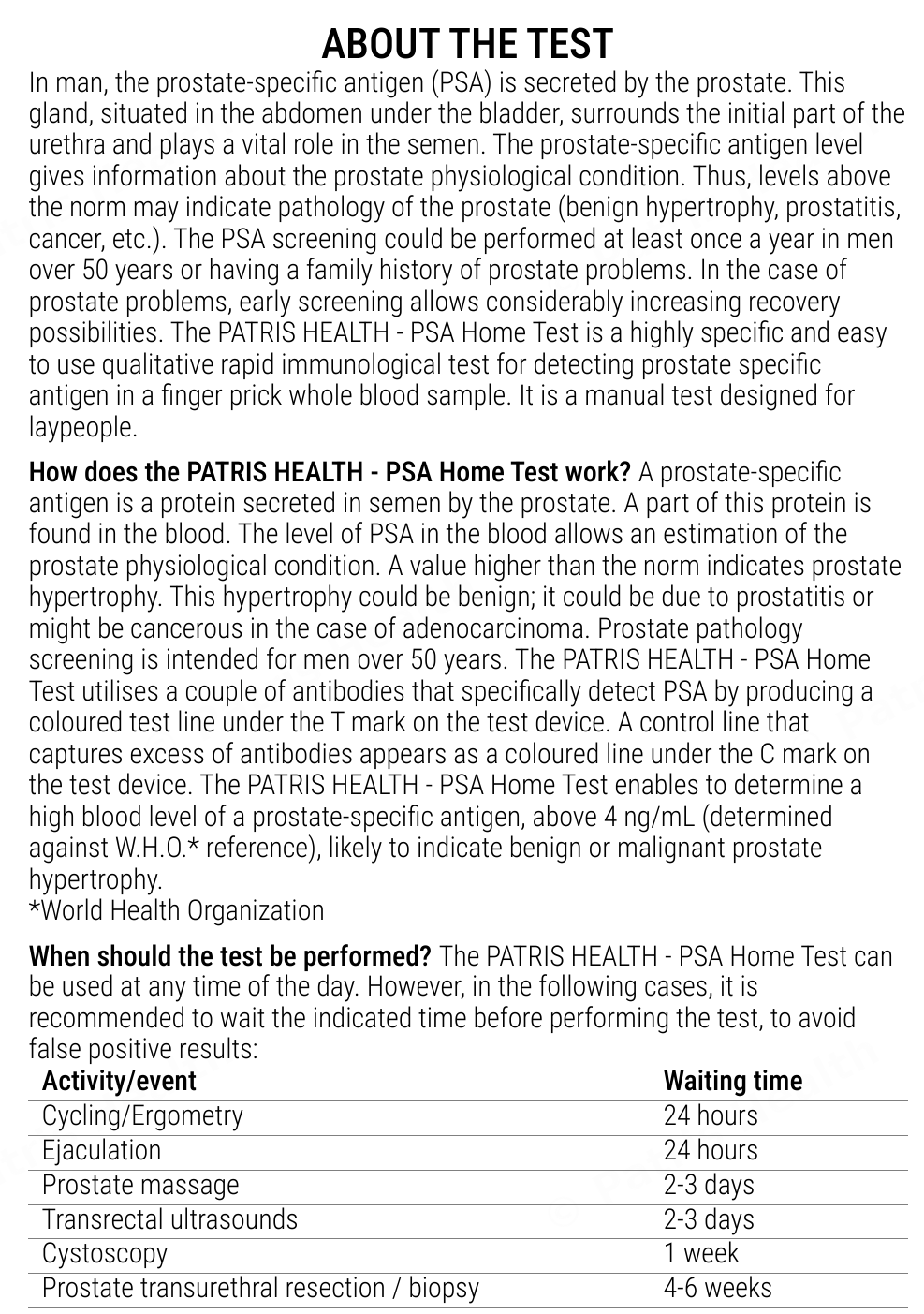
PSA, prostate-specific antigen, is a protein made by the prostate. A small part of it reaches the blood, and its level tells how the prostate is doing. Prostate problems often cause no symptoms early, when they are easiest to treat. A PSA test you do at home gives you a first answer in ten minutes. It is used by:
- Men over 50, as a yearly check
- Men with prostate problems in the family
- Men who want a first answer before they see a doctor
Why a yearly check. When a prostate problem is found early, the chances of recovery are considerably higher. European urology guidelines advise offering a PSA test to men from the age of 50, and from 45 when prostate cancer runs in the family. A raised PSA does not mean cancer; discuss the result with your doctor.
- From 50The age from which European urology guidelines advise offering a PSA test
- Father or brother affectedA family history raises the risk; the guidelines advise testing from 45
- Peace of mindA normal result once a year

What it measures
What this PSA test tells you, and what it does not
It tells you
- Whether the PSA in your blood is above 4 ng/mL, determined against the WHO reference
- A raised PSA is a reason to have the prostate examined
- From a fingertip blood sample, in ten minutes, at home, at any time of day
It does not tell you
- Whether you have cancer. A raised PSA also occurs with a benign enlarged prostate and with prostatitis
- The exact PSA number. It answers above or below one threshold
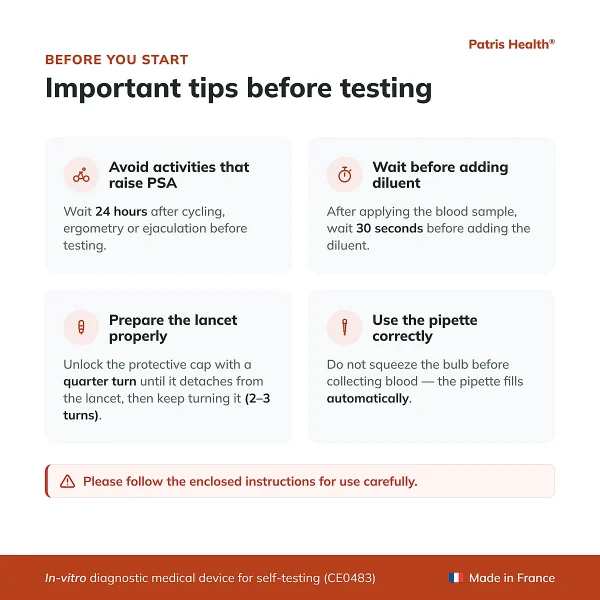
- Anything reliable shortly after cycling, ejaculation or a prostate examination — see the waiting times below
- That the prostate is healthy for good. A normal result should be repeated once a year
Wait before you test
These raise PSA for a while and can give a false positive result. Leave the time shown before testing.
| Cycling or ergometry | 24 hours |
|---|---|
| Ejaculation | 24 hours |
| Prostate massage | 2–3 days |
| Transrectal ultrasound | 2–3 days |
| Cystoscopy | 1 week |
| Prostate biopsy or transurethral resection | 4–6 weeks |
Contents
What is in the box
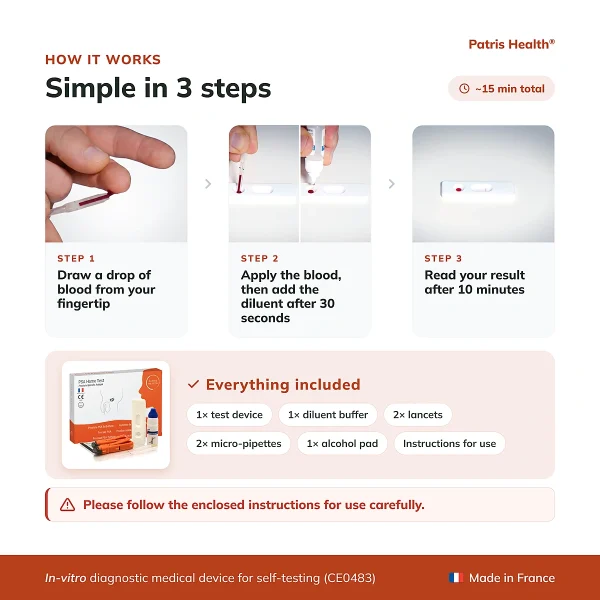
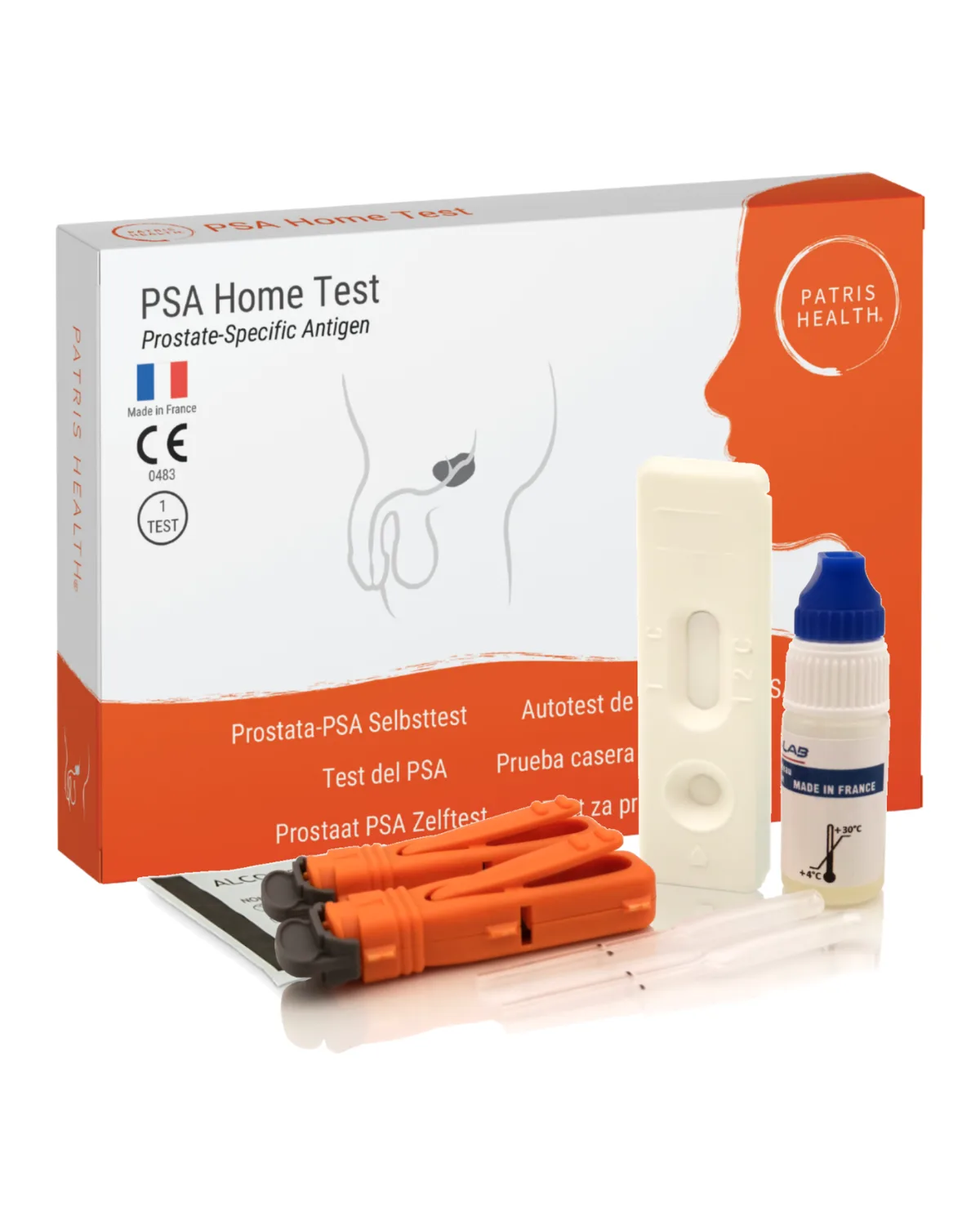
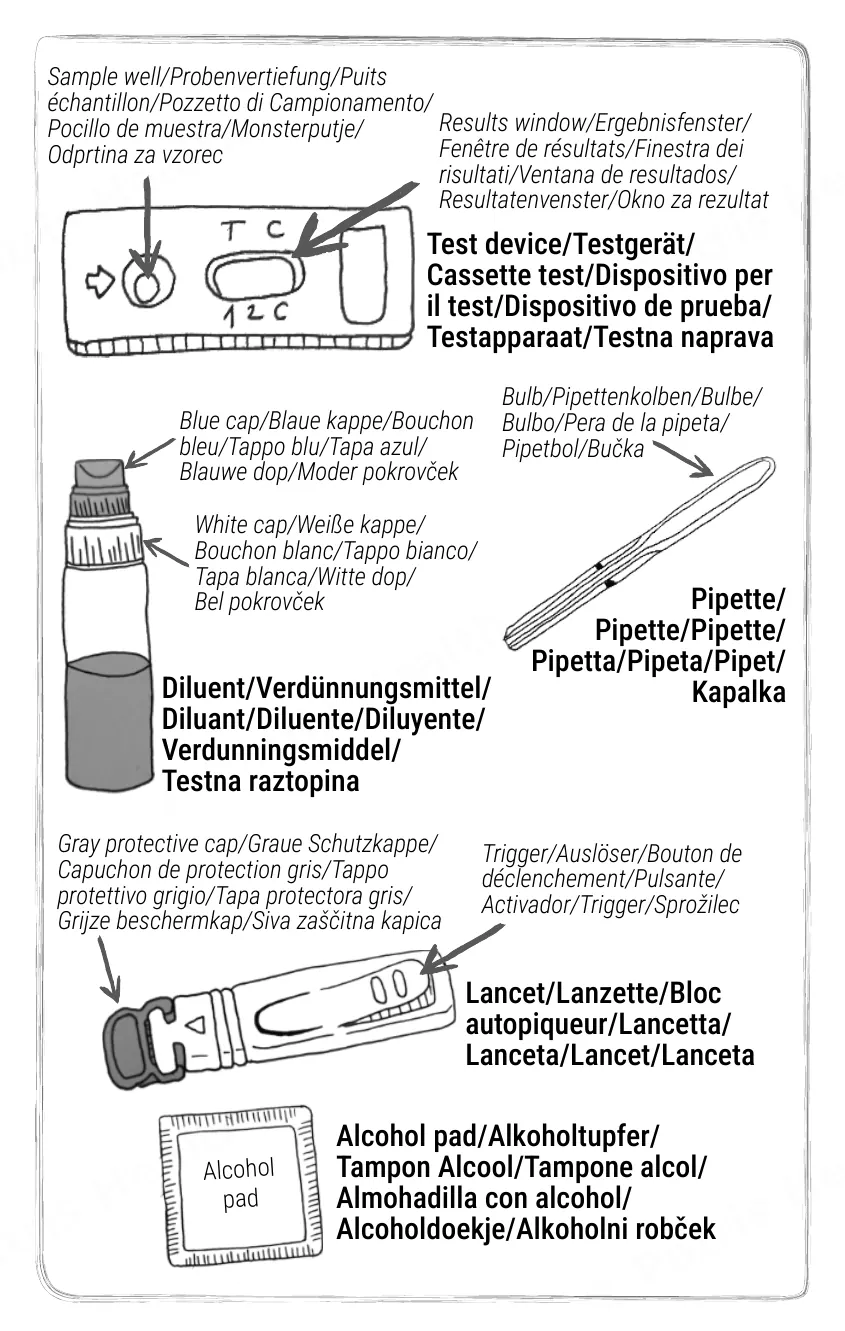
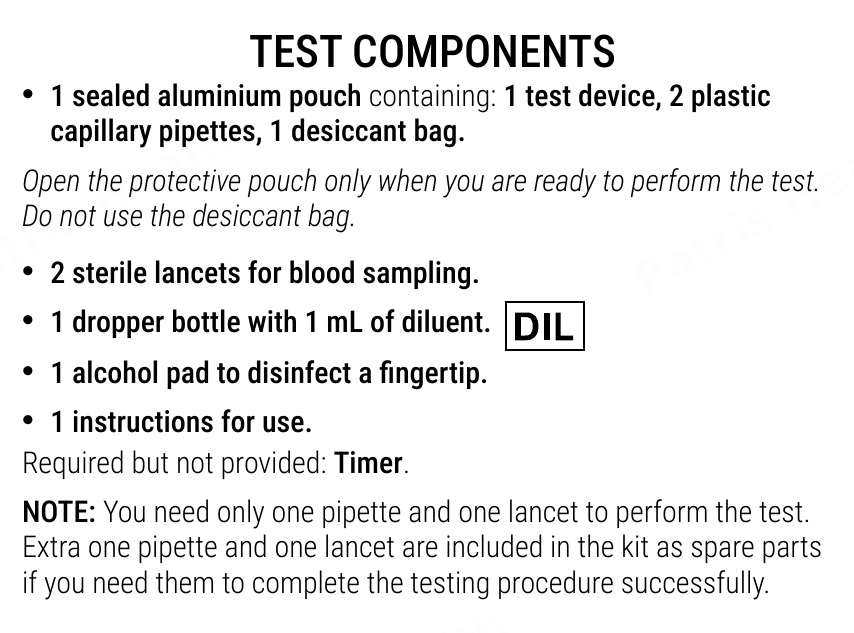
- 1 × test device in a sealed foil pouch
- 1 × dropper bottle of diluent 1 mL
- 2 × plastic capillary pipettes one is a spare
- 2 × sterile lancets one is a spare
- 1 × alcohol pad
- 1 × instructions for use in seven languages
- 1 × desiccant bag discard it, do not use it
Everything you need is in the box except a timer. Keep the foil pouch sealed until you test.
How it works
Five steps, about fifteen minutes

01
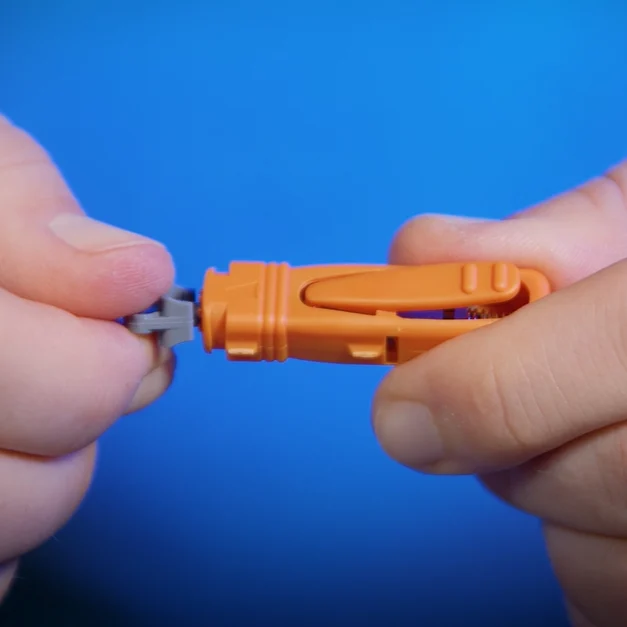
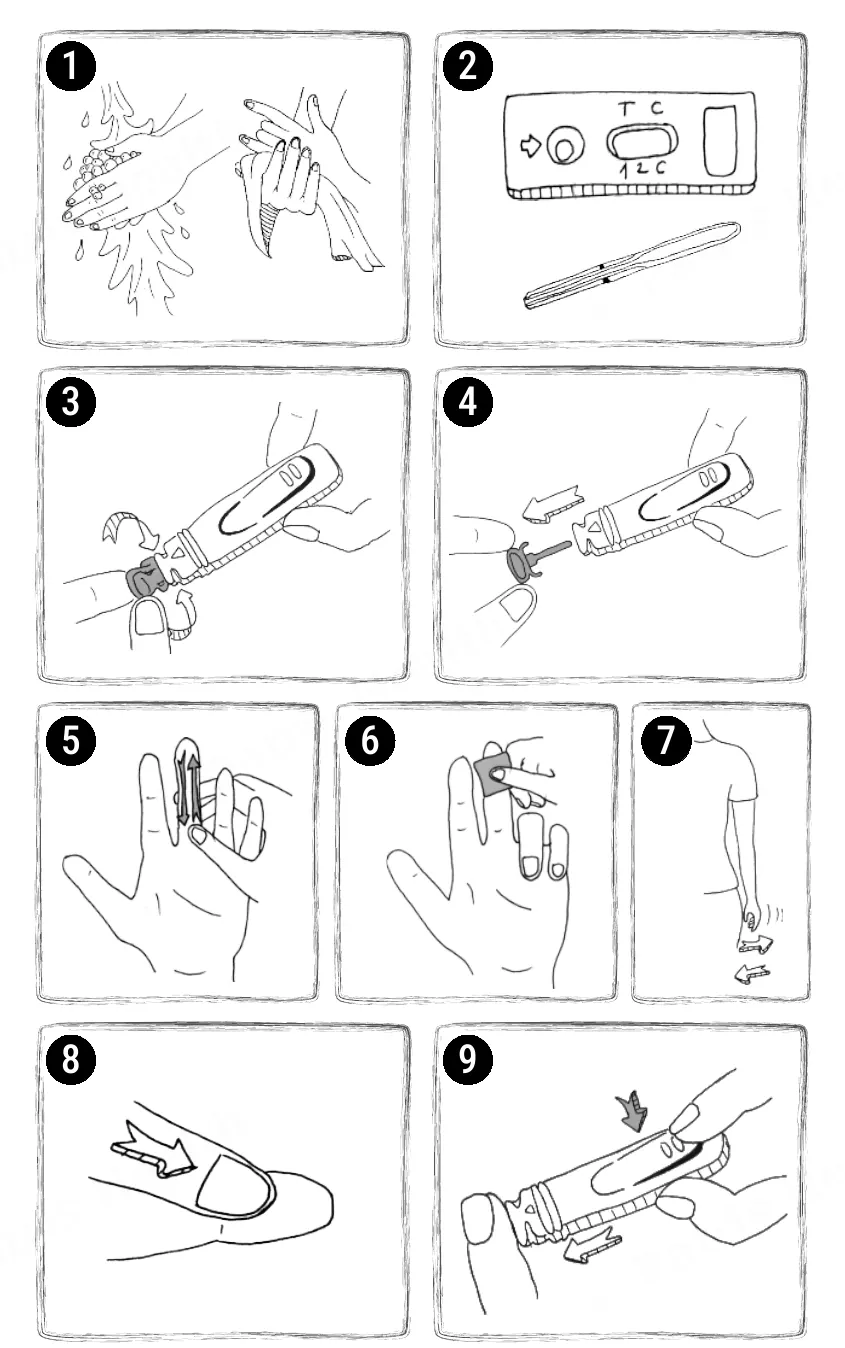
Prepare the lancet
Very important: do not touch the trigger. Twist the grey protective cap off, never pull it. Keep turning until it comes away.

02
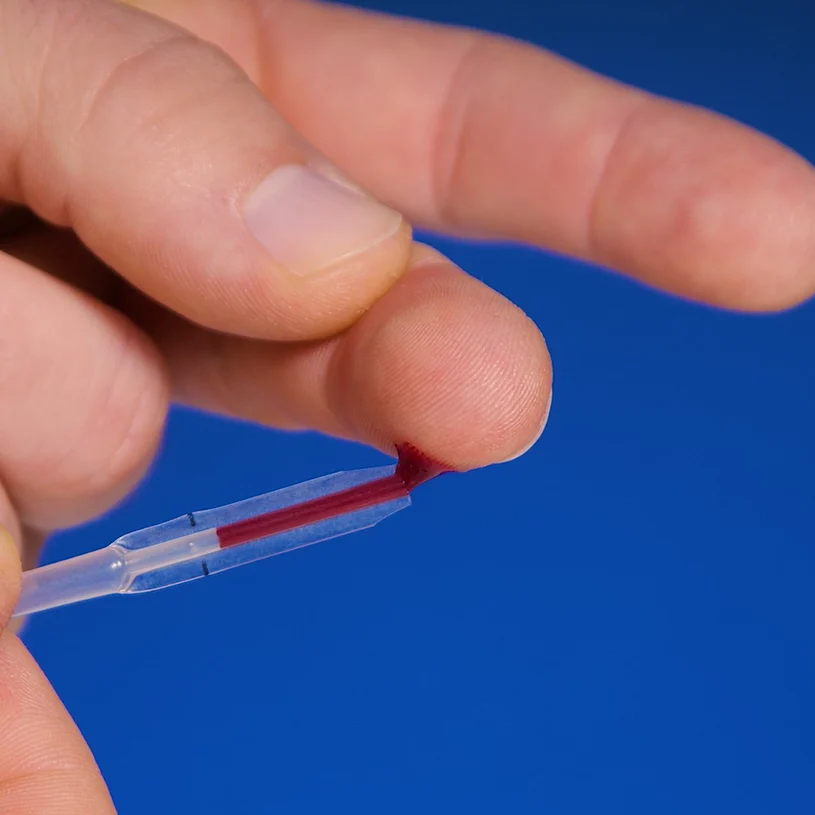
Take a blood sample from your fingertip
Very important: use the pipette correctly — lightly touch the drop of blood with the pipette’s tip, not the skin, do not squeeze the bulb, fill to the line.

03
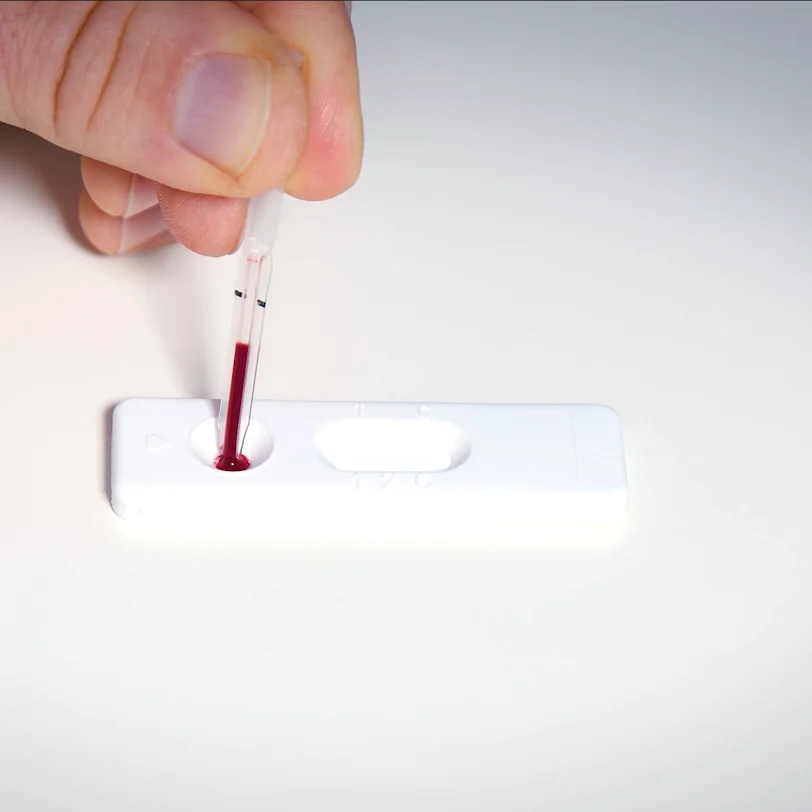
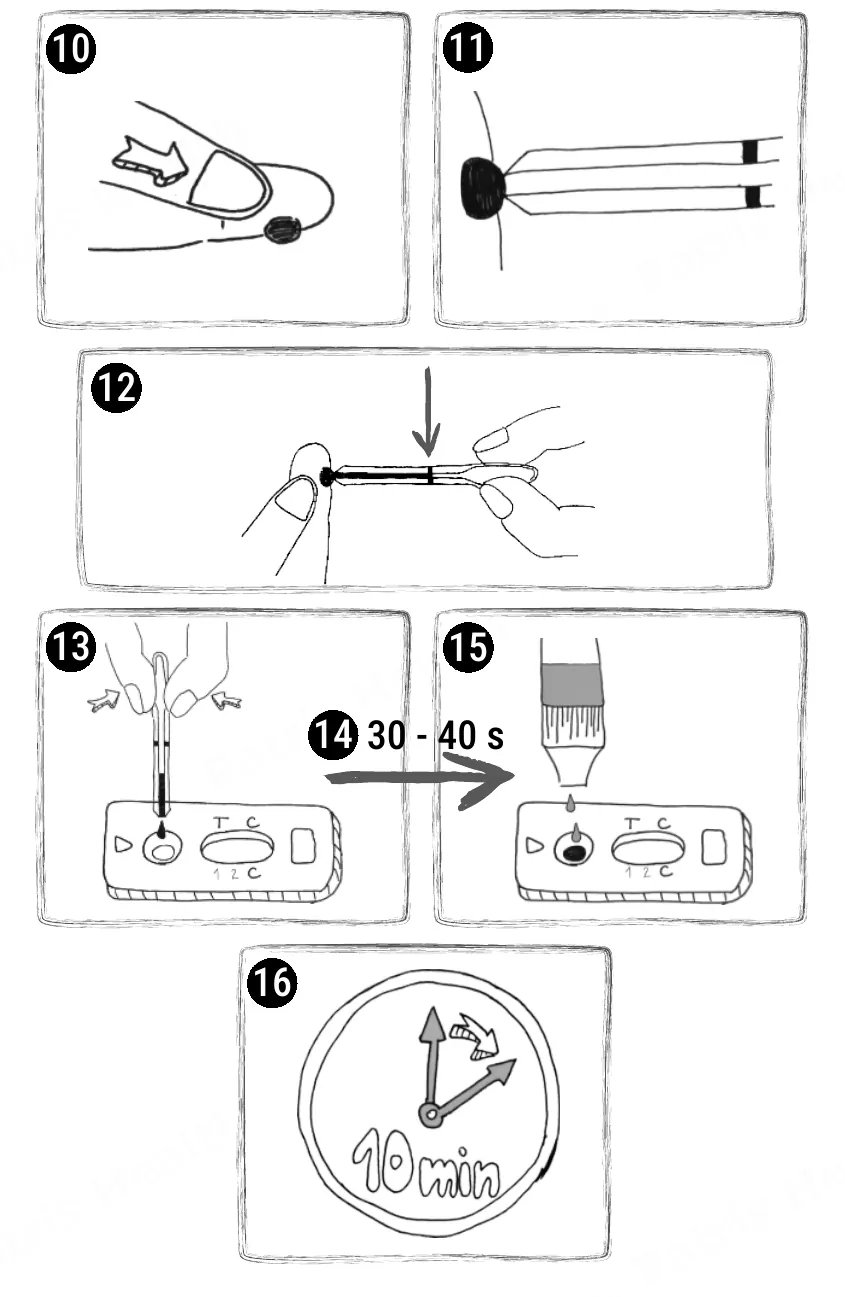
Put the blood into the sample well
Press the pipette bulb to release the blood into the sample well. Then wait 30 to 40 seconds until it is absorbed.

04
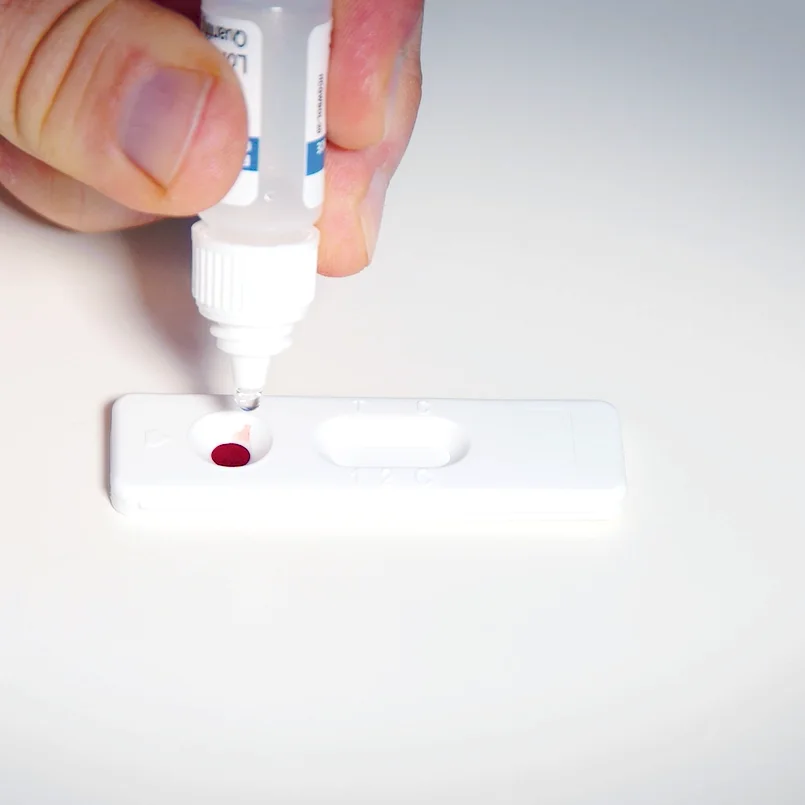
Add exactly 4 drops of diluent
Very important: add the diluent only after the 30 to 40 seconds. Hold the vial upright and add exactly four drops, 2–3 seconds apart.

05
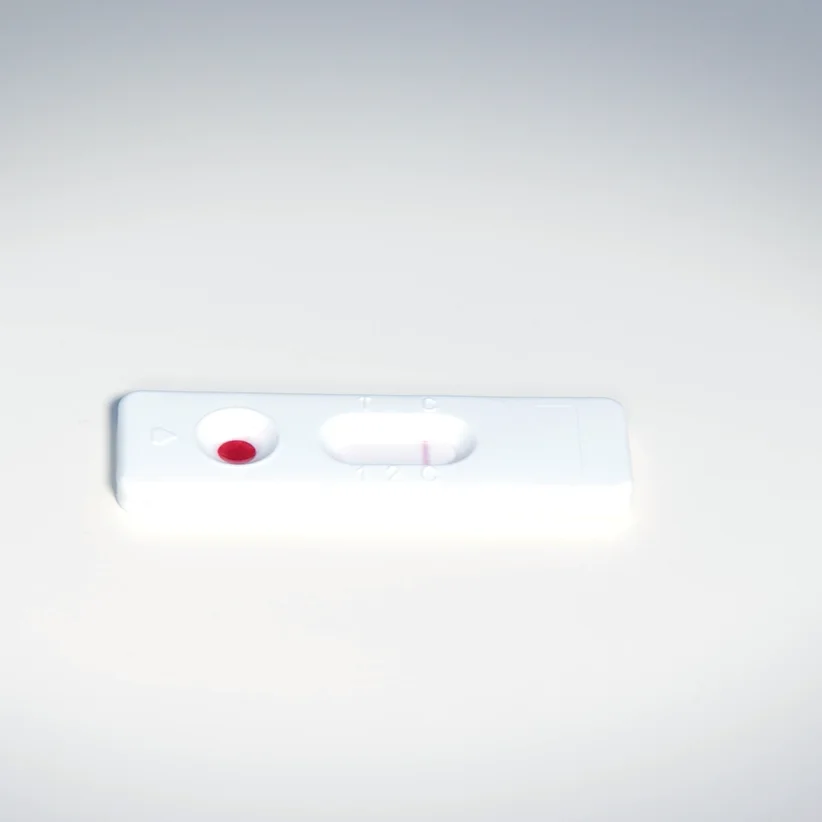
Read the result after 10 minutes
Not after 15. Set a timer.
Instructions for useWatch the video demonstration
On the clock: the ten minutes, step by step
- Drop in
Blood from the pipette into the sample well.
- Wait, then diluent
Not before 30–40 seconds. Then exactly four drops, 2–3 seconds apart.
- Colour moves
Lines begin to form. Not readable yet.
- Read
Read the result now, in good light.
- Stop
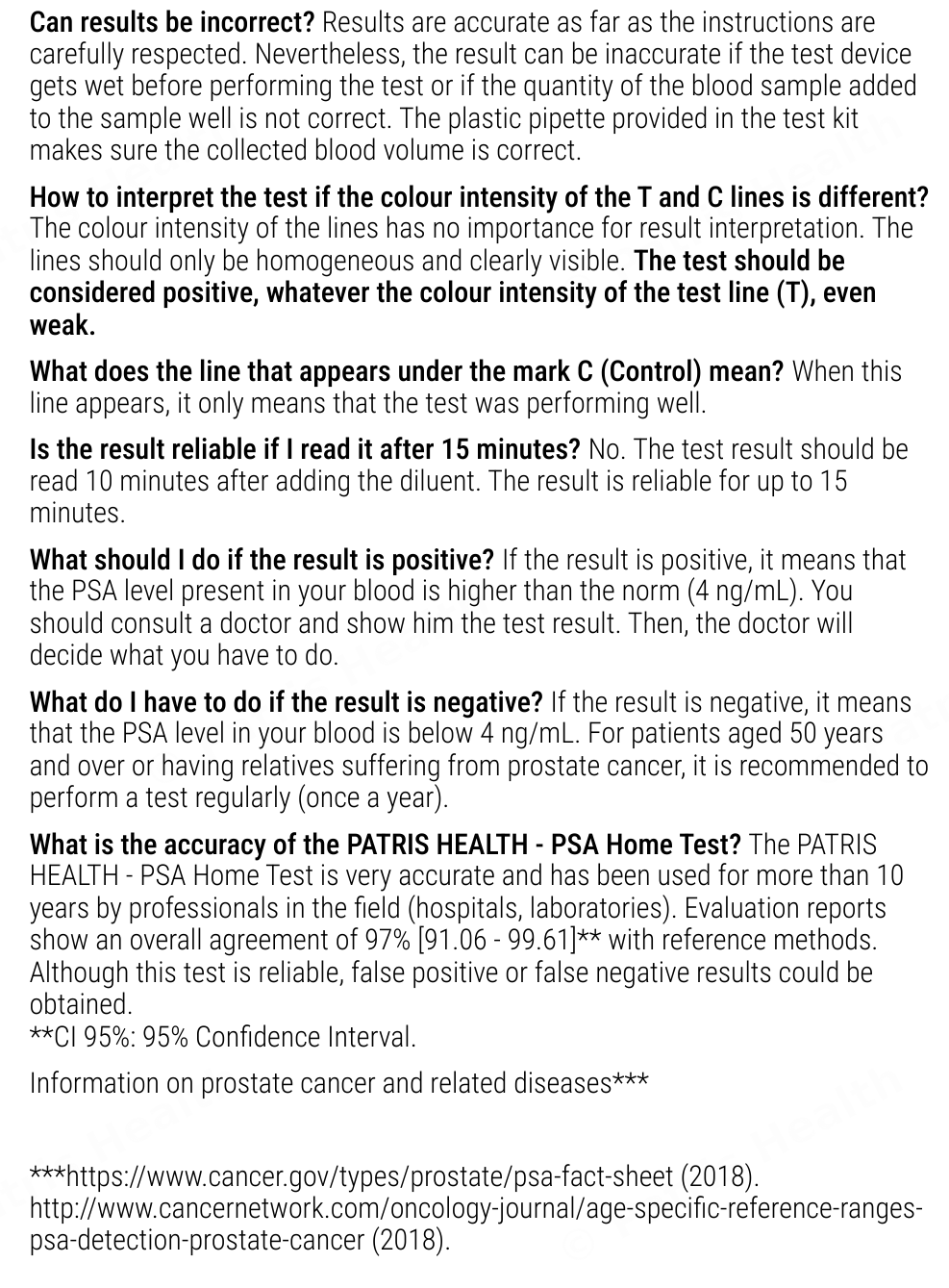
Do not interpret the result after 15 minutes.
Your result
How to read your PSA test result
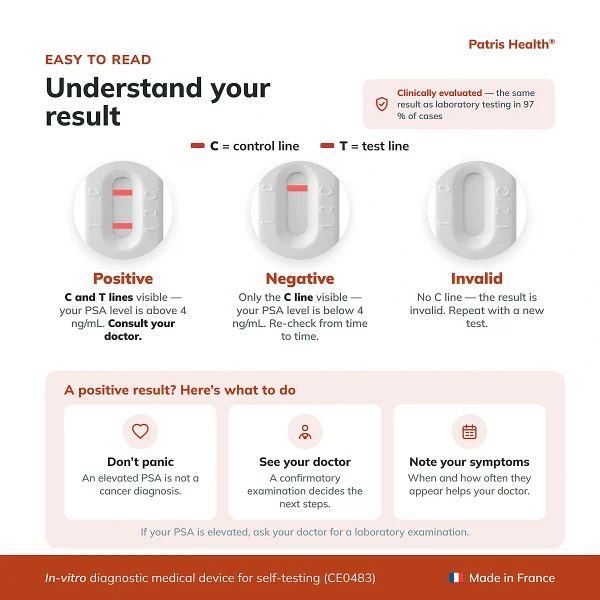
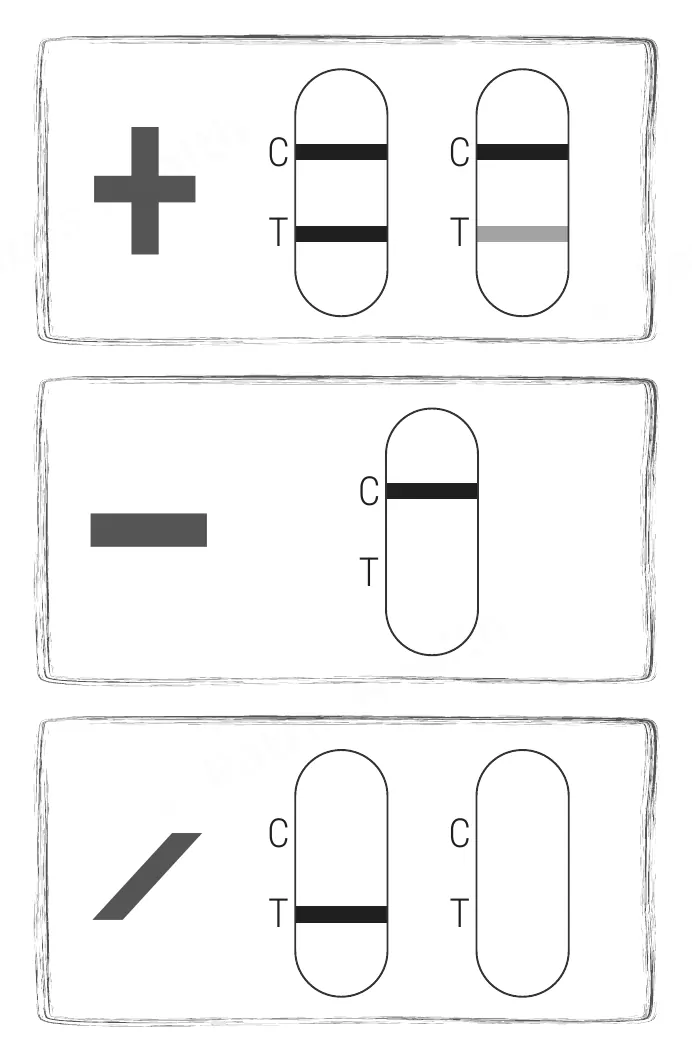
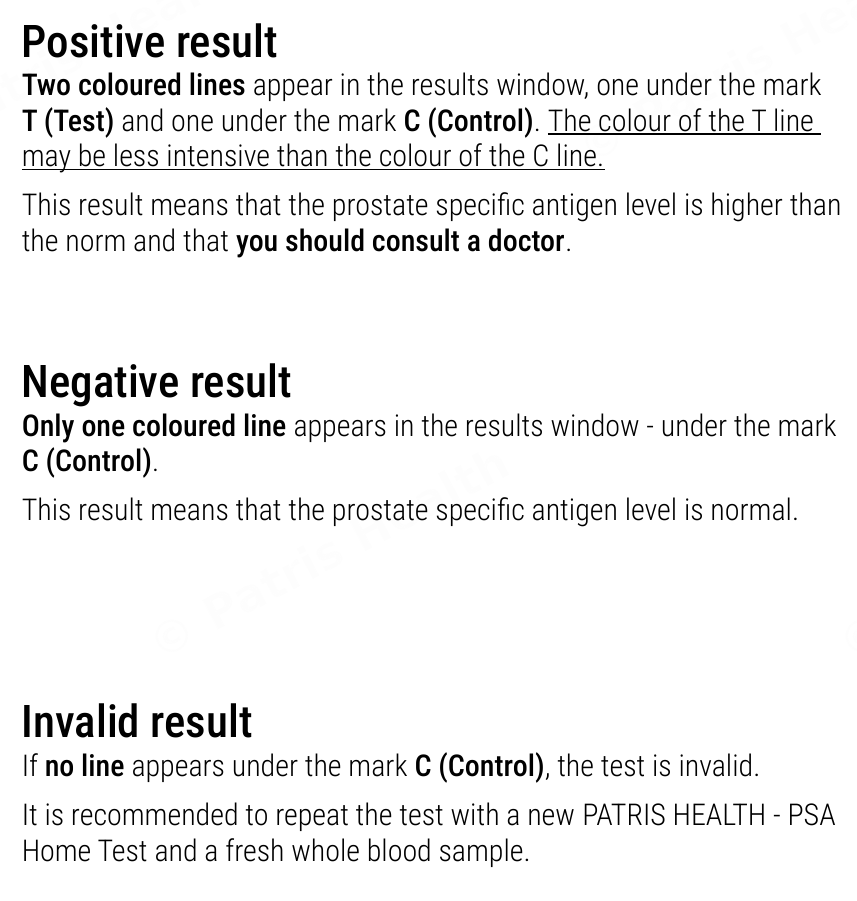
Two lines means your PSA is raised. One line means it is in the normal range. A faint second line still counts as a line. The pictures below show each result.
PSA raised positive
Both C and T lines are visible. PSA is above 4 ng/mL. See your doctor.
Normal negative
Only the C line is visible. PSA is below 4 ng/mL.
Invalid repeat
No C line. The result cannot be read. This happens most often when the diluent is added before the blood has been absorbed. Repeat with a new test and a fresh blood sample, and wait the full 30 to 40 seconds before you add the diluent.
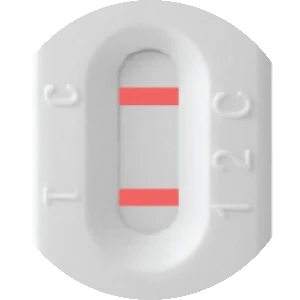
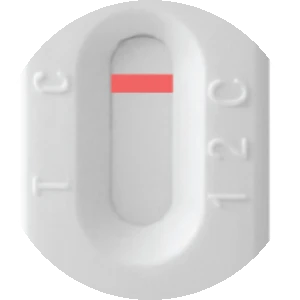
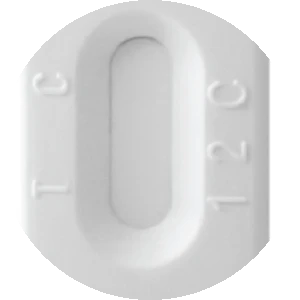
A faint T line still counts as a line — the colour and intensity of the lines do not matter, only that they are homogeneous and complete. Read at 10 minutes; do not interpret the result after 15. The pictures are for illustration purposes; the actual lines may differ in intensity.
Next step
What to do with your result
If your PSA is raised
See your doctor and show the result. A raised PSA is not a diagnosis: it can come from a benign enlargement, an inflammation or a tumour, and only an examination tells them apart. Do not wait, and do not assume the worst.
If your PSA is normal
Your PSA is in the normal range. A normal PSA does not rule out every prostate problem, so see your doctor if you have symptoms. From the age of 50, or with prostate cancer in the family, repeat the test once a year.
The technology
What happens inside the test device
All of it happens on a paper strip inside the test device, in ten minutes.
- The sample moves
The drop of blood and the diluent travel along the strip by capillary action. No pump, no power.
- Antibodies find PSA
The strip carries antibodies tagged with a coloured reagent. As the sample passes, they bind to the prostate-specific antigen in it.
- The T line
A second antibody fixed at T catches those complexes. Above 4 ng/mL, a coloured line appears. Below that, none.
- The C line
The C line captures the excess reagent whatever the sample holds. The C line only means that the test was performed well. No C line, no result.
This test has been used by professionals in hospitals and laboratories for more than 10 years. It gives one answer — above or below the threshold — not a number.
Quality
Made in France, checked batch by batch
30+
years of diagnostic expertise — rapid tests made in France since 1991
- ISO 13485The international quality-management standard for organisations that design, manufacture and service medical devices
- Every batch checkedDefined checks completed before a batch is released
- Monitored after releasePerformance tracked for as long as the batch is on the market
Notified body 0483ISO 13485Made in FranceCE-marked IVD
The Patris Health promise. No valid result? Write to us and we replace the test or refund the purchase price. It applies whenever the test was performed as the instructions describe, and we do not argue about it.
Specification
Technical data for the PSA test
| Intended use | Qualitative immunochromatographic screening test for prostate-specific antigen (PSA) in capillary whole blood, for self-testing by lay users |
|---|---|
| Analyte | Prostate-specific antigen (PSA) |
| Method | Lateral flow immunoassay |
| Cut-off | 4 ng/mL (determined against the WHO reference) |
| Sample | Capillary whole blood from a fingertip, pipette filled to the line |
| Time to result | Read at 10 minutes; do not interpret after 15 minutes |
| Agreement | 97 % overall agreement with reference methods (95 % CI 91.06–99.61 %) |
| Storage | 4 to 30 °C, do not freeze |
| Expiry date | Indicated on the label and the foil pouch |
| Device type | CE-marked in-vitro diagnostic medical device (IVD) for self-testing |
| Certificates | CE 0483 · ISO 13485 |
Questions
Asked before ordering
How accurate is a PSA test at home compared with the laboratory?+
In the evaluation studies, the test agreed with laboratory reference methods in 97 % of cases (95 % CI 91.06–99.61 %). The difference is what you get back: the laboratory reports a PSA number, this test tells you whether you are above or below 4 ng/mL. For a yearly check that is enough; if it is raised, the number comes from your doctor. As with any rapid test, a false positive or false negative result can occur.
Does the finger prick hurt?+
It is a brief prick. Wash your hands with warm water first, massage the finger towards the tip for 10 to 15 seconds, and prick the side of the fingertip. The needle retracts into the lancet straight away.
Does a raised PSA mean cancer?+
No. PSA rises with a benign enlarged prostate and with an inflammation of the prostate as well as with cancer. A raised result means the prostate should be examined, nothing more.
How often should I test?+
Once a year from the age of 50, or if a close relative has had prostate cancer.
I cycled this morning. Can I test today?+
Wait 24 hours. Cycling and ejaculation raise PSA for about a day; a prostate examination for longer. The waiting times are listed on this page.
What if I cannot get enough blood?+
Massage the finger gently from its base towards the tip, with a light squeeze-and-release motion, until a large drop forms. Then fill the pipette to the line. Every kit has a spare lancet and pipette for a second attempt.
The lancet did nothing when I pressed it+
A lancet works only once. If the grey protective cap was pulled off by force instead of twisted, the lancet may already have been triggered. Take the spare lancet, give the cap a quarter turn, keep turning until it comes away, then press the lancet firmly against the side of the fingertip and press the trigger button.
Why did I get an invalid result?+
The most common causes are an incorrect amount of blood, adding the diluent before the blood was absorbed, or a test device that was exposed to moisture before use. A test device can be used only once, so repeat with a new test: fill the pipette to the line, wait 30 to 40 seconds, then add four drops. Write to us and we replace the test.
How do I dispose of the lancet?+
The needle retracts into the lancet body after use, so all components can go in household waste. If your pharmacy collects sharps separately, use that; it is the tidier option.
Sources
European Association of Urology. (2026). EAU guidelines on prostate cancer: Diagnostic evaluation. https://uroweb.org/guidelines/prostate-cancer/chapter/diagnostic-evaluation
National Cancer Institute. (2025, January 31). Prostate-specific antigen (PSA) test. https://www.cancer.gov/types/prostate/psa-fact-sheet
National Health Service. (2024, September 2). PSA test. https://www.nhs.uk/tests-and-treatments/psa-test/
National Health Service. (2025a, July 31). Symptoms of prostate cancer. https://www.nhs.uk/conditions/prostate-cancer/symptoms/
National Health Service. (2025b, July 31). What is prostate cancer? https://www.nhs.uk/conditions/prostate-cancer/what-is-prostate-cancer/
Last reviewed 2 October 2026
Instructions for use
Patris Health PSA Home Test
Detection of Prostate Specific Antigen (PSA) in whole blood. CE-marked in-vitro diagnostic medical device for self-testing.
This is the English part of the multi-language instructions for use. The printed instructions in the box carry the same text in seven languages: English, German, French, Italian, Spanish, Dutch and Slovenian. If the version printed on the instructions in your box differs from this one, follow the instructions in your box.
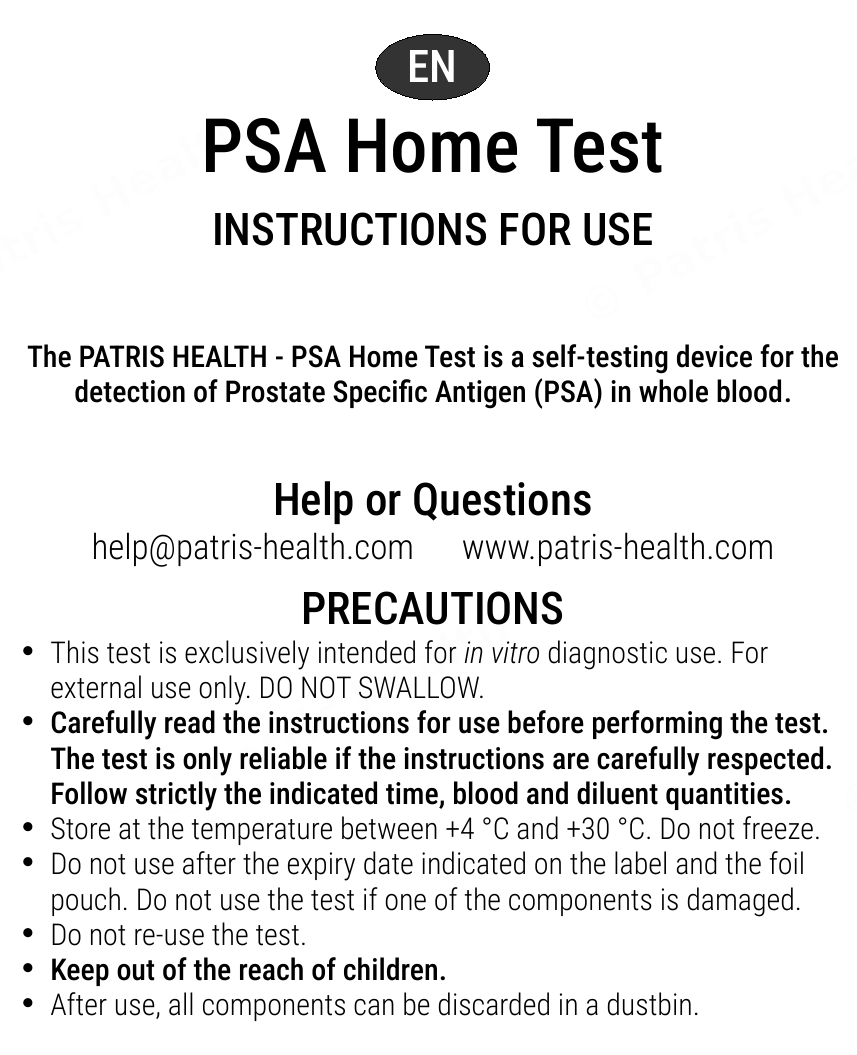
Precautions and test components
Read this before you start: safety, storage and what is in the kit.
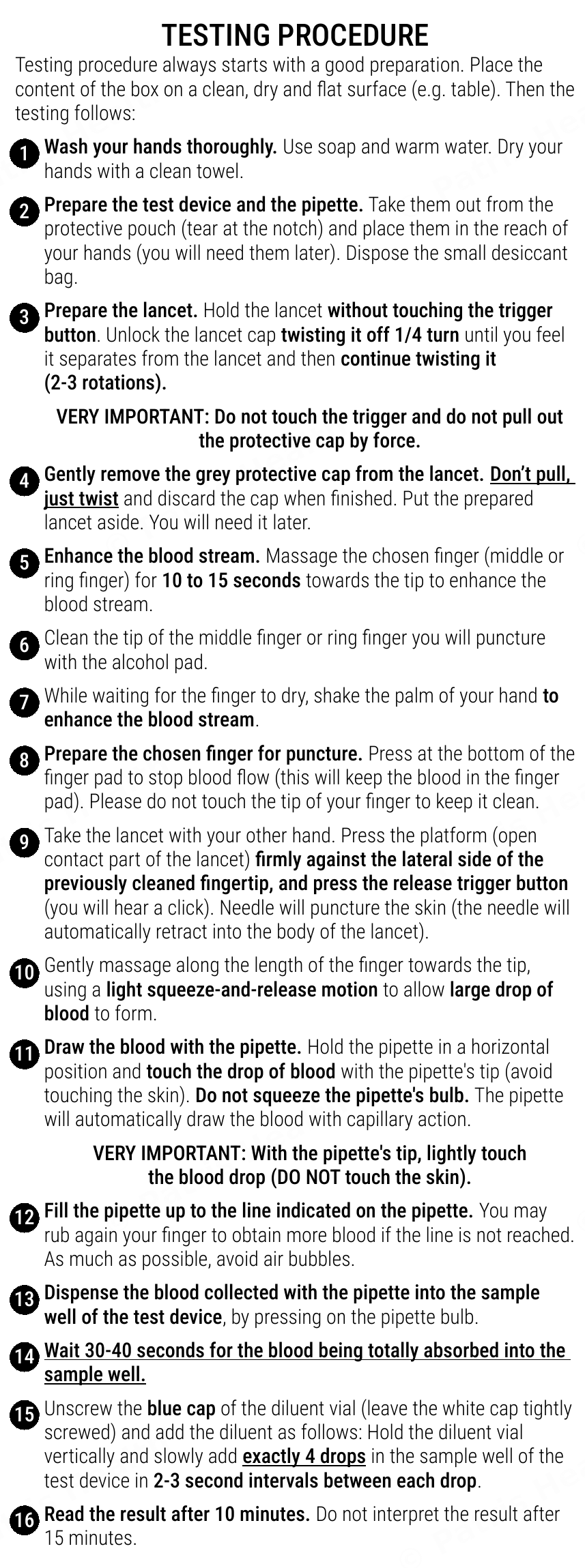
Testing procedure
Step by step, with a picture for each step.
Interpretation of the results
How to read your result, with pictures.

About the test
Background, questions and answers, accuracy.
Questions about the test: help@patris-health.com
Instructions for use PSAV02, January 2025 · © Patris Health. Copying and reproduction are not permitted.