



Who it is for
Is this rotavirus and adenovirus test right for you?
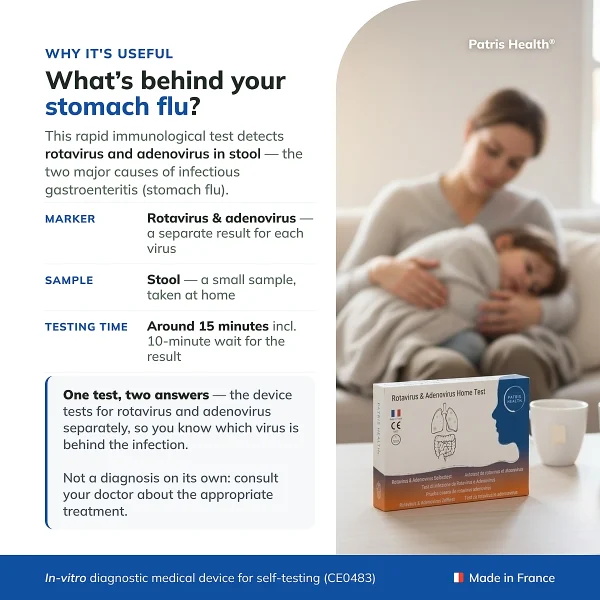
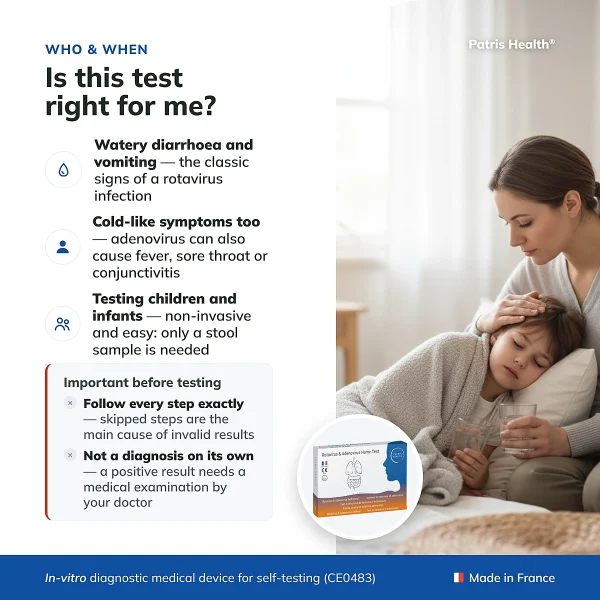
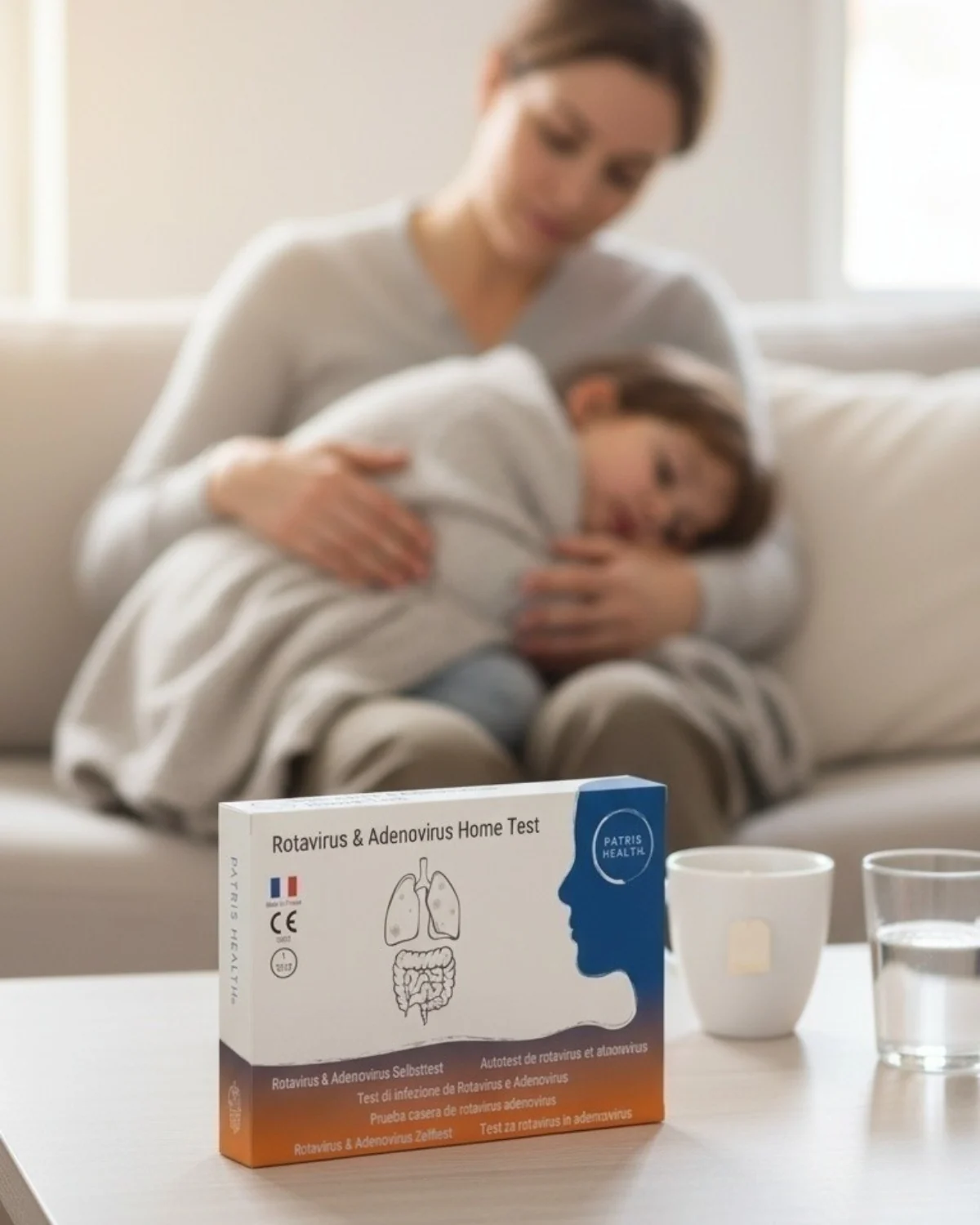
Rotavirus and adenovirus are among the main causes of infectious gastroenteritis — the stomach bug that brings sudden diarrhoea and vomiting. Both spread quickly through contact with contaminated hands and surfaces, and both can be severe in young children, older people and anyone with a weakened immune system. This rotavirus test at home also checks for adenovirus and gives you an answer in ten minutes. People use it when:
- Diarrhoea and vomiting come on suddenly
- A child or an older relative is ill
- Several people in the household or nursery fall ill together
- They want to know whether a virus is the cause before seeing a doctor
Why it helps to know. A viral stomach bug is not treated with antibiotics, and knowing which virus is the cause helps protect the people most at risk.
- Young childrenInfections can be severe
- Older peopleInfections can be severe
- Weakened immune systemSee a doctor after a positive result
- Autumn and springWhen epidemics usually appear
What it measures
What this rotavirus and adenovirus test tells you, and what it does not
It tells you
- Whether rotavirus is present in the stool
- Whether adenovirus is present in the stool — each virus has its own result window
- From one small stool sample, in ten minutes, at home
It does not tell you
- Whether another virus or a bacterium is the cause, if both result windows are negative
- How severe the infection is
- Whether treatment is needed. With a positive result, especially with a weakened immune system, that is your doctor’s decision
Contents
What is in the box
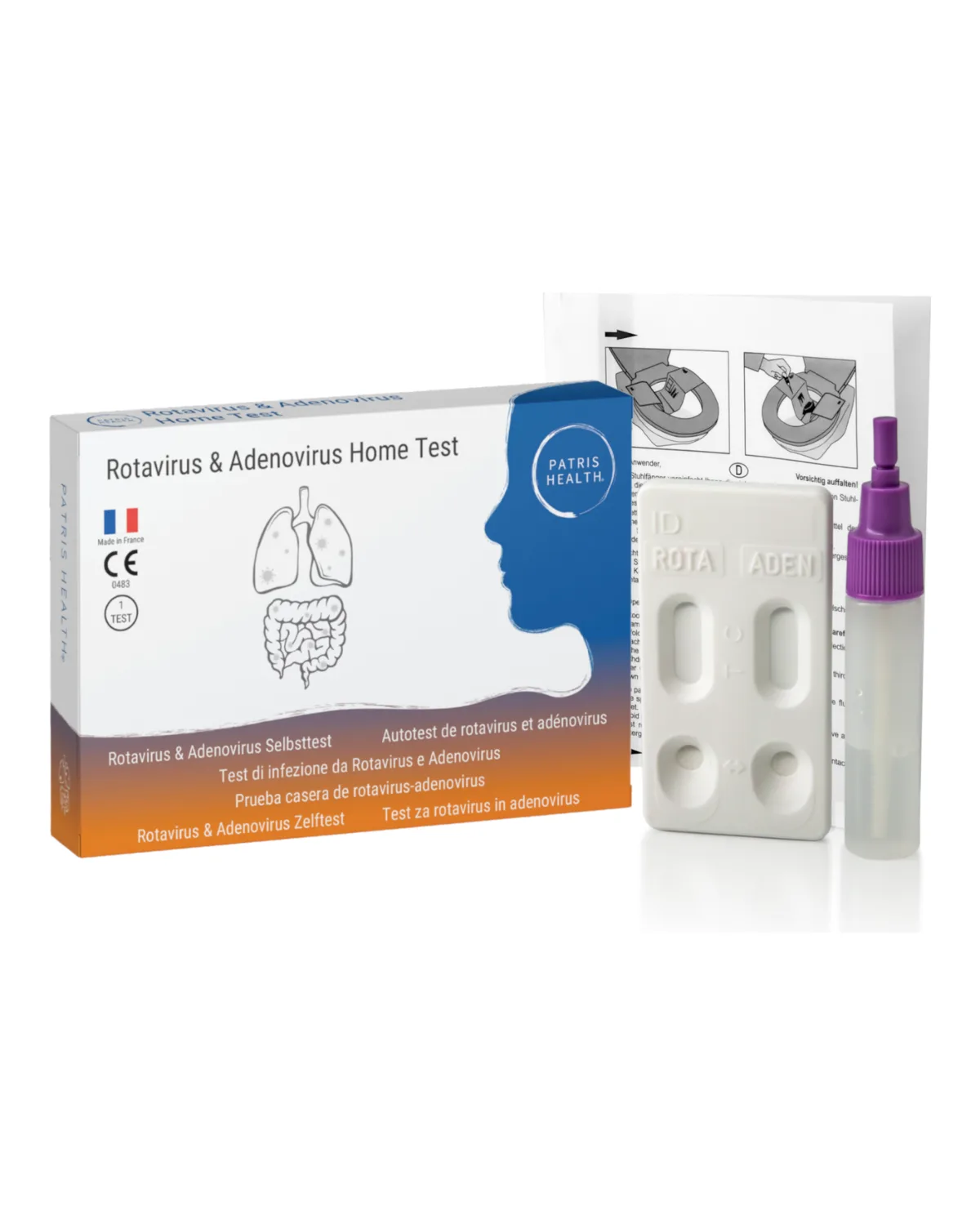
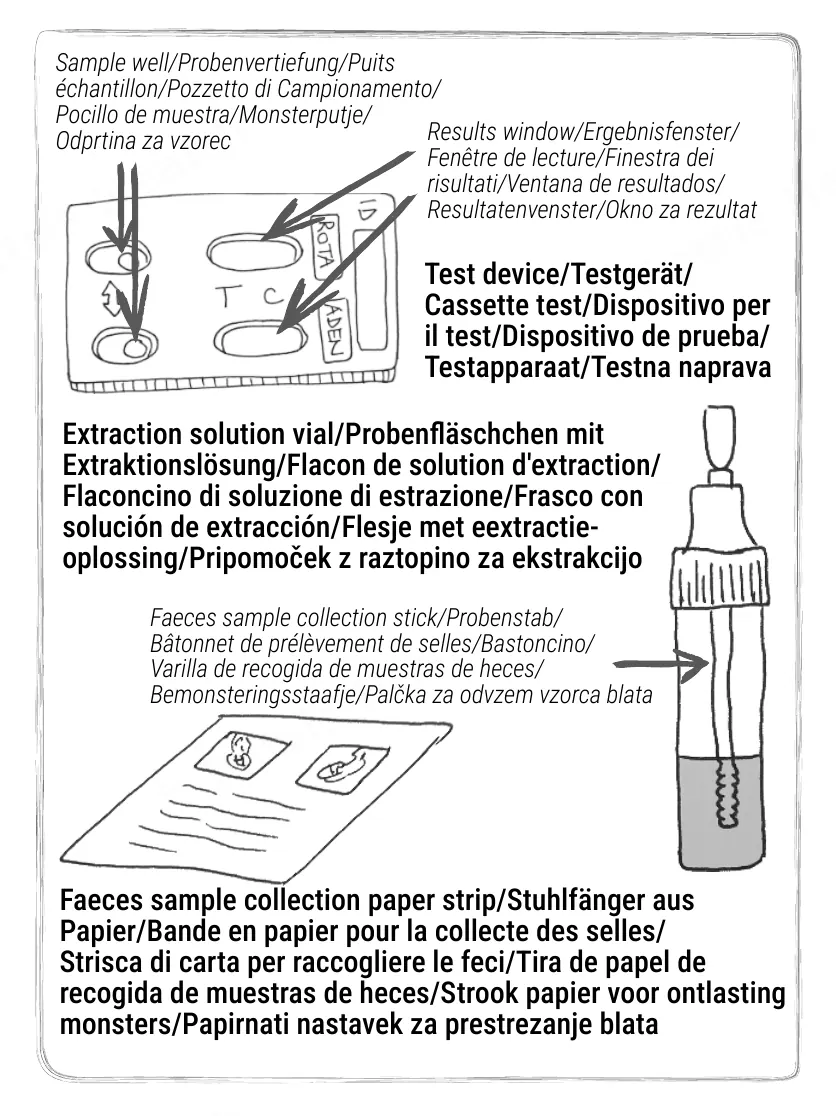
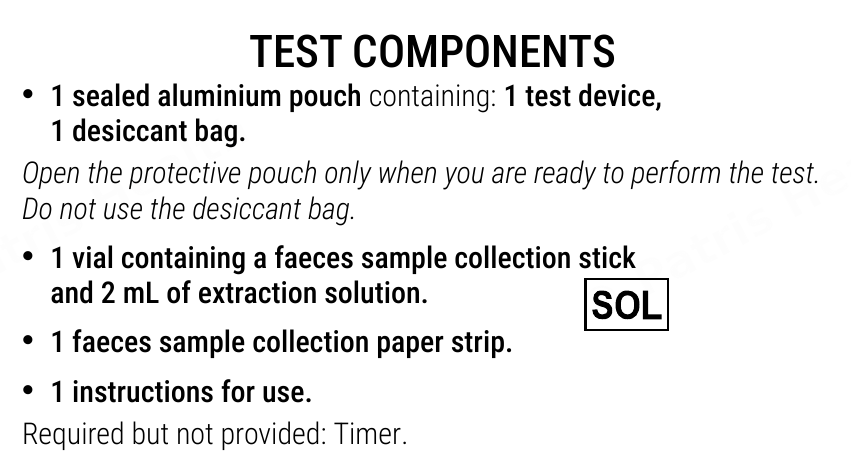
- 1 × test device with two result windows, in a sealed foil pouch
- 1 × collection vial with sampling stick and 2 mL of extraction solution
- 1 × stool collection paper strip
- 1 × instructions for use in seven languages
- 1 × desiccant bag discard it, do not use it
Everything you need is in the box except a timer. Keep the foil pouch sealed until you test.
How it works
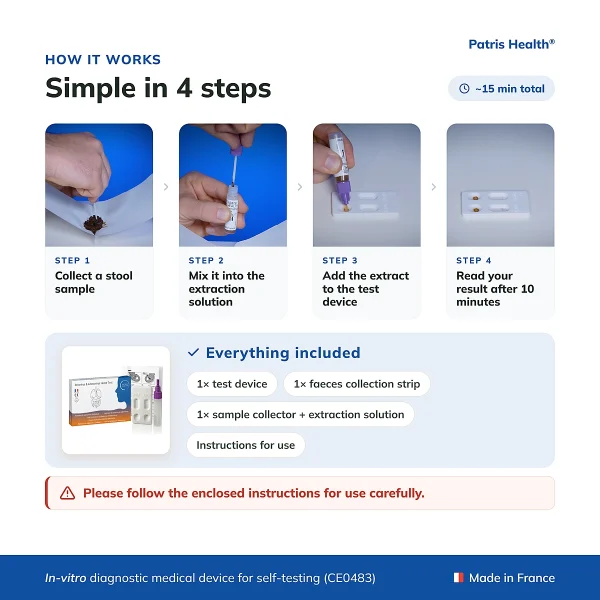
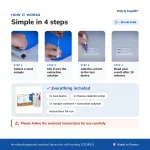
Four steps, about fifteen minutes

01
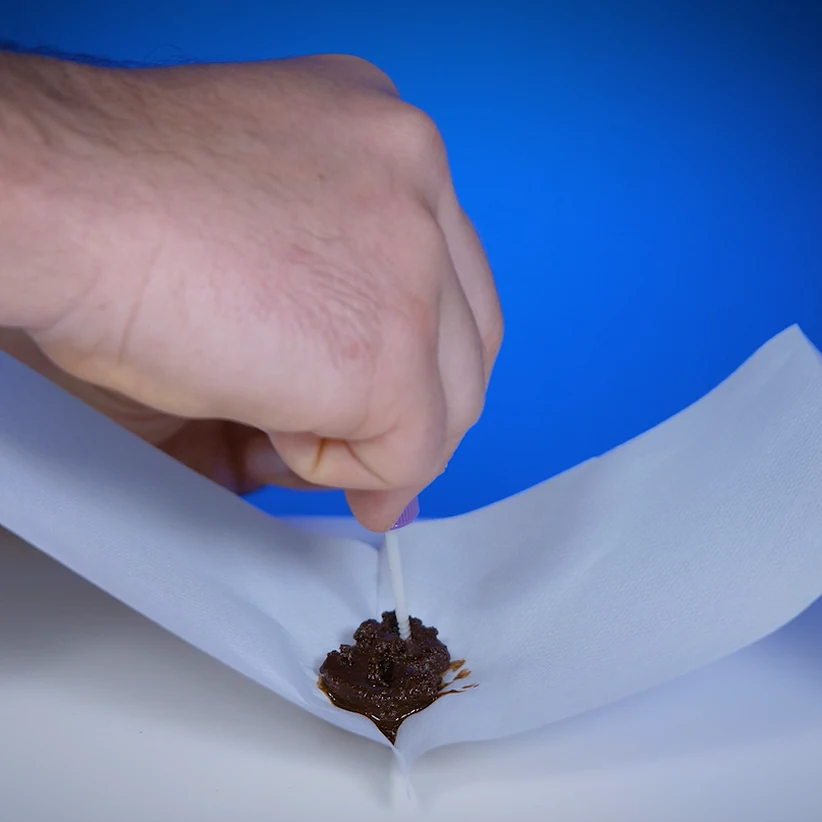
Collect a small stool sample
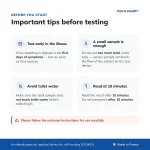
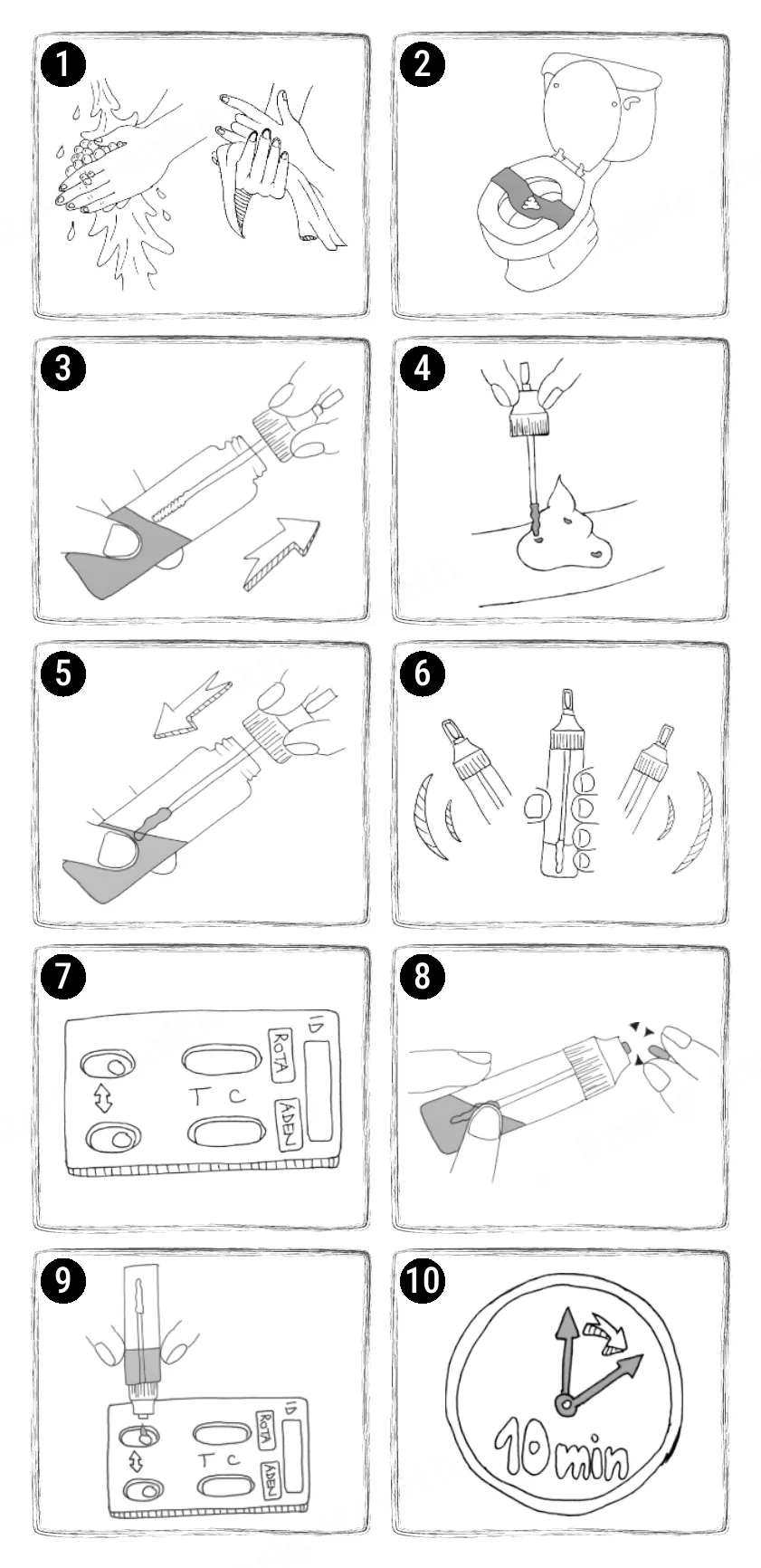
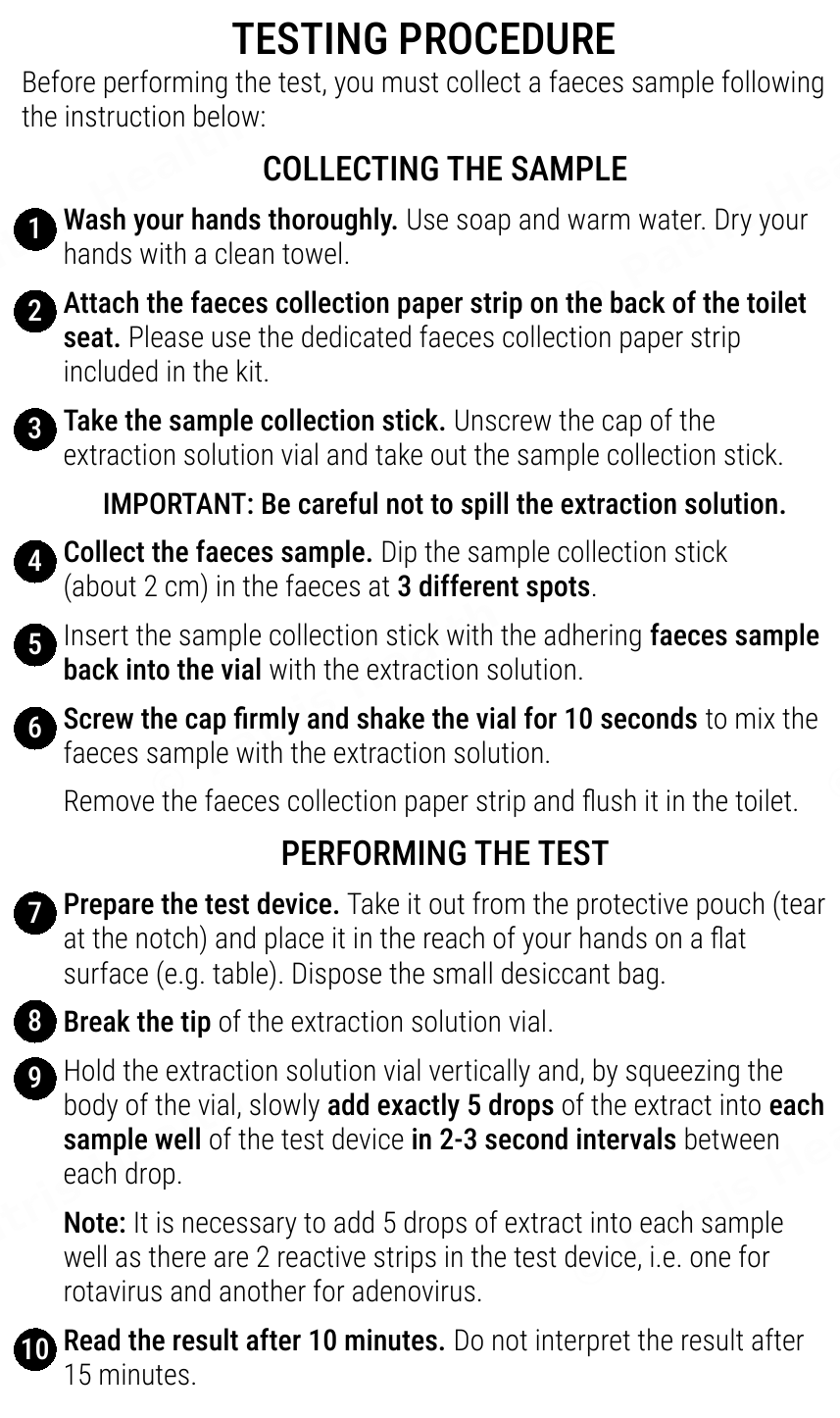
Fix the paper strip across the back of the toilet seat. Unscrew the cap of the vial without spilling the extraction solution, and dip the stick about 2 cm into the stool at three different spots.
02
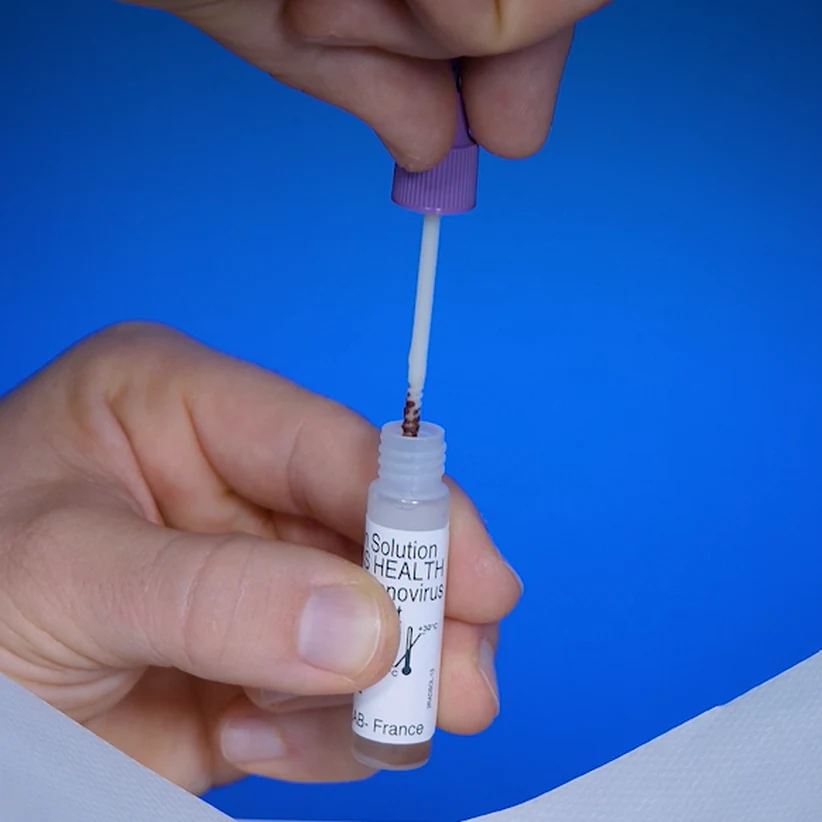
Back into the vial, then shake
Put the stick back into the vial, close the cap firmly and shake for 10 seconds so that the sample mixes with the extraction solution.
03
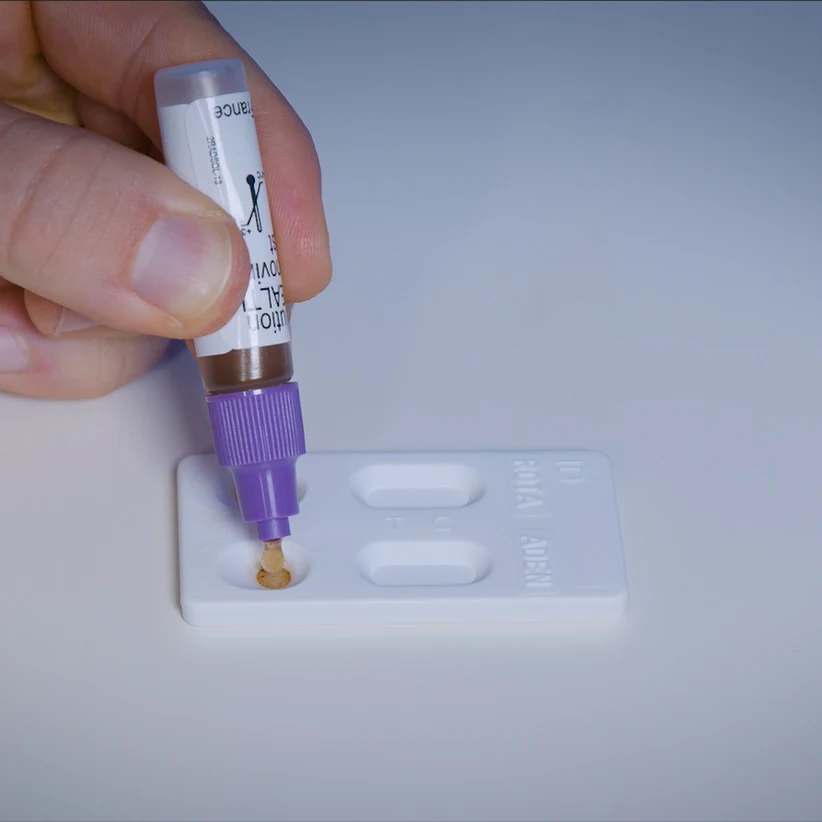
Five drops into each of the two wells
Very important: the test device has two sample wells, one for each virus. Break off the tip, hold the vial upright and squeeze gently to add exactly five drops into each well, 2–3 seconds apart.
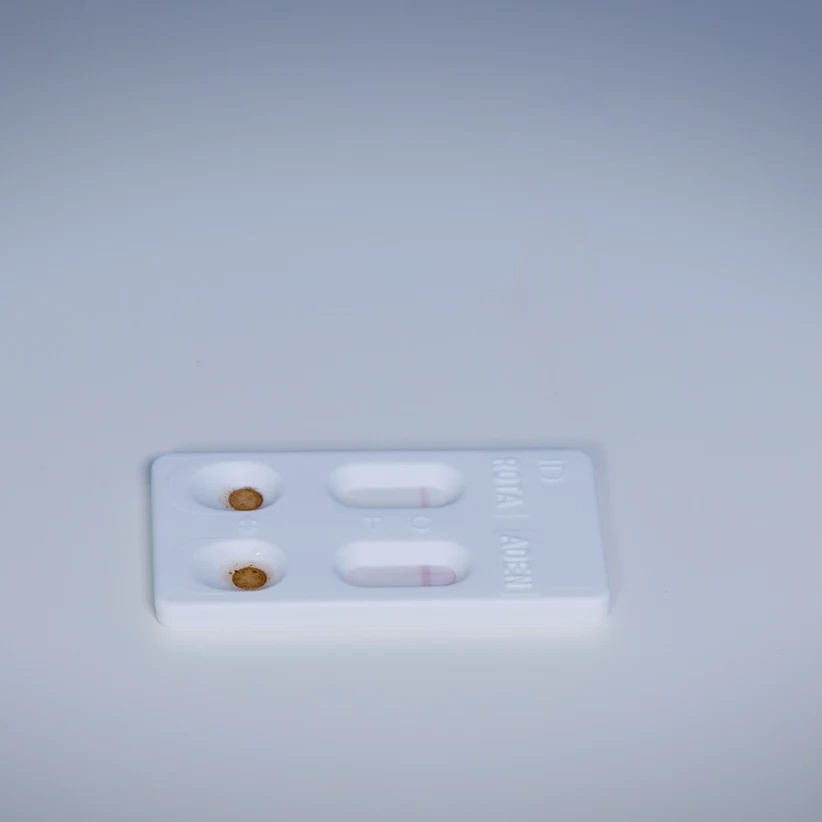
04
Read both result windows after 10 minutes
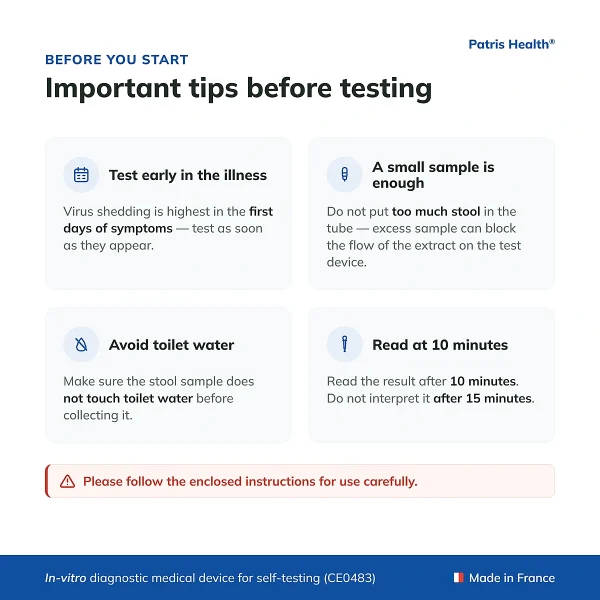
Not after 15. Set a timer.
Instructions for useWatch the video demonstration
On the clock: the ten minutes, step by step
- Sample
Stick into the stool at three spots, back into the vial.
- Shake
Ten seconds, then break off the tip.
- Five drops, twice
Exactly five into each of the two wells.
- Read
Read both result windows now, in good light.
- Stop
Do not interpret the result after 15 minutes.
Your result
How to read your rotavirus and adenovirus test result
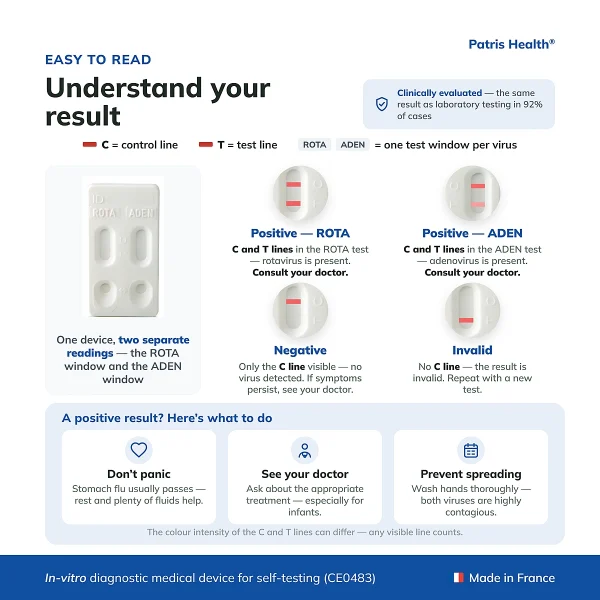
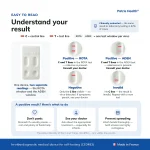
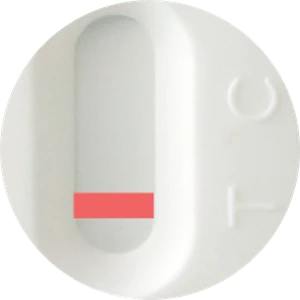
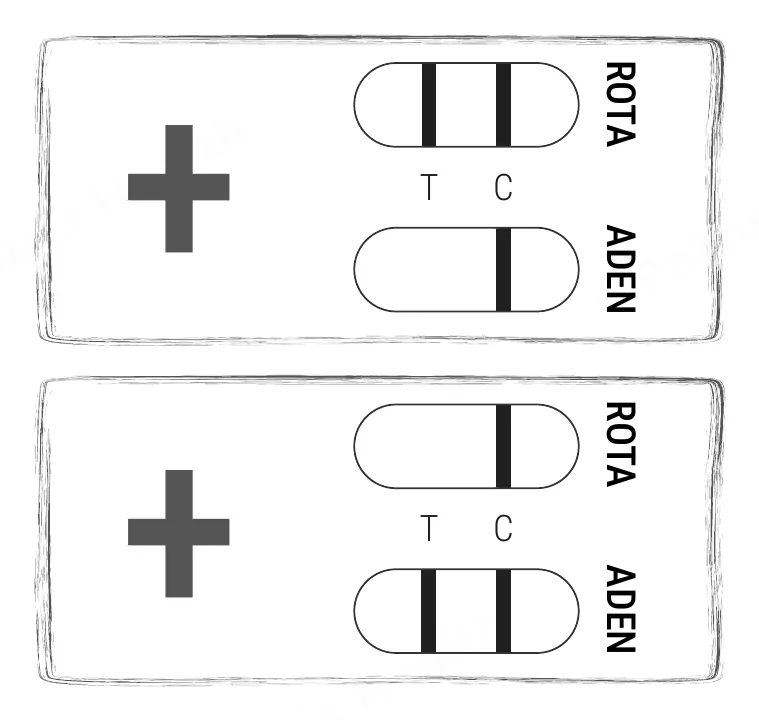
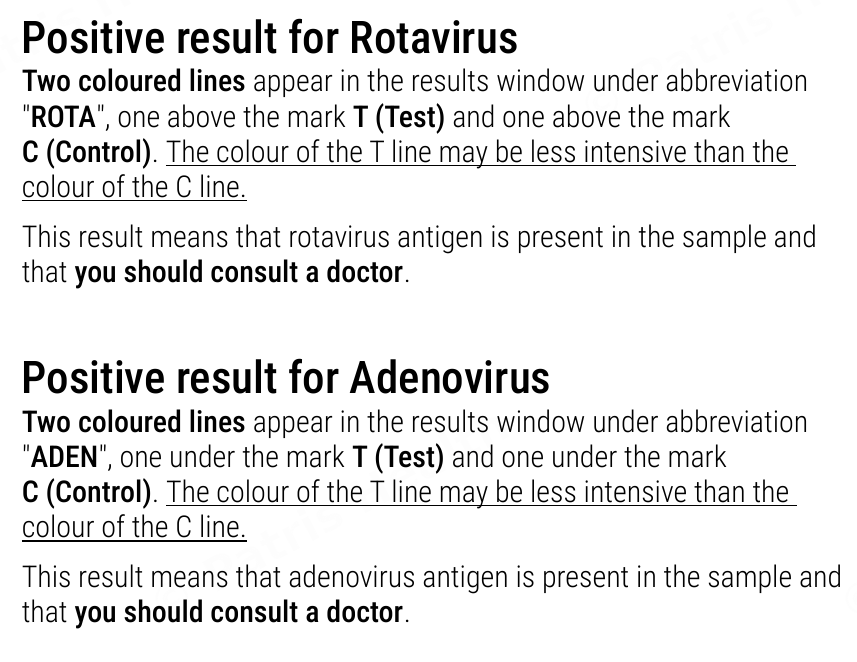
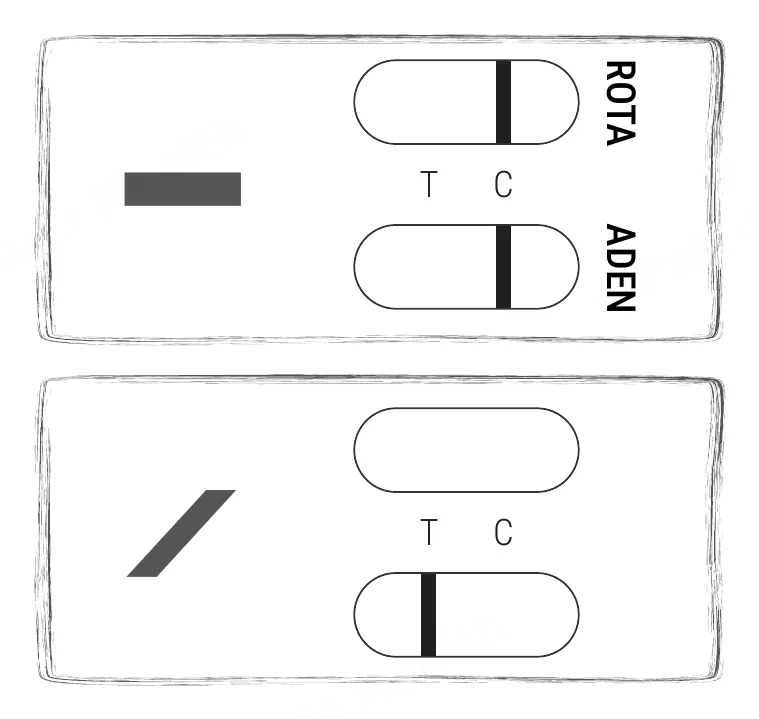
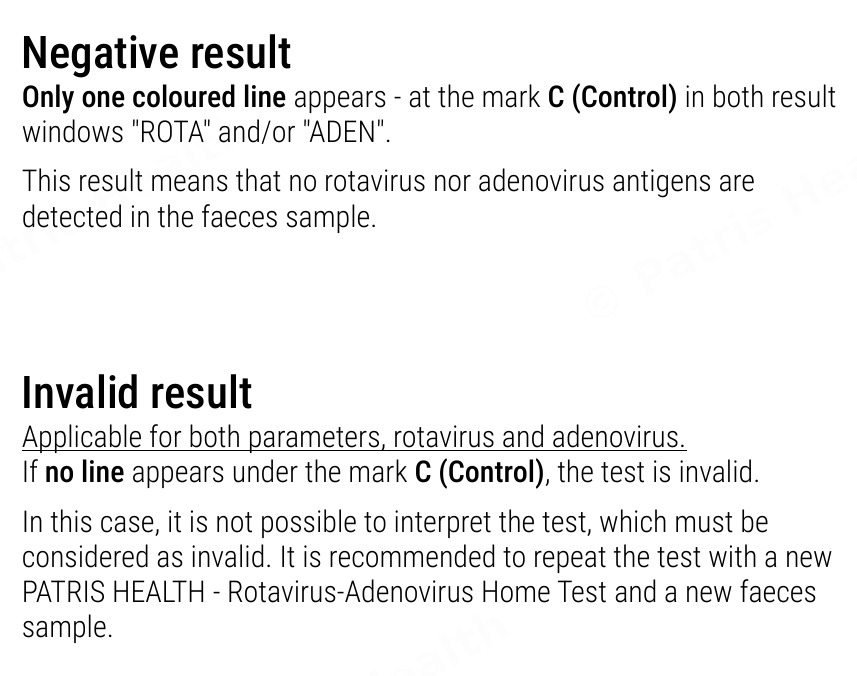
One test device, two separate readings. The ROTA result window shows the result for rotavirus, the ADEN result window the result for adenovirus. Read each result window on its own: two lines in a result window means that virus was found; one line, at C, means it was not. A faint second line still counts.
C = control lineT = test lineROTA ADEN = one result window for each virus
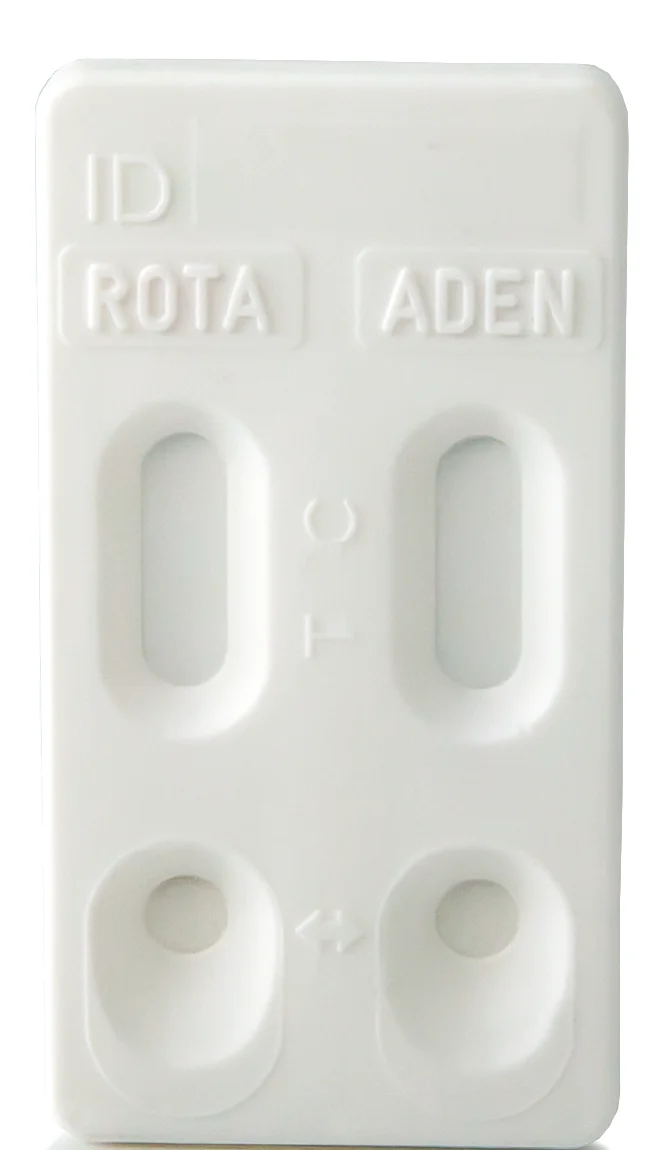
Two separate readings — the ROTA result window and the ADEN result window. Each has its own C and T lines.
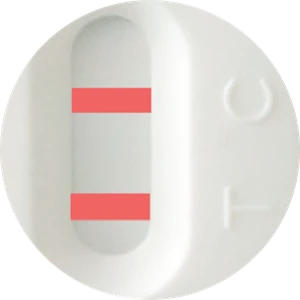
Positive — ROTA positive
C and T lines in the ROTA result window: rotavirus is present in the sample. See your doctor.
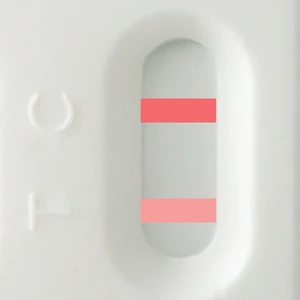
Positive — ADEN positive
C and T lines in the ADEN result window: adenovirus is present in the sample. See your doctor.
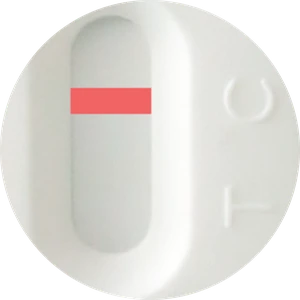
Negative negative
Only the C line in a result window: that virus was not detected. If the symptoms continue, see your doctor.
Invalid repeat
No C line in a result window: the result cannot be read. Repeat with a new test and a new sample.
Both result windows can be positive at the same time. A faint T line still counts as a line — the intensity of the colour does not matter, only that the line is complete. Read at 10 minutes; do not interpret the result after 15. The pictures are for illustration purposes; the actual lines may differ in intensity.
Next step
What to do with your result
If a virus was found
See your doctor and show the result, especially for a young child, an older person or anyone with a weakened immune system. Until then, drink enough, and wash hands and surfaces carefully: both viruses spread through contact.
If neither was found
Neither rotavirus nor adenovirus was detected in the sample. If diarrhoea, abdominal pain or other signs of infection continue, see your doctor.
The technology
What happens inside the test device
All of it happens on two paper strips inside one test device, in ten minutes.
- The sample moves
The drops of extract travel along both strips by capillary action. No pump, no power.
- Antibodies find the virus
Each strip carries antibodies tagged with red gold particles: one strip for rotavirus, the other for adenovirus.
- The T lines
A second antibody fixed at T catches the virus together with its gold tag. When that virus is present, a red line appears in its result window.
- The C line
The excess reagent is caught at C whatever the sample holds. The C line only means that the test was performed well. No C line, no result.
This test has been used by professionals in hospitals and laboratories for more than 20 years. It gives one answer for each virus — detected or not detected.
Quality
Made in France, checked batch by batch
30+
years of diagnostic expertise — rapid tests made in France since 1991
- ISO 13485The international quality-management standard for organisations that design, manufacture and service medical devices
- Every batch checkedDefined checks completed before a batch is released
- Monitored after releasePerformance tracked for as long as the batch is on the market
Notified body 0483ISO 13485Made in FranceCE-marked IVD
The Patris Health promise. No valid result? Write to us and we replace the test or refund the purchase price. It applies whenever the test was performed as the instructions describe, and we do not argue about it.
Specification
Technical data for the rotavirus and adenovirus test
| Intended use | Qualitative immunochromatographic screening test for rotavirus and adenovirus in faeces, for self-testing by lay users |
|---|---|
| Analyte | Rotavirus antigen and adenovirus antigen, on two separate strips |
| Method | Lateral flow immunoassay |
| Result type | Qualitative — antigen detected or not detected, for each virus |
| Sample | Stool, one sample taken at three spots |
| Time to result | Read at 10 minutes; do not interpret after 15 minutes |
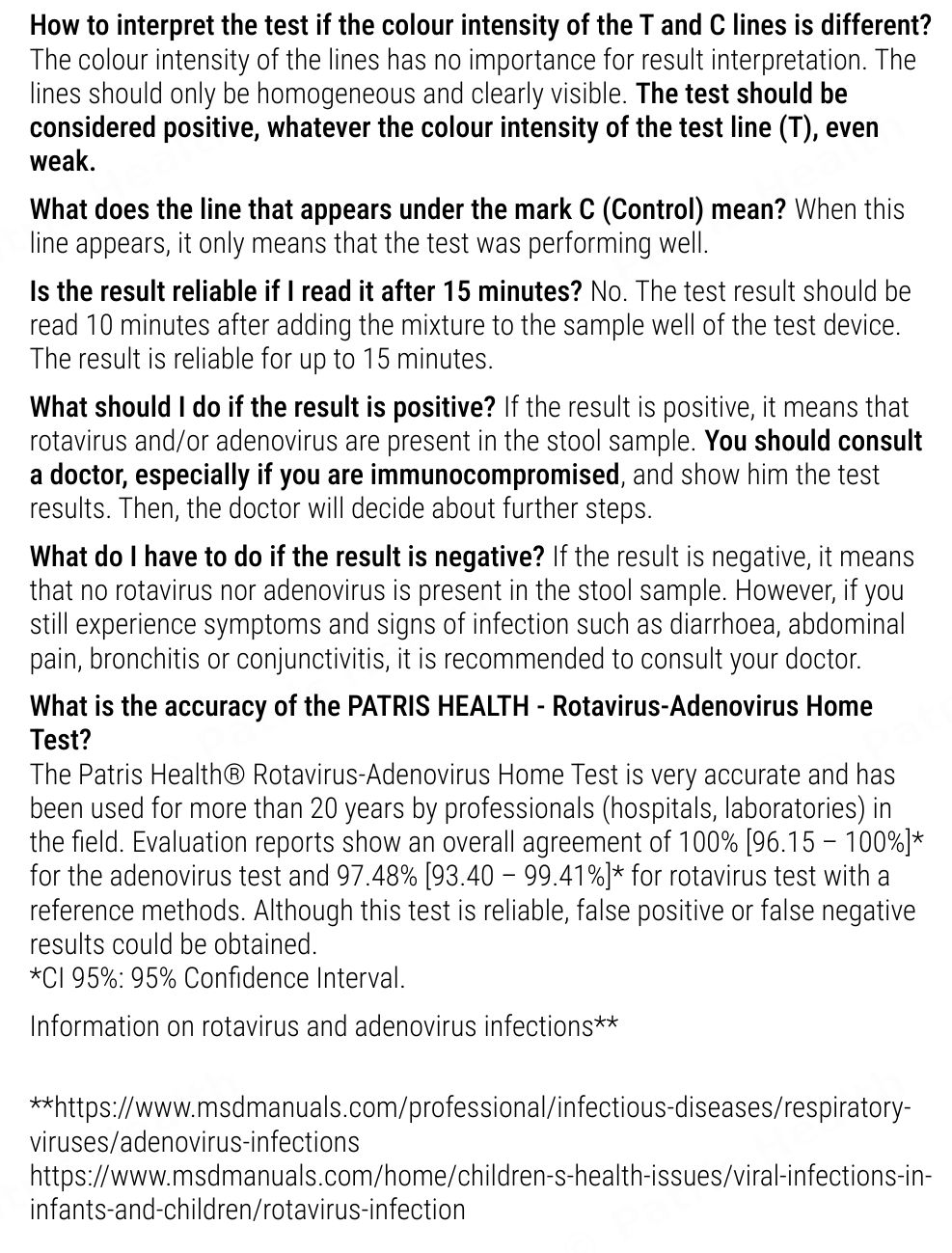
| Agreement | Adenovirus 100 % (95 % CI 96.15–100 %); rotavirus 97.48 % (95 % CI 93.40–99.41 %) overall agreement with reference methods |
| Storage | 4 to 30 °C, do not freeze |
| Expiry date | Indicated on the label and the foil pouch |
| Device type | CE-marked in-vitro diagnostic medical device (IVD) for self-testing |
| Certificates | CE 0483 · ISO 13485 |
Questions
Asked before ordering
How accurate is a rotavirus and adenovirus test at home compared with the laboratory?+
In the evaluation studies, the test agreed with reference methods in 100 % of cases for adenovirus (95 % CI 96.15–100 %) and 97.48 % for rotavirus (95 % CI 93.40–99.41 %). As with any screening test, false positive or false negative results are possible; if the symptoms are severe, see a doctor whatever the result.
Can I use it for my child?+
The sample is taken from the stool, so nothing is done to the child. With a young child who is vomiting or has diarrhoea, do not wait for a test to decide whether to see a doctor.
Is collecting the sample unpleasant?+
Less than people expect. A paper strip attached to the back of the toilet seat catches the stool, the collection stick takes a very small amount, and the strip is flushed away afterwards. Nothing has to be sent anywhere.
Why are there two result windows?+
The test device holds two separate strips, one for rotavirus and one for adenovirus. Each needs its own five drops, and each is read on its own.
Why did I get an invalid result?+
Usually because the sample was not collected as described, because the wrong number of drops went into a well, or because the test device got wet before use. Repeat with a new test and a new sample: dip the stick at three spots, shake for 10 seconds, then add exactly five drops into each of the two wells. Write to us and we replace the test.
How do I dispose of the test?+
All components can go in household waste. The paper strip is flushed down the toilet.
Sources
Centers for Disease Control and Prevention. (2024, April 22). About rotavirus. https://www.cdc.gov/rotavirus/about/index.html
Centers for Disease Control and Prevention. (2025, December 16). About adenovirus. https://www.cdc.gov/adenovirus/about/index.html
European Centre for Disease Prevention and Control. (2023, December 1). Disease factsheet about rotavirus. https://www.ecdc.europa.eu/en/rotavirus-infection/facts
National Institute of Diabetes and Digestive and Kidney Diseases. (2018a, May). Symptoms & causes of viral gastroenteritis (“stomach flu”). https://www.niddk.nih.gov/health-information/digestive-diseases/viral-gastroenteritis/symptoms-causes
National Institute of Diabetes and Digestive and Kidney Diseases. (2018b, May). Treatment of viral gastroenteritis (“stomach flu”). https://www.niddk.nih.gov/health-information/digestive-diseases/viral-gastroenteritis/treatment
Last reviewed 2 October 2026
Instructions for use
Patris Health Rotavirus & Adenovirus Home Test
Detection of Rotavirus and/or Adenovirus in feces. CE-marked in-vitro diagnostic medical device for self-testing.
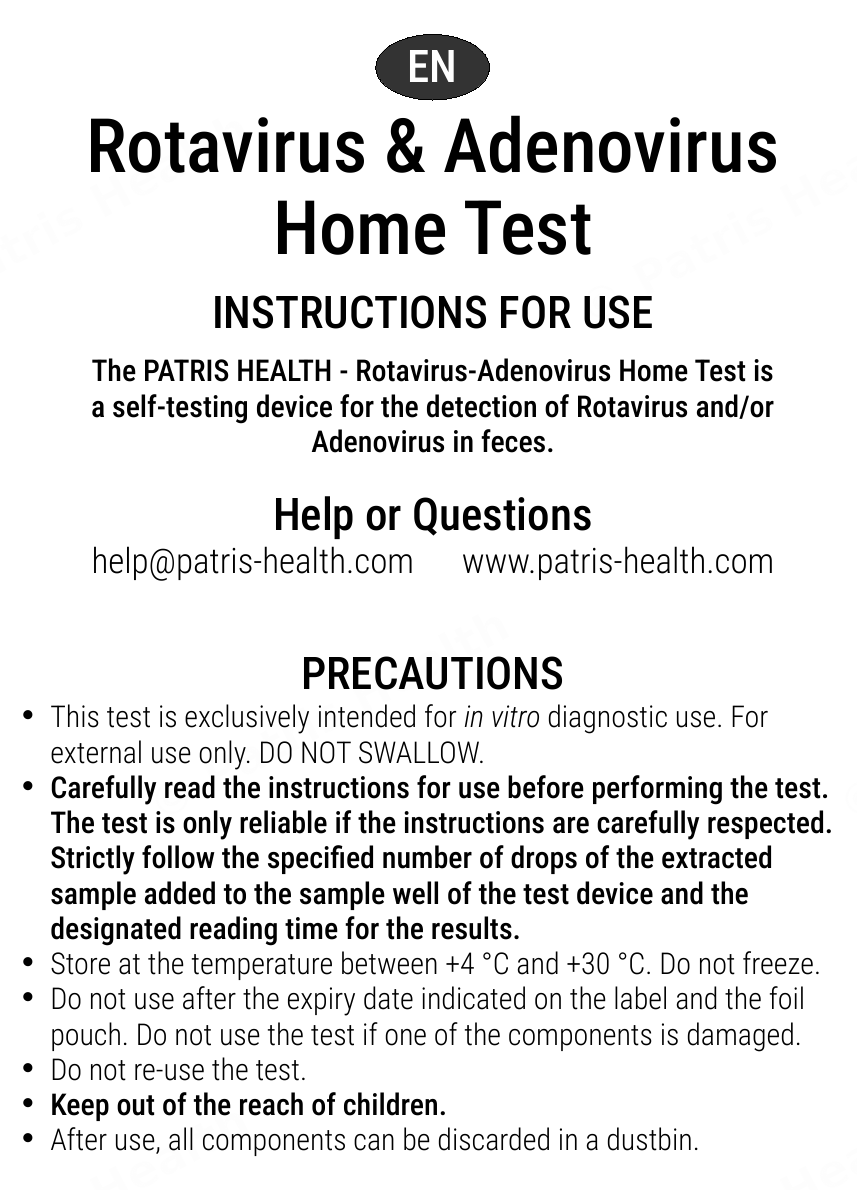
This is the English part of the multi-language instructions for use. The printed instructions in the box carry the same text in seven languages: English, German, French, Italian, Spanish, Dutch and Slovenian. If the version printed on the instructions in your box differs from this one, follow the instructions in your box.
Precautions and test components
Read this before you start: safety, storage and what is in the kit.
Testing procedure
Step by step, with a picture for each step.
Interpretation of the results
How to read your result, with pictures.
About the test
Background, questions and answers, accuracy.
Questions about the test: help@patris-health.com
Instructions for use RTADV02, June 2025 · © Patris Health. Copying and reproduction are not permitted.